
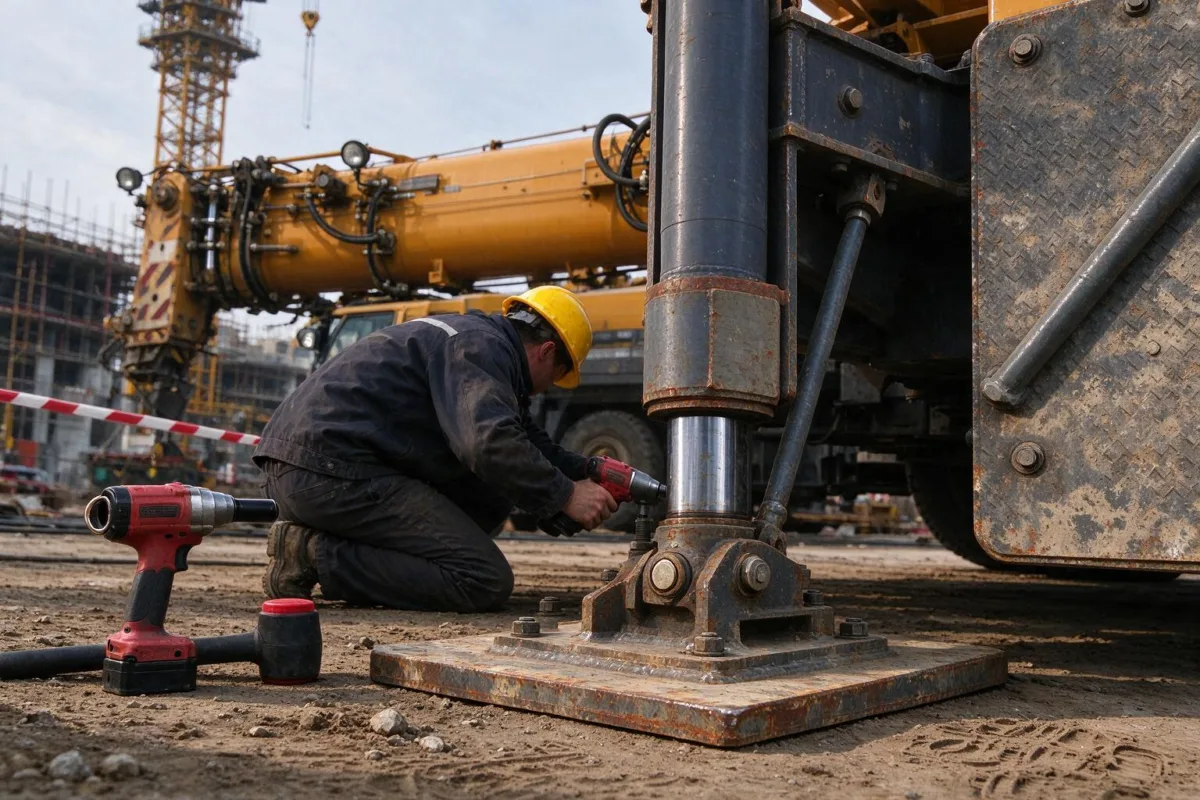
Outrigger configuration varies significantly across XCMG crane families, and parts sourcing must match the actual machine type rather than a generic tonnage figure. These XCMG crane outrigger parts maintenance tips begin with identifying the correct outrigger architecture for each model, since beam wear pads, jack cylinders, leg lock valves, and pivot pins differ by family. XCMG truck cranes in the QY series, spanning roughly the 25 to 130 ton class, use H-style hydraulic outriggers: horizontal extension beams that deploy laterally, paired with vertical hydraulic jacks at each corner. The QY25K and QY50K are common in rental fleets and share a similar outrigger architecture, which simplifies parts stocking for operators running both models.
Core Outrigger Components and Their Failure Modes
Outrigger performance on XCMG cranes depends on several wear interfaces that degrade at different rates. Inspectors should understand each component’s dominant failure mode before ordering replacements.
Beam and Leg Assemblies
Horizontal extension beams wear at the slide pads and along the box-section contact surfaces. Scoring of the beam faces and thinning of the pads reduce support stiffness, producing leg droop and uneven extension between sides. On higher-duty models such as the QY50K (50 t) and QY70K (70 t), repeated full-extension cycles under load accelerate pad wear.
Vertical Jack Cylinders
Seal degradation in the jack cylinders typically appears as slow drift under load, external weeping at the rod gland, and chrome pitting on the rod where grit has entered the wiper seal. Pitting, once started, damages the gland seal on every stroke.
Hydraulic Lock Valves
Pilot-operated check valves hold each leg after leveling. Internal leakage in the lock valve allows the leg to creep down, a symptom frequently misdiagnosed as a cylinder seal fault. Bench-testing the lock valve before replacing cylinder seals avoids unnecessary repairs.
Outrigger Pads and Floats
Cast nylon or steel pads crack at the boss under repeated point loading. Undersized pads raise ground bearing pressure and increase stress in the beam assembly.
Pins, Bushings, and Locking Mechanisms
Ovalized pin bores and worn bushings introduce play that appears as leg wobble during swing operations. Locking mechanisms should be checked for positive engagement at every inspection interval.
| Component | Primary Failure Mode | Typical Symptom |
|---|---|---|
| Beam slide pads | Pad thinning, surface scoring | Leg droop, uneven extension |
| Jack cylinder seals | Seal degradation, rod pitting | Slow drift, gland weeping |
| Lock valves | Internal leakage | Leg creep after leveling |
| Outrigger pads | Boss cracking | Pad failure under load |
| Pins and bushings | Bore ovalization | Leg wobble during swing |
Daily and Pre-Lift Inspection Points
Outrigger condition on XCMG cranes should be confirmed at the start of every shift and again before the first lift. The checks below apply across the QY series, from the QY25 to the QY100, and to larger models such as the QY130K, with the understanding that leg configuration and lock valve placement vary by model.
Hydraulic Fluid and Leak Check
Check the hydraulic reservoir level against the sight glass or dipstick before the first lift. Inspect the outrigger circuit for external leaks at the cylinder rod seals, lock valve bodies, and hose fittings. Fluid weeping at a rod seal or a damp fitting indicates a developing fault that should be logged and corrected before the leg is loaded.
Full-Stroke Extension and Retraction
Extend and retract each leg through its full stroke. Listen for cavitation noise and watch for jerking or uneven motion. Either symptom points to air ingress or a sticking lock valve. On the QY50K and QY70K, the lock valve is integral to the vertical cylinder and should be checked for contamination if the leg hesitates under load.
Pad Inspection
Inspect pad contact faces for cracks, deformation, or embedded debris. Confirm that pad retention pins are fully seated and that retaining clips are present. A missing pin allows the pad to detach under load and is a stop-work condition.
Level Indicators and Load Verification
Verify the level indicators, whether bubble or electronic, and confirm that all four legs bear load before boom elevation begins. A leg that does not load indicates a lock valve or cylinder fault. Do not elevate the boom until the fault is resolved.
Leg Drift Recording
Mark rod extension with chalk, hold the load for ten minutes, and note any measurable creep. Record drift values in the machine log so that gradual seal wear can be tracked against previous readings.
Scheduled Maintenance Intervals and Wear Limits
Outrigger condition on XCMG cranes should be tracked against fixed intervals rather than run to failure. In high-cycle rental use, slide pad clearance and beam wear are measured at 250-hour or monthly intervals, whichever comes first. This applies across model series, from the QY25K and QY50K truck cranes to the QY70K and larger QY100K units. Measuring at consistent intervals builds a wear trend that shows whether a beam is approaching its limit or has stabilized.
Hydraulic filter replacement on the outrigger circuit follows the manufacturer’s service schedule. Contaminated fluid is a leading cause of lock valve sticking, and a sticking lock valve can allow an outrigger beam to creep under load. Filter changes made on schedule, together with fluid sampling, are the most direct control against this failure mode on the QY50K and comparable series.
Rod chrome damage deeper than the seal lip tolerance requires rod repair or replacement rather than seal-only service. A new seal fitted over a scored rod will leak again within a short period, and repeated seal-only service adds cost without correcting the cause.
Pin and bushing clearance beyond the service manual limit introduces shock loading into the beam structure and should trigger replacement, not shimming. Shimming restores apparent tightness while leaving the shock path in place. The table below summarizes the intervals.
| Item | Interval | Action at Limit |
|---|---|---|
| Slide pad clearance and beam wear | 250 hours or monthly, whichever first | Adjust or replace pads |
| Outrigger circuit hydraulic filter | Per manufacturer’s schedule | Replace filter, sample fluid |
| Rod chrome condition | Each inspection | Repair or replace rod if damage exceeds seal lip tolerance |
| Pin and bushing clearance | Per service manual | Replace pins and bushings |
| Beam mounting bolts and cylinder anchor fasteners | Annual inspection cycle | Torque check to specification |
Torque checks on beam mounting bolts and cylinder anchor fasteners belong in the annual inspection cycle. Loose anchors redistribute load into the beam and frame, and the resulting movement is often mistaken for a hydraulic fault.
Hydraulic System Care Specific to Outrigger Circuits
On most XCMG truck cranes, the outrigger circuits draw from and return to the same reservoir as the main hydraulic system. This shared architecture means contamination does not stay contained. Particulate matter generated or introduced on the outrigger side migrates through the reservoir to the boom, swing, and hoist circuits, where it accelerates wear in pumps and valve spools. Filtration discipline therefore protects both systems at once. Servicing return and suction filters at the intervals specified for the machine, and verifying filter bypass indicators, matters more on shared-circuit cranes than the outrigger duty cycle alone would suggest.
Water ingress through reservoir and cylinder breathers is a persistent problem on jack cylinders that remain extended for long periods, such as during seasonal storage or long-duration lift campaigns. Condensation and humid air drawn past aging breather elements promote corrosion on rod surfaces and inside cylinder barrels. Reservoir breathers should be drained and inspected on a seasonal basis, with elements replaced when saturated or damaged.
Pilot pressure below specification prevents the outrigger lock valves from opening fully. The result is slow or incomplete leg retraction, often misdiagnosed as a cylinder seal fault. Technicians should confirm pilot pressure at the lock valve against the specification for the specific model series, such as the QY25K or QY50K, before removing any cylinder.
When replacing outrigger hoses, match both the pressure rating and the bend radius of the original. Undersized return lines raise back pressure and add heat to the circuit, which degrades fluid life and seal performance over time.
Identifying Genuine and Compatible Replacement Parts
Part selection for XCMG crane outrigger systems should begin with the crane model and serial number range, not the nominal tonnage. Outrigger components fitted to a QY25K and a QY25K5 can differ by production batch, so a part that fits one unit within a model series may not fit another built in a different period. The parts catalog entry for the specific serial number is the authoritative reference.
Genuine XCMG parts carry cast or stamped part numbers on the component body. These markings should be checked against the catalog listing for the crane’s serial number before installation. Numbers that are absent, ground off, or inconsistent with the catalog warrant rejection of the part.
Aftermarket outrigger cylinders and lock valves vary in rated pressure and internal tolerances between suppliers. The pressure rating should be confirmed to meet or exceed the original specification before fitting, and lock valve cracking pressure and flow characteristics should be verified against the OEM data for the model.
Seal kits require material compatibility checks against the hydraulic fluid in use. Nitrile and polyurethane kits are not interchangeable across all operating temperatures; the selected compound must suit both the fluid and the expected ambient range.
Re-labeled outrigger pads and pins sold without load ratings are a recurring problem. Undocumented castings are a common source of premature failure, particularly on load-bearing pins and pad mounts. Request material certification and rating data before accepting such parts.
| Check | Method | Rejection criterion |
|---|---|---|
| Part identity | Cast or stamped number vs. catalog for serial number | No marking or catalog mismatch |
| Cylinder and lock valve | Rated pressure vs. original specification | Rating below OEM specification |
| Seal kit | Compound vs. fluid and temperature range | Incompatible material |
| Pads and pins | Load rating documentation | No rating data supplied |
Common Maintenance Errors and Their Consequences
Most outrigger failures on XCMG cranes trace back to a small set of recurring maintenance errors rather than component defects. Each error has a predictable failure path.
Ground Conditions and Load Distribution
Extending outriggers on unlevel or uncompacted ground shifts load onto a single leg. On models such as the QY25K and QY50K series, the affected beam and pad boss can bend or crack under this asymmetric loading. Pad loads should be verified against the crane’s load chart for the actual ground bearing capacity before leveling.
Leaking Lock Valves
Operating with a leaking outrigger lock valve and compensating with continuous pump pressure overheats the hydraulic fluid and accelerates seal wear throughout the circuit. A lock valve that does not hold should be repaired or replaced, not worked around.
Reused or Repaired Structural Components
Reusing deformed pins or welding worn bores instead of replacing components compromises the structural load path. Welded repairs on pin bores alter heat treatment and fit, and deformed pins redistribute stress into the beam eyes.
Deferred Slide Pad Replacement
Skipping slide pad replacement until metal-to-metal contact scores the beam converts a low-cost wear item into a major structural repair. Pads should be inspected at each scheduled service interval.
Storage with Jacks Extended
Storing cranes with jacks fully extended exposes rod chrome to grit and moisture, leading to pitting and eventual seal damage. Legs should be retracted for storage where site conditions permit.
| Error | Primary Consequence |
|---|---|
| Outriggers on unlevel or uncompacted ground | Bent beam, cracked pad boss |
| Leaking lock valve with pump compensation | Fluid overheating, accelerated seal wear |
| Reused deformed pins, welded bores | Compromised structural load path |
| Deferred slide pad replacement | Beam scoring, major structural repair |
| Storage with jacks extended | Rod chrome pitting, seal damage |
For the QY25K and QY50K series, outrigger hardware should be inspected against the published parts breakdown at every service interval.
Parts Sourcing and Documentation Practice
Outrigger maintenance on XCMG cranes is only as reliable as the records behind it. A parts log keyed to the crane serial number should list every outrigger component replaced, including the part number, supplier, date of installation, and the hour meter reading at replacement. This applies across model series, from the 25-ton QY25K5 to the 130-ton QY130K, where outrigger beam, jack cylinder, and valve configurations differ. A serial-number-keyed log allows a maintenance planner to trace repeat failures to a specific supplier lot rather than to the machine as a whole.
When sourcing cylinders or valves from any non-genuine supplier, request material certificates for the cylinder barrel and rod stock, and pressure ratings for valves and hydraulic components. These documents should state test pressure against the rated working pressure of the outrigger circuit. Without them, a substituted relief valve or jack cylinder cannot be verified against the crane’s design envelope, and any subsequent failure becomes difficult to attribute.
Photograph worn components before disposal. Wear patterns on outrigger jack pads, beam slide blocks, and cylinder rod surfaces support warranty claims and help predict the next failure interval. A scored rod photographed at 4,000 hours, for example, gives a baseline for scheduling seal replacement on the same unit.
Finally, cross-reference the crane’s parts manual revision date against the serial number. Mid-series updates on XCMG models change outrigger part numbers, and a manual that predates the machine can direct a technician to a superseded beam or valve part. Confirm the revision against the serial number before ordering.