
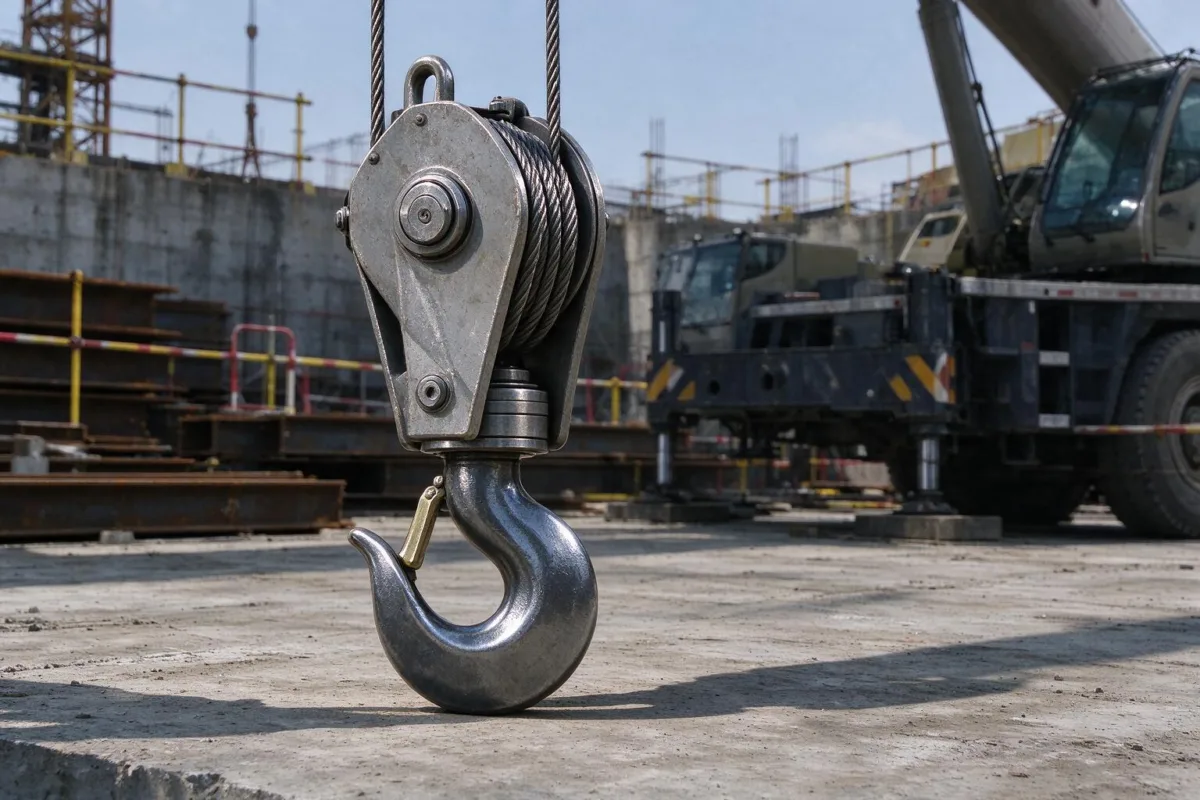
This XCMG QY25K hook parts guide covers the hook assembly on a 25-ton truck crane in the QY series, a model family widely used for general lifting, construction, and infrastructure work. Use it to identify hook components correctly before ordering, since the boom, chassis, and hoist configuration suit the QY25K to mixed-duty job sites where road travel and lift performance both matter. Because the QY series spans several capacities, parts identification should always pair the tonnage with the model designation: a 25-ton QY25K component is not interchangeable with parts from other QY-series cranes without verification.
Hook Block Specifications for the QY25K
The XCMG QY25K crane uses two hook block categories: a main hook block for heavy lifting and an auxiliary hook for lighter or single-line work. Specifications below reflect typical configurations, and actual values should be confirmed against the specific crane’s load chart and manual.
Main hook blocks for the QY25K are generally rated for 25 tons. Sheave counts typically range from 3 to 5, depending on the boom configuration and the required parts of line. A higher sheave count increases the number of line parts, which reduces load per rope segment and suits heavier lifts or longer boom lengths. The sheave count must correspond to the reeving arrangement specified for the lift.
Auxiliary hooks are often rated for 3 to 5 tons and are used for lighter loads or single-line operations. The auxiliary hook typically runs on a single line, which makes it suitable for fast, low-load handling rather than main lifting duty.
Each hook block assembly includes sheaves, bearings, a hook latch, and a safety pin. These components wear at different rates, and each must match the original specifications for dimensions, material, and load rating. A mismatched sheave or bearing can affect rope tracking and load distribution.
Replacement hook blocks should conform to the crane’s load chart and wire rope diameter to ensure proper reeving. The rope diameter determines sheave groove size, and the load chart defines the permissible rated capacity for each configuration.
| Hook Type | Typical Rating | Sheave Count | Typical Use |
|---|---|---|---|
| Main hook block | 25 t | 3 to 5 | Heavy lifting, multi-part reeving |
| Auxiliary hook | 3 to 5 t | Single line | Light loads, single-line operations |
Key Components of the Hook Assembly
The hook assembly on the XCMG QY25K crane (25-tonne class) consists of several interacting components that determine lifting safety and wire rope life. Inspection and replacement decisions should reference the specific QY25K model series parts catalog, as hook block configurations vary by production period.
Sheaves
Sheaves guide the wire rope through the hook block and reduce friction during reeving and load movement. Groove condition is critical: worn sheaves accelerate rope wear, induce rope rotation, and can damage strands. Sheaves should be replaced when groove wear exceeds the limits stated in the maintenance manual, typically measured with a groove gauge. Sheave diameter and groove profile must match the rope size specified for the QY25K.
Bearings
Bearings support sheave rotation under load. Sealed bearings are common on this class of hook block and resist contamination in dusty or wet conditions. Lubrication intervals and bearing replacement criteria should follow the maintenance manual for the QY25K series. Rough rotation, noise, or visible seal damage indicates the bearing requires attention before further lifting.
Hook Latch
The hook latch prevents load slippage from the hook throat. It must be spring-loaded and functional at all times; a latch that does not close fully or lacks spring tension renders the hook unfit for service until corrected.
Safety Pin and Retaining Components
The safety pin and associated retaining components secure the hook block and prevent accidental detachment. These items should be inspected for deformation, corrosion, and correct seating at each periodic check.
| Component | Function | Replacement trigger |
|---|---|---|
| Sheaves | Guide rope, reduce friction | Groove wear beyond manual limit |
| Bearings | Support sheave rotation | Noise, roughness, seal damage |
| Hook latch | Prevent load slippage | Loss of spring action or closure |
| Safety pin | Secure hook block | Deformation or corrosion |
Identifying Genuine XCMG Hook Parts
Genuine XCMG hook parts for the QY25K crane series carry several identifiers that allow buyers to verify authenticity before installation. Hook blocks and individual components typically display XCMG branding, a part number, and a batch code. These markings should be cross-referenced against the parts catalog specific to the QY25K series, since part numbers can differ between model variants and production years. A part number that does not appear in the catalog for the applicable crane model warrants further investigation.
Physical inspection provides a second layer of verification. Genuine components show consistent casting marks, clean machining on load-bearing surfaces, and an even surface finish. Counterfeit or aftermarket hook parts frequently exhibit irregularities such as rough castings, misaligned bore holes, inconsistent thread profiles, or uneven paint coverage that obscures weld seams. Dimensional checks against published specifications are advisable where access to measuring equipment permits.
Documentation is a key differentiator. Genuine hook blocks are supplied with certificates of conformity and load test reports that reference the component serial number and rated capacity. For the QY25K series, rated capacities should be confirmed against the load chart for the specific configuration. Absence of test documentation is a significant risk indicator for lifting equipment.
Purchasing through authorized dealers or established suppliers reduces exposure to counterfeit components. Unbranded parts, generic packaging, or packaging inconsistent with XCMG’s labeling conventions should be avoided, particularly for load-path components where material traceability cannot be confirmed.
Aftermarket and OEM-Equivalent Options
Hook assemblies for the XCMG QY25K (25-tonne class, QY series) are available through several supply channels beyond the original equipment route. Aftermarket hook blocks, shank hooks, and related components may be offered at lower cost, but quality varies considerably between suppliers. Buyers should verify material certifications and rated load capacities for each component rather than relying on catalogue descriptions alone. Hook forgings and castings should be traceable to a recognized standard, with documentation confirming the grade of steel and the applicable proof-load or fatigue test regime.
OEM-equivalent parts from established manufacturers can be a viable alternative when they meet or exceed the original specifications. In these cases, dimensional tolerances, hook throat opening, and safety latch geometry should be checked against the QY25K parts listing. Suppliers should be able to state the specification the part is built to and demonstrate equivalence through drawings or test data.
Compatibility with the QY25K’s reeving arrangement and load chart is critical. A hook block of incorrect mass or sheave count alters the effective load on the boom and can produce readings that no longer match the load chart for the 25-tonne QY series. Mismatched components may void warranties and compromise safety, particularly where the hook block interfaces with the hoist rope and overload protection system.
To mitigate risk, request test reports, material certificates, and warranty terms from any supplier before purchase. Documented proof of load rating and a defined warranty period provide the minimum basis for accepting a non-original part.
Selection Criteria for Hook Parts
Selecting replacement hook components for the XCMG QY25K requires matching each part to the crane’s rated capacity and the specific boom and outrigger configuration in use. The four criteria below cover the primary technical checks.
Load Rating
The hook block and its internal components must carry a working load limit equal to or greater than the crane’s maximum lifting capacity for the configuration in which the crane operates. For the QY25K (25-ton class), the main hook block is typically rated for the full 25-tonne capacity in the standard configuration, while auxiliary hooks carry lower ratings. Parts rated below the applicable configuration limit should not be installed, and the rating should be verified against the load chart rather than assumed from the model name alone.
Material and Construction
Forged steel hooks are standard for durability under repeated lifting cycles. Heat-treated sheaves resist groove wear and deformation. Buyers should confirm forging grade and heat-treatment specification where documentation is available, as cast or untreated components wear faster and may fail inspection.
Compatibility
Sheave groove profile, bearing type, and mounting dimensions must match the original part. Groove radius and rope diameter must align to avoid accelerated rope wear. Bearing bore, pin diameter, and bolt-hole spacing should be measured against the removed component or the parts manual before ordering.
Certification
Documentation to ISO, CE, or equivalent standards supports quality and safety verification. Certificates should reference the specific part and load rating.
| Criterion | Check |
|---|---|
| Load rating | Meets or exceeds QY25K capacity for the configuration |
| Material | Forged steel hook, heat-treated sheave |
| Compatibility | Groove profile, bearing type, mounting dimensions |
| Certification | ISO, CE, or equivalent documentation |
Maintenance and Inspection Practices
Hook assemblies on the XCMG QY25K crane (25-tonne class) require structured inspection to maintain lifting safety and component service life. The following practices apply to the hook block, latch, sheaves, and bearings.
Daily Inspections
Operators should inspect the hook before each shift. Verify that the hook latch closes fully and springs back to the seated position without binding. Rotate each sheave by hand to confirm smooth movement and check for rope wear patterns, flat spots, or debris in the groove. Examine the hook body, shank, and nut for visible cracks, deformation, or corrosion. Any hook with a crack or excessive throat opening should be removed from service immediately.
Periodic Inspections
At intervals defined by the maintenance plan, measure sheave groove wear with a groove gauge and compare results against the wear limits in the QY25K service documentation. Check bearing play by rocking the sheave and observing axial or radial movement; replace bearings that show roughness or excess clearance. Measure hook throat opening and compare it to the original dimension recorded at commissioning. Replace latch springs, latches, sheaves, or bearings when measurements exceed limits.
| Component | Check | Action threshold |
|---|---|---|
| Hook latch | Function and spring return | Replace if binding or not seating |
| Sheave groove | Wear measurement | Replace at documented wear limit |
| Bearings | Play and rotation | Replace if rough or loose |
| Hook throat | Opening dimension | Remove from service if beyond limit |
Lubrication
Follow the manufacturer’s lubrication schedule for sheave bearings, hook swivel, and latch pivot points. Use the specified grease grade and avoid over-lubrication that can attract abrasive debris.
Record Keeping
Maintain inspection logs recording dates, measurements, findings, and replacement history. These records support part life tracking and help schedule preventive replacement of QY25K hook components.
Common Pitfalls and Safety Notes
Hook assembly parts for the XCMG QY25K crane must match the load ratings and geometry specified for that 25-ton model series. Several recurring errors in parts selection and maintenance affect safety and component life.
Capacity Mismatches
Fitting hook blocks or shank components not rated for the QY25K’s capacity introduces a direct overload risk. A hook block or latch rated below the 25-ton class may appear to fit but can yield or fail under rated loads, particularly during dynamic lifting or multi-part reeving. Parts should be verified against the load chart and hook block rating for the QY25K, not simply matched by pin diameter or mounting pattern.
Mixed-Component Assemblies
Combining hook parts from different manufacturers can produce tolerance stack-up at the shank, nut, and thrust bearing interface. Mismatched thread pitches, bearing seat depths, or latch spring geometry may cause improper seating, accelerated wear, and reduced safety margins. Where assemblies are rebuilt, keeping hook, nut, bearing, and latch from a single qualified source reduces fit uncertainty.
Wear Limits on Hooks and Sheaves
Ignoring wear limits is a frequent cause of secondary damage. Hook throat opening that exceeds the manufacturer’s rejection limit indicates deformation and reduces the margin against load loss. Sheave groove wear beyond limit allows rope to bottom out or pinch, causing wire rope damage, broken wires, and uneven spooling. Thrust bearings and latch springs also require inspection at defined intervals.
| Component | Check | Consequence if Neglected |
|---|---|---|
| Hook | Throat opening, cracks, twist | Load loss, hook failure |
| Sheave | Groove depth and profile | Rope damage, uneven wear |
| Latch | Spring tension, engagement | Load release |
| Nut and bearing | Thread condition, seating | Shank separation risk |
Documentation and Qualified Personnel
Replacement decisions should follow the crane’s manual and load chart for the QY25K model series. Critical hook replacements, including shank and bearing work, should be performed or verified by qualified personnel, with inspection records retained.