
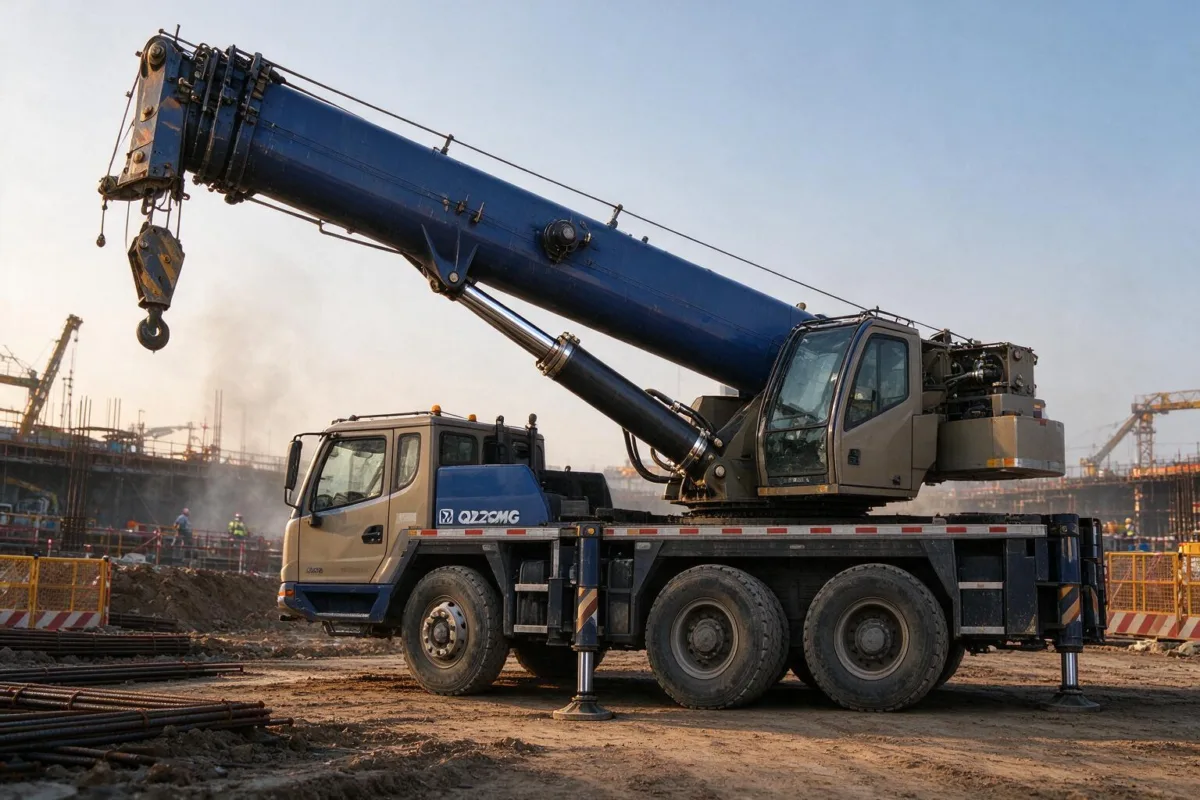
The QY25K is a 25-ton truck crane in XCMG’s QY series, a long-running line of telescopic-boom mobile cranes used for general construction, plant erection, and infrastructure work. Any XCMG QY25K hydraulic cylinder price depends on which cylinder position is being replaced, since the crane uses several distinct cylinder groups with different dimensions. The model pairs a 25-ton rated lifting capacity with a multi-section telescopic boom and a carrier chassis configured for road travel between job sites.
Hydraulic cylinders on this class of crane fall into distinct functional groups:
- Boom telescope cylinders (one per extending boom section)
- Boom luffing (derrick) cylinders
- Outrigger jack cylinders
- Outrigger beam cylinders
- Steering cylinders on the carrier
Each group has its own bore, rod diameter, stroke, and mounting geometry. Pricing must therefore always be quoted against a specific cylinder position and part number, not against the model alone. A luffing cylinder and an outrigger jack cylinder for the same QY25K are not comparable items on cost, and a quote that references only “QY25K cylinder” carries no useful information.
Later variants such as the QY25K5 and QY25K5-I share the 25-ton class but differ in boom configuration and cylinder dimensions. Parts are not automatically interchang
What the Price Actually Covers
A hydraulic cylinder price for the XCMG QY25K (25-ton QY series) typically reflects the complete assembly: barrel, chrome-plated piston rod, piston, gland or guide, seal set, and end fittings. Buyers comparing quotes should confirm which of these items are included, because listings often mix tiers.
Three product tiers exist, with materially different price bands:
- Bare components – barrel and rod only, no piston, gland, or seals.
- Seal kits – wear parts only, priced as a consumable set.
- Complete assemblies – fully built, tested, and ready to install.
Genuine OEM assemblies carry the highest price. The premium reflects traceable material certification, documented tolerances, and warranty terms tied to the QY25K specification. Aftermarket assemblies vary widely, and price gaps usually trace to four variables: rod chrome thickness, seal compound (NBR versus polyurethane or PTFE-based), barrel honing quality, and heat treatment of the rod. A low quote often signals thinner chrome or a lower-grade seal compound, which shortens service life under the cyclic loads typical of a 25-ton crane.
Freight is a meaningful line item. A boom luffing cylinder for the QY25K is a long, heavy assembly, and shipping can represent a substantial share of landed price. Quotes should state Incoterms and whether crating and export packing are included, since these affect the total cost as much as the unit price itself.
Price Ranges by Cylinder Position
Hydraulic cylinder pricing for the XCMG QY25K crane varies substantially by position on the machine. The QY25K, a 25-tonne capacity unit in XCMG’s K-series, uses cylinders across several distinct hydraulic circuits, and each position carries different cost drivers.
Outrigger jack and beam cylinders are generally the lowest-cost group. Shorter strokes and simpler single-stage construction keep machining and sealing requirements modest compared with superstructure cylinders.
Steering cylinders on the carrier are also comparatively low-cost. They are frequently misidentified in parts inquiries because they sit on the truck chassis outside the crane superstructure, leading buyers to search under the wrong assembly group.
Boom telescope cylinders sit in the middle price band. Multi-stage designs cost more than single-stage units, and correct replacement requires exact stage matching to the original part number, since stroke and stage sequencing differ between boom configurations.
Boom luffing cylinders are usually the highest-cost single item in the set. Large bore, long stroke, and a high pressure rating drive material and machining costs well above the other positions.
| Cylinder position | Relative cost band | Primary cost drivers |
|---|---|---|
| Outrigger jack and beam | Lowest | Short stroke, simple construction |
| Carrier steering | Low | Compact bore, chassis-mounted location |
| Boom telescope | Middle | Multi-stage design, exact stage matching |
| Boom luffing | Highest | Large bore, long stroke, high pressure rating |
Any published range should be treated as indicative only. Final pricing depends on the specific variant, part number, and current lead time at the time of quotation.
How to Verify a Part Number Before Requesting a Quote
Accurate identification of the original cylinder is the first step in obtaining a usable quotation for a XCMG QY25K hydraulic cylinder. Because the QY25K (25-ton class) was produced in several variants and mid-series revisions, an incorrect or generic part number can result in a cylinder that does not fit.
Begin with the cylinder itself. Locate the nameplate or stamped identification on the original unit; this is typically found on the barrel or near the rod-end gland. Record the full part number as stamped, including any suffix characters. XCMG part numbers are position-specific and variant-specific, so a number for a boom-lift cylinder will not interchange with one for an outrigger or steering cylinder on the same machine.
Cross-reference the recorded number against the crane’s parts catalog for the exact QY25K variant, not a generic 25-ton listing. Catalog entries are keyed to machine serial number ranges, and mid-series changes to the QY25K can alter cylinder mounting dimensions even where the function is unchanged. Record the machine serial number from the chassis plate and include it with the inquiry.
Where identification is illegible, measure the original:
| Dimension | Measurement point |
|---|---|
| Bore | Internal barrel diameter |
| Rod diameter | External rod diameter |
| Stroke | Full extension minus retracted length |
| Pin diameter | Mounting pin bore |
| Mounting centre distance | Pin centre to pin centre, retracted |
Photographs of the mounting eyes, ports, and any identification plate should accompany the inquiry. Complete identification reduces quotation errors and the likelihood of returns.
Distinguishing Genuine, OEM-Equivalent, and Unverified Units
Buyers sourcing a boom cylinder for the XCMG QY25K (25-ton QY series) encounter three broad categories of supply, and the documentation attached to each varies considerably.
Genuine units typically arrive in manufacturer packaging with a part number label that matches the published catalog entry. Documented inspection or test records should accompany the cylinder, covering bore dimensions, rod straightness, and a pressure test at rated load. The label and paperwork are as important as the casting marks.
OEM-equivalent units are produced to matching dimensions by third-party manufacturers. Fit is usually correct, but service life depends entirely on material grade and process control: chrome plating thickness, honing finish, weld quality, and seal selection. Buyers should request test data, including a hydrostatic proof test certificate and material certificates for the barrel and rod, rather than accepting dimensional drawings alone.
Warning signs include part numbers that do not resolve in the catalog, missing pressure test certificates, and rod chrome showing pitting or an uneven finish on inspection. Seal branding and compound also warrant a check; low-cost assemblies often use generic seals that fail early under the high duty cycles of a 25-ton crane boom. Confirm the pressure rating matches the crane’s system pressure, and verify port thread standards against the original hose fittings before installation.
| Attribute | Genuine | OEM-Equivalent | Unverified |
|---|---|---|---|
| Packaging and part number label | Manufacturer packaging, catalog-matched label | Varies | Often absent or mismatched |
| Test records | Inspection and pressure test documents | Available on request | Rarely provided |
| Seal branding | Specified compound, branded | Depends on supplier | Generic, unbranded |
| Rod chrome condition | Uniform, documented thickness | Inspect for finish | Pitting or uneven finish common |
Cost Drivers Beyond the Part Itself
The invoice price of a QY25K hydraulic cylinder assembly is only one component of the total cost of a replacement. Several factors outside the part itself materially affect the budget, and these should be assessed before a purchase decision is made.
Lead time. Expedited genuine assemblies carry a premium, particularly for boom cylinders on the 25-ton QY25K series, where stock levels at distributors vary. Planned purchases made against a maintenance schedule avoid air freight and rush-handling surcharges, which can add a significant percentage to the unit price.
Core exchange and rebuild options. Where the barrel and rod of an original cylinder remain serviceable, resealing or re-chroming can cost less than a new assembly. This route suits cylinders with worn seals or minor rod scoring but sound structural integrity; heavily damaged barrels or bent rods generally rule it out.
Installation labor. Boom cylinder replacement on a QY25K requires support equipment and competent rigging, and this should be budgeted separately from the part. Labor varies with site access and the condition of adjacent pins and mounts.
Downtime. For a 25-ton crane on a critical schedule, lost availability often exceeds the price difference between competing cylinder options. A higher-priced assembly that ships immediately can be the lower-cost choice in practice.
Warranty. Warranty length and the claim process affect total cost of ownership. A longer warranty with a straightforward claim route may justify a higher invoice price compared with a cheaper unit offering limited coverage.
| Cost factor | Effect on total cost |
|---|---|
| Expedited lead time | Premium over planned purchase |
| Reseal or re-chrome | Lower than new, if barrel and rod serviceable |
| Installation labor | Separate budget item, rigging-dependent |
| Downtime | Can exceed part price difference |
| Warranty terms | Influences long-term cost of ownership |
Matching Cylinder Specification to Application and Duty
Cylinder specification for the XCMG QY25K (25-tonne class) should follow the machine’s actual duty cycle rather than a generic parts-list match. Cranes used mainly for lifting duty accumulate load-hold cycles that stress piston seals and rod packings through sustained pressure, while travel-heavy carrier work subjects the same cylinders to vibration, rod-side contamination, and flexing loads from road transport. These distinct wear patterns should inform seal selection and inspection intervals.
High-cycle applications, such as rental fleet QY25K units, justify higher-specification seals and enhanced rod coatings. The incremental cost is typically recovered through longer service intervals and reduced downtime compared with standard-configuration components.
The replacement cylinder must be rated for the QY25K’s system pressure and the boom configuration fitted to the specific machine. Boom length, jib fitment, and telescoping section count vary across the QY25K production run and affect rod and bore requirements.
For older QY25K units, verify whether the machine has been modified. Non-standard repairs, including welded mounts or substituted pins, can change mounting requirements and invalidate a catalogue-based specification.
Document the agreed specification in writing with the supplier before ordering:
| Parameter | Requirement |
|---|---|
| Bore diameter | Confirmed against machine records |
| Stroke length | Confirmed against boom geometry |
| Pressure rating | Equal to or above QY25K system pressure |
| Seal type | Matched to duty cycle |
| Rod coating | Standard or enhanced, per application |
| Mounting interface | Verified on the specific machine |
Written confirmation protects both parties if fitment issues arise after delivery.
A Practical Purchasing Checklist
Purchasing a replacement hydraulic cylinder for a 25-tonne class XCMG QY25K crane requires verification at several stages before an order is placed. The following checklist supports buyers sourcing through aftermarket suppliers or authorized channels.
Pre-Purchase Verification
Identify cylinder position and machine variant. The QY25K series has seen multiple revisions. Confirm whether the unit is a QY25K, QY25K5, or another variant, and record the machine serial number. Cylinder position (boom lift, boom telescope, outrigger, steering, or stabilizer) determines bore, stroke, and mounting configuration.
Obtain the original part number. Record the part number from the removed cylinder’s nameplate or casting marks, then cross-check it against the XCMG parts catalog for the confirmed serial number range. Part numbers can change between production batches.
Collect measurements and photographs. Document rod diameter, bore, stroke, pin diameters, mounting centre distances, port sizes and orientation, and overall closed length. Photograph the nameplate, ports, and both mounting ends.
Supplier Evaluation
Request written documentation. Each supplier should provide a specification sheet, pressure and function test records, material and surface treatment details, and written warranty terms. Verbal assurances are insufficient for a 25-tonne class QY25K component.
Compare landed cost. Unit price alone is misleading. Include freight, duties, and estimated installation labor. A lower-priced cylinder requiring adapter fittings or extended downtime may cost more overall.
| Cost element | Supplier A | Supplier B |
|---|---|---|
| Unit price | ||
| Freight and duties | ||
| Fittings and adapters | ||
| Estimated installation labor | ||
| Warranty coverage period | ||
| Total landed cost |
After Removal
Retain the removed cylinder. Keep the original unit until the replacement is installed and tested. It allows inspection of wear patterns and provides a rebuild option if the new part underperforms.