
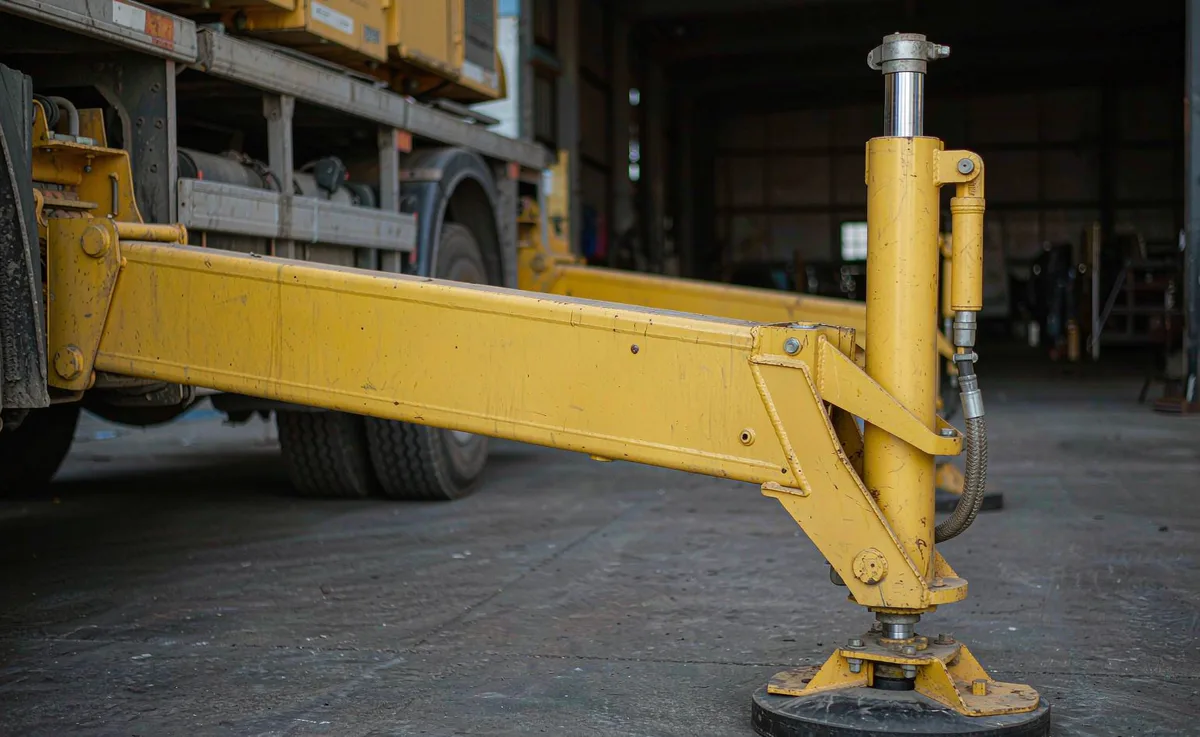
The outrigger system on a 25-tonne truck crane is the part that decides whether the load chart can be used as printed. Buyers usually contact a supplier only after a jack leg starts sinking or a beam will not extend fully, which means the purchase is made under time pressure and on price alone. This XCMG QY25K outrigger buying guide sets out the three assemblies that fail separately, how to identify which one you actually need, and which specifications should be in writing before the order is placed.
The QY25K uses an H-pattern outrigger arrangement with a hydraulically extended horizontal beam and a vertical jack leg at each corner. Front and rear assemblies are not interchangeable, and later production batches differ in beam section and pin diameter.
Three Assemblies That Fail Separately
| Assembly | Failure mode | Usual symptom |
|---|---|---|
| Horizontal beam | Bent section, worn slide pads, cracked weld at the box | Beam extends slowly, binds, or will not reach full span |
| Jack leg cylinder | Internal bypass, scored rod, failed seals | Leg creeps down under load, or will not hold pressure |
| Foot pad and swivel | Worn spherical seat, bent pad plate | Pad does not sit flat on the ground, machine rocks |
Diagnosing which of the three is at fault matters because the price difference between a foot pad and a complete beam assembly is more than an order of magnitude. A leg that sinks slowly under load is almost always an internal cylinder bypass, not a beam problem, and a beam that binds is almost always a slide pad or a bent section, not a hydraulic fault.
Beam: Section, Pads and Weld Condition
When ordering a beam, three dimensions have to be confirmed against the machine: the outside section of the box, the pin diameter at the pivot, and the stroke length. A beam that matches in section but not in stroke will extend to a shorter span and quietly reduce the working radius available to the operator.
Inspect the slide pads before replacing a beam. Worn pads allow the beam to drop and bind, and replacing pads on a straight beam restores smooth extension at a fraction of the cost. Also check the weld at the box corner where the beam enters the frame; a crack there is a structural issue that must be repaired rather than adjusted.
Jack Leg: Cylinder, Seals and Rod
Most jack leg faults are seal faults. A rod that is scored will destroy a new seal kit within weeks, so measure the rod for scoring and ovality before fitting seals. If the chrome is damaged, the cylinder is a replacement item, not a reseal item.
Ask for the seal material when ordering. Standard nitrile seals are adequate for normal site work, but machines that operate in cold climates need low-temperature seals, and units working near coastal or chemical environments benefit from the harder rod seal. A seal kit that is 15 percent cheaper and fails in the first winter is not cheaper.
Check the holding valve as well. A leg that creeps down with a healthy cylinder usually has a leaking holding valve or a contaminated valve seat, and replacing the cylinder will not fix it. The test is simple: load the leg, isolate the circuit and watch the pressure gauge. If pressure holds at the valve but the leg still drops, the fault is downstream.
Foot Pad: Contact Area and Swivel Condition
The foot pad transfers load into the ground, and the correct pad depends on the surface rather than on the crane. Standard flat pads suit concrete and compacted hardstanding. Larger pads reduce ground pressure on soft or made ground, and some sites require timber or steel spreader mats regardless of pad size.
Inspect the spherical seat on the swivel. A worn seat lets the pad tilt under load, which concentrates pressure on one edge and can lead to a pad failure during a lift. A pad that no longer sits flat is a safety item, not a cosmetic one.
What to Confirm Before Ordering
1. Machine serial number and the current outrigger part numbers. 2. Front or rear position, and left or right hand. 3. Beam section, pivot pin diameter and stroke length. 4. Cylinder bore, rod diameter and seal material. 5. Foot pad size and swivel type. 6. Whether the quotation includes pins, bushes, hoses and mounting hardware.
Installation Notes That Affect the Load Chart
After replacing any outrigger component, verify that all four legs reach full extension and that the machine sits level before the load chart is used. A beam that extends 50 mm less than the others will change the effective span and, on some configurations, the permitted working radius. Re-check the level indication after the first lift and again after the machine has been on site for a week, because new pads and pins settle.
Finally, keep the replaced parts until the new assembly has worked under load. A creaking noise that appears after a beam replacement is usually a dry pin rather than a defective part, and having the old assembly on hand shortens the diagnosis.
A correctly specified outrigger assembly is not an expensive part. Buying it twice because the stroke or the seal material was wrong is what makes it expensive.