
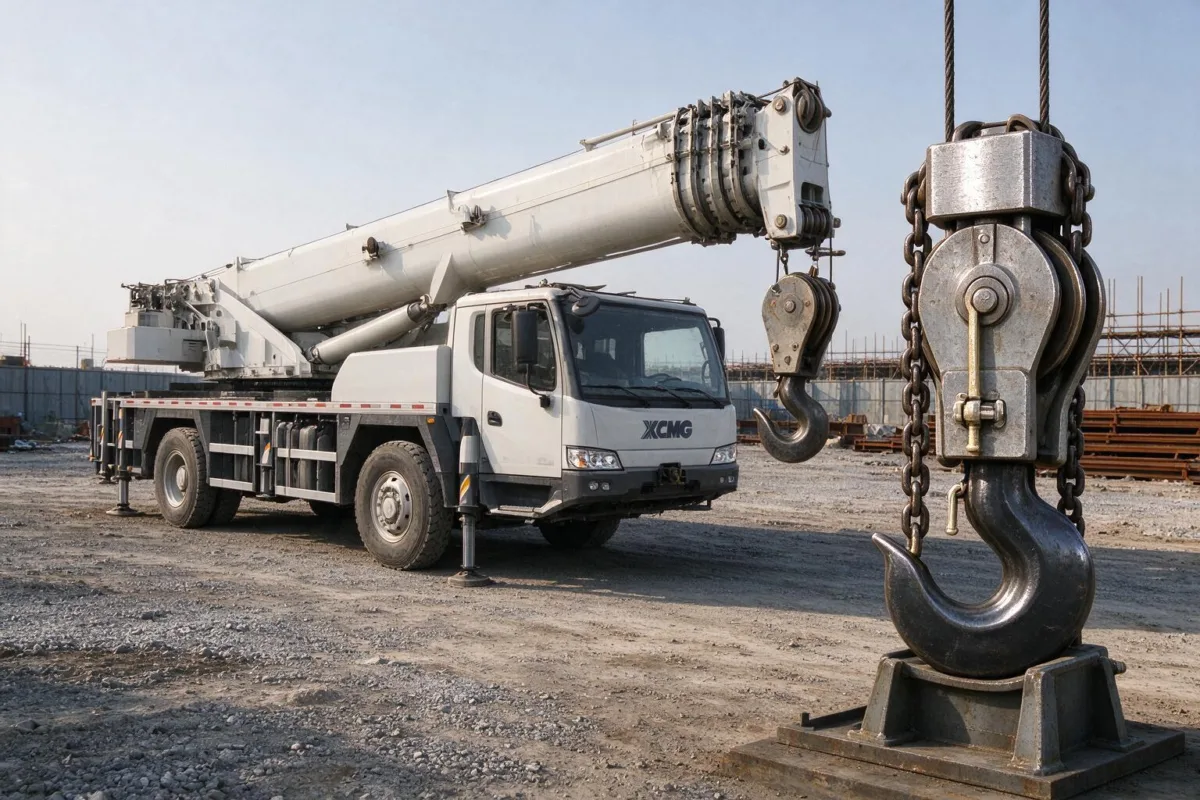
This XCMG QY25K hook buying guide covers the hook assembly for the 25-tonne class truck crane in the QY series. The hook assembly is a load-path component matched to the crane’s rated capacity chart, not an interchangeable commodity item. Because the hook block carries the payload through the reeving to the boom head, any mismatch in capacity, sheave geometry, or attachment affects the crane’s safe working envelope rather than just the hook itself. The QY25K is typically supplied with a main hook block and an auxiliary (single-line) hook. Both must be rated for the line pull and parts-of-line defined in the crane’s load chart.
Matching Hook Capacity to the QY25K Load Chart
Hook selection for the XCMG QY25K begins with the load chart, not the hook catalog. The rated capacity of the hook block must equal or exceed the maximum load the crane can impose on that hook in any permitted configuration. This includes not only the payload but also the effective weight of the block, slings, and any reeving hardware carried below the boom head. A higher-rated hook is acceptable only when its own weight and geometry remain within the crane’s permitted boom-head loading and clearance limits; an oversized block can reduce available capacity or interfere with sheave alignment.
Reeving changes the load path. Increasing parts of line raises the load carried by the block while reducing line speed. The hook’s rated capacity must cover the resulting line pull multiplied by the reeving factor, and the rope must be rated for the same condition. A block rated for the payload alone, without accounting for the multiplied line pull, is not adequate.
The auxiliary hook on the QY25K, a 25-tonne-class crane, is generally limited to single-line duty. It should not be used for multi-part reeving unless both the block and the rope are explicitly rated for that arrangement. Confirm the hook rating against the specific QY25K load chart revision in use, since chart updates can change permitted configurations, boom lengths, and allowable line pulls.
Sheave, Rope and Reeving Compatibility
Sheave geometry is a primary determinant of wire rope service life on the XCMG QY25K crane series. The groove profile and sheave diameter must match the rope diameter specified for the QY25K. An undersized sheave increases bending stress as the rope passes over it, accelerating fatigue and, in severe cases, deforming the groove itself. Replacement blocks should be checked against the rope diameter stated in the crane’s load chart and manual before installation.
Groove radius must support the rope across a sufficient arc without pinching the strands. A groove that is too tight grips the rope and abrades it; one that is too wide allows the rope to flatten under load. Worn or mismatched grooves are a common cause of strand breakage near the hook, and groove wear should be measured periodically with a groove gauge rather than assessed visually.
Multi-sheave main blocks must be reeved to match the parts of line in use. Unused sheaves should be left unreeved rather than partially loaded, since a sheave carrying only part of the load distributes force unevenly across the block and rope. Reeving diagrams for the QY25K series should be followed exactly when changing line configuration.
Finally, confirm that the block’s rope guard or sheave guard is present and undamaged. Missing guards allow the rope to jump the groove under slack conditions, which can wedge the rope between sheave and block housing and damage both components.
Hook Latch, Safety Device and Headache Ball Requirements
Every lifting hook on a QY25K series crane must carry a functioning hook latch. The latch is a safety device, not an accessory: it closes the throat opening so that slings, shackles, and load lines cannot slip out when tension is released. A serviceable latch closes the full throat, returns to the closed position under spring force, and moves without binding through its full travel. A latch that sticks open, hangs below the throat, or fails to seat is a defect and should be replaced before the hook returns to service.
Latch kits are model-specific. Hooks across the QY25K series differ in throat profile, tip geometry, and latch mounting, so a kit selected only by shank or pin dimension may not close the throat correctly. A latch that fits the mounting point but leaves a gap at the throat provides no effective closure and should be rejected regardless of fit at the shank.
The headache ball on the auxiliary line is a load-bearing component and must be matched to the rope diameter and rated for the line pull of the auxiliary hoist. It is not a simple weight. An undersized or unmatched ball can distort the rope termination and does not provide the intended downhaul mass.
Swivel action should be checked under load-free conditions. The ball or hook should rotate freely by hand. A seized swivel induces rope twist on every lift and can unlay the rope over repeated cycles, which shortens rope life and compromises the termination. Any swivel that does not turn freely should be repaired or replaced.
Inspecting a Used or Replacement Hook Block
Inspection of a hook block for the XCMG QY25K crane begins with dimensional verification against the manufacturer’s discard criteria. The throat opening should be measured with a caliper or dedicated gauge and compared to the original specification. Any throat opening beyond the stated limit, visible deformation, or cracking requires immediate removal from service. The hook shank should also be measured for wear and compared to the discard limit; a worn shank reduces the safety margin under load and cannot be corrected by field adjustment.
Crack inspection should focus on three zones: the saddle, the throat, and the transition between the hook and shank. Forged hooks that have experienced side-loading are prone to cracking in these areas. Dye penetrant or magnetic particle inspection is appropriate where visual inspection is inconclusive.
Sheave condition affects both rope life and block function. Groove depth and flange wear should be checked against the sheave manufacturer’s limits. A groove worn beyond limit allows the rope to bottom out, damaging the rope and accelerating sheave wear.
Capacity markings must remain legible and match the crane’s documentation. Unmarked or heavily over-painted hooks cannot be verified and should not be placed in service.
Finally, confirm the block’s weight is consistent with the rigging allowance for the QY25K series. An overweight block reduces available lifting capacity and may alter load charts.
| Check | Limit Source | Action if Out of Limit |
|---|---|---|
| Throat opening | Manufacturer discard criteria | Remove from service |
| Shank wear | Manufacturer discard criteria | Remove from service |
| Cracks (saddle, throat, shank) | Visual or NDT | Remove from service |
| Sheave groove depth | Sheave manufacturer | Replace sheave |
| Capacity marking | Crane documentation | Do not place in service |
| Block weight | Rigging allowance, QY25K | Verify against load chart |
Distinguishing Genuine and Aftermarket Hook Parts
Genuine XCMG hook components for the QY25K series typically carry three identifiers: the rated capacity marking, a part number, and a batch or serial number. These should be checked against the crane’s parts documentation and the load chart for the specific QY25K variant. A hook block that lacks any of these markings, or whose markings do not reconcile with the crane’s documentation, warrants closer inspection before use.
Aftermarket hook blocks may satisfy nominal dimensional requirements while differing in material grade, forging quality, and proof-load testing. Buyers should request test certificates and material specifications, including the steel grade and the proof-load value applied, rather than accepting dimensional fit as evidence of equivalence.
Re-marked hooks present a specific risk. Capacity stamps can be altered, so verification should extend to shank dimensions and block weight, which are more difficult to falsify and can be compared against the stated rating. A block weighing noticeably less than the specified unit for its rated capacity is a warning sign.
| Check point | Genuine component | Common aftermarket variance |
|---|---|---|
| Capacity marking | Stamped, matches load chart | Stamp may be altered or absent |
| Part and serial number | Present, traceable | Often missing or generic |
| Material certification | Available on request | Frequently unavailable |
| Proof-load test record | Documented | Rarely supplied |
| Block weight | Matches specification | May be lighter than rated unit |
Fasteners, pins, and latch springs are frequent substitution points. Mismatched hardware can fail independently of the hook body, so these items should be verified as part of the same specification. Purchase through channels that can provide traceability to the original component specification rather than relying on visual similarity alone.
Application Fit: When the QY25K Hook Configuration Suits the Job
The XCMG QY25K 25-tonne class truck crane is configured for general construction lifting, precast element placement, and plant maintenance where the crane must travel by road between sites. Its hook options should be matched to the duty cycle rather than treated as interchangeable.
Single-line auxiliary hook work suits light loads and faster cycle times. The auxiliary hook allows a single-part line for low-weight picks, reducing reeving time and increasing hook speed. This configuration is appropriate for small components, tools, and secondary handling tasks where the load stays well inside the chart.
Main block multi-part reeving suits heavier, slower lifts within the load chart. Multiple parts of line reduce line pull per part and improve control for precast placement and structural picks, at the cost of lower hook speed and longer setup.
For repetitive lifts at a fixed radius, confirm that hook block weight and reeving do not erode the margin between rated and actual load. Block weight counts against capacity, and added parts of line add rigging weight. A lift that appears within the chart on paper can lose margin once the block and slings are included.
Where site regulations require specific safety latches or inspection intervals, verify the hook assembly meets those requirements before deployment. Latch type, certification, and inspection records should be confirmed against the site’s lifting plan. Matching the hook configuration to the task, the chart margin, and the site’s compliance rules keeps the QY25K within its intended application envelope.
Procurement Checklist for QY25K Hook Assemblies
Ordering a replacement hook for a QY25K crane requires documented machine identification before any specification is quoted. Hook assemblies are matched to the load chart and reeving configuration of the specific unit, so the purchase request should begin with the crane model, serial number, and the revision date of the load chart in force. Where a QY25K has been re-rated or had its boom or jib configuration changed, the current chart revision governs, not the original delivery documents.
The purchase request should state the rated capacity in tonnes for the 25-tonne QY25K series, the number of sheaves, the rope diameter range the hook block is designed to accept, and the mounting interface (shank type, pin or clevis arrangement, and any dimensional tolerances). Vague descriptions such as “25-ton hook” are insufficient, because blocks of the same nominal capacity can differ in sheave count and rope size.
Suppliers should provide proof-load test certificates traceable to the specific assembly, material certification for the hook forging and block components, and details of how the rated capacity is marked on the block. The latch and any safety device should be quoted as part of the complete assembly, not as an optional line item, since a hook delivered without a functioning latch cannot enter service.
| Receiving check | Acceptance criterion |
|---|---|
| Capacity marking | Legible, matches order and load chart |
| Dimensions | Within drawing tolerance |
| Weight | Consistent with certificate |
| Latch function | Closes and locks freely |
A receiving inspection covering markings, dimensions, weight, and latch operation should be completed and recorded before the hook is released for lifting duty.