
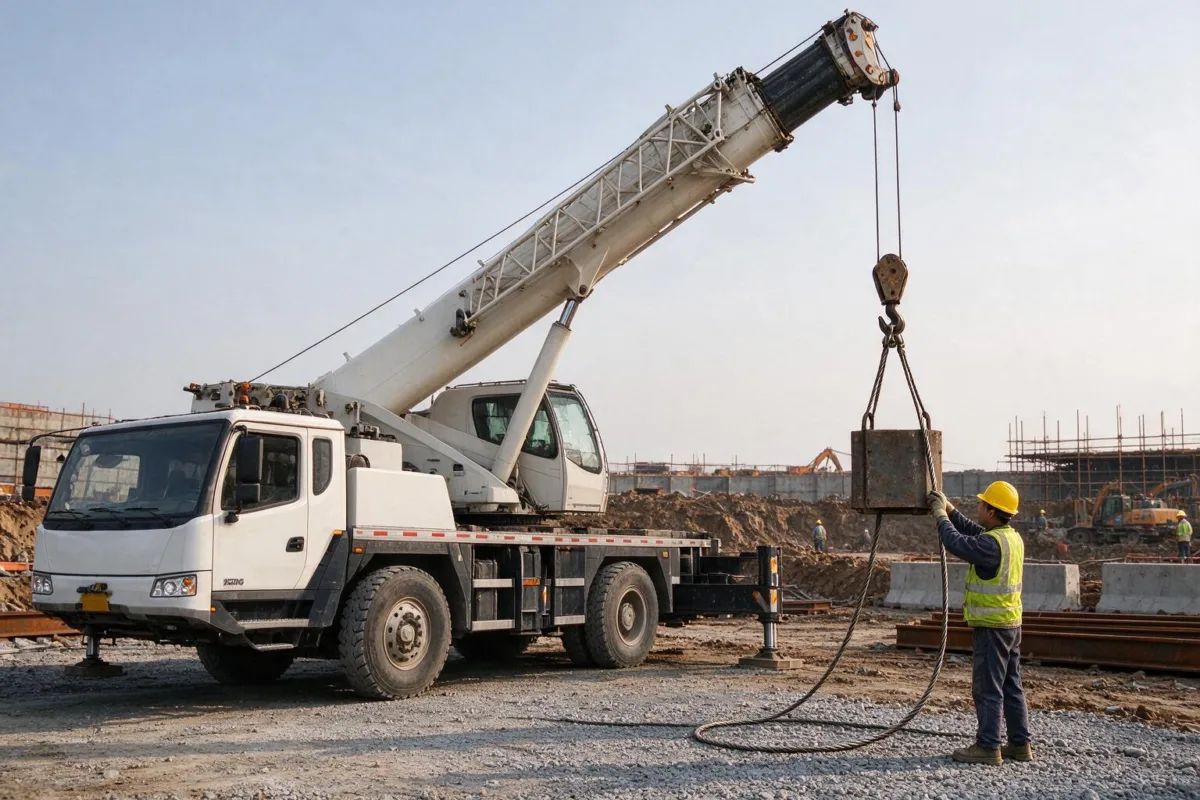
This XCMG QY25K wire rope buying guide begins with the crane’s configuration, because that configuration determines the rope inventory a fleet needs to stock. The XCMG QY25K is a 25-tonne class truck crane in the QY series, built with a telescopic boom and, on most variants, a single main hoist drum. Wire rope on this crane class serves two distinct duties. The first is hoist rope on the main drum, which carries the load through the reeving system and must resist bending fatigue over the sheaves. The second is boom telescoping or retraction rope on the boom extension system, which operates under different tension and cycling conditions and therefore has different construction requirements, typically a more compact strand arrangement suited to the extension mechanism. These ropes are not interchangeable.
Hoist Rope Specifications for the 25-Tonne QY Series
The main hoist rope on 25-tonne QY class cranes is typically a rotation-resistant or low-rotation construction in the 14 mm to 18 mm diameter range. The exact diameter depends on the drum capacity and the reeving configuration specified for the individual machine.
Rotation-resistant ropes use an inner strand lay opposite to the outer strand lay. This counter-lay limits load spin during single-line lifting, which matters on boom-tip work where a spinning hook block can be difficult to control. Standard 6×19 or 6×36 class ropes remain common where multi-part reeving is used and spin resistance is less critical, since the reeving itself constrains rotation.
| Parameter | Typical Range | Notes |
|---|---|---|
| Diameter | 14–18 mm | Depends on drum and reeving |
| Construction | Rotation-resistant, 6×19, 6×36 | Rotation-resistant for single-line |
| Rope grade | 1770 or 1960 N/mm² | Higher grade, smaller diameter |
| Drum grooving | Plain or Lebus | Affects diameter tolerance |
Rope grade is commonly 1770 N/mm² or 1960 N/mm². A higher grade reduces the diameter required for a given breaking force, but it also increases sensitivity to sheave mismatch and wear. Minimum breaking force must be checked against the crane’s rated line pull and the applicable safety factor for the lifting application. Buyers should also confirm whether the drum uses a Lebus grooving pattern, as this affects rope diameter tolerance and spooling behavior.
Boom Telescoping and Auxiliary Rope Requirements
Telescoping ropes on the QY25K (25-tonne class) boom system operate under load profiles distinct from hoist rope. They cycle frequently as boom sections extend and retract, and they reverse-bend at the boom head sheave during each cycle. These ropes are typically smaller in diameter than the main hoist rope and may use a compacted or swaged strand construction to resist abrasion in the confined sheave spaces of the boom head.
Where an auxiliary hoist or whip line is fitted, the rope must be matched to the auxiliary drum capacity and the head sheave groove. A rope that is oversized for the drum will not spool correctly; one that is undersized for the sheave groove will lack proper support and wear prematurely.
Reverse bending fatigue is the dominant failure mode on telescoping ropes. Construction choice should account for sheave count and bend direction along the reeving path. Ropes that see repeated reverse bending generally benefit from a construction with good fatigue resistance, such as a compacted strand or a rope with a high number of outer strands.
Rope end terminations on boom systems are often swaged sockets or wedge sockets. The termination type must match the rope construction supplied, since a socket sized for a standard rope may not seat correctly on a compacted or swaged rope of the same nominal diameter.
| Rope Position | Typical Construction Consideration | Termination |
|---|---|---|
| Boom telescoping | Compacted or swaged strand, fatigue-resistant | Swaged or wedge socket |
| Auxiliary hoist / whip line | Matched to drum capacity and sheave groove | Per drum design |
Verification of rope diameter, construction, and termination against the QY25K (25-tonne class) parts documentation is recommended before ordering.
Rope Construction and Lay Selection
Wire rope selection for the XCMG QY25K crane (25-tonne class, QY series) involves matching lay type, core, strand compaction, and lay direction to the duty cycle and drum arrangement.
Lang lay ropes place outer strands at the same angle as the rope lay, exposing more wire length to sheave and drum contact. This improves abrasion resistance and fatigue life on multi-sheave reeving. The trade-off is reduced resistance to spin and twist, so installation requires controlled unspooling to avoid kinks and core distortion.
Regular lay ropes are more stable under load and easier to inspect for broken wires, since outer wires run roughly parallel to the rope axis. This makes regular lay a common choice for general lifting duty on the QY25K where inspection access is limited.
Independent wire rope core (IWRC) construction provides higher breaking force and better resistance to drum crushing than fiber core (FC) alternatives. For the QY25K’s main hoist drum, IWRC is generally preferred where rated capacity margins are tight.
Compacted strands increase fill factor and surface contact area with sheave grooves, reducing groove wear and contact stress. Plastic-impregnated or lubricated cores can extend service life in dusty or high-cycle environments, though re-lubrication intervals still apply and should follow the crane’s maintenance schedule.
Lay direction must match drum winding direction to prevent crossed or slack spooling on the first layer. A mismatch causes uneven spooling, accelerated wear, and potential rope damage during the first wrap.
| Parameter | Option | Typical QY25K Application |
|---|---|---|
| Lay type | Lang lay | High-cycle, multi-sheave duty |
| Lay type | Regular lay | General lifting, easy inspection |
| Core | IWRC | Main hoist, high breaking force |
| Core | FC | Light duty, flexibility priority |
| Strand | Compacted | Reduced sheave groove wear |
| Lay direction | Right or left hand | Match drum winding |
Fitment Checks Before Purchase
Wire rope selection for the XCMG QY25K (25-tonne class) requires verification against the crane’s drum, sheave, and reeving configuration before ordering.
Diameter and Groove Dimensions
Confirm the nominal rope diameter against the drum and sheave groove dimensions. A groove that is too narrow pinches the rope and concentrates wear on the outer wires, while an oversized groove allows the rope to sit low and accelerates flattening and ovalization. Groove radius should nominally match the rope radius within the crane manufacturer’s tolerance.
Certification and Data Plate
Check the rope certification for minimum breaking force, construction, lay, and grade against the QY25K load chart and the rope data plate on the crane. The rope’s minimum breaking force must meet or exceed the design factor applied to the maximum line pull for the working boom length and reeving.
Termination Compatibility
Confirm termination compatibility. Swaged fittings, wedge sockets, and rope clips each require specific rope constructions and end preparations; a fitting rated for one construction may be unsuitable for another.
Measuring the Existing Rope
Measure the existing rope’s actual diameter under tension. Worn rope reads undersize and can mislead diameter selection; a nominal 16 mm rope worn to 15.5 mm should not drive a replacement order for 15.5 mm rope.
Length and Rotation Characteristics
Confirm the required rope length from drum capacity plus the number of dead wraps and the reeving for the working boom length. Match rope rotation characteristics to the reeving: single-line lifting benefits from rotation-resistant rope, while multi-part reeving tolerates standard constructions.
| Check | Verify Against |
|---|---|
| Nominal diameter | Drum and sheave groove dimensions |
| Breaking force, construction, lay, grade | Load chart and rope data plate |
| Termination type | Rope construction and end preparation |
| Length | Drum capacity, dead wraps, reeving |
| Rotation characteristics | Single-line or multi-part reeving |
Identifying Counterfeit and Non-Conforming Rope
Counterfeit wire rope for XCMG QY25K crane applications often carries copied labels and packaging but lacks traceable mill certification or heat and batch numbers. Without these identifiers, the rope cannot be linked to a specific production lot, and any strength claim remains unverified.
The certificate itself warrants close reading. A valid document names the actual rope manufacturer and states breaking force from a tested sample, not a calculated nominal value. Certificates that list only a distributor, or that present calculated figures in place of test results, do not demonstrate conformance.
Physical inspection supplements the paperwork. Check strand uniformity, wire surface finish, and lay regularity. Inconsistent lay pitch indicates poor stranding control and points to a rope that may not meet its stated construction. Verify the rope core type by cross-section where possible, since substituted fiber cores reduce breaking force below the stated rating.
Purchasing through distributors that can supply batch traceability and, where required, third-party verification of the certificate reduces exposure to non-conforming product. Rope marketed with tonnage ratings rather than diameter, construction, and breaking force should be treated with caution. Tonnage ratings are application-specific and not a rope property; a rating quoted for a QY25K boom hoist does not describe the rope itself.
| Check | Conforming Rope | Non-Conforming Indicator |
|---|---|---|
| Certification | Names actual manufacturer, tested breaking force | Distributor-only, calculated values |
| Traceability | Heat and batch numbers present | No lot identification |
| Strand and lay | Uniform pitch and finish | Irregular lay pitch |
| Core | Matches specified type in cross-section | Substituted fiber core |
| Marketing | Diameter, construction, breaking force | Tonnage rating only |
Installation and Break-In Practices
Correct installation and a controlled break-in period extend wire rope service life on the XCMG QY25K (25-tonne class) and reduce the risk of early wire breaks, drum crushing, and termination failure.
Install the rope under tension with the drum rotated in the correct direction so the rope lays into the groove without crossing. Cross-winding or slack spooling allows adjacent wraps to press into one another, which can deform strands and create localized wear points. Confirm the fleet angle is within the limits specified for the QY25K boom and hoist arrangement before spooling the full length.
After installation, run several light load cycles to seat the rope on the drum before returning to full working loads. This bedding process distributes the first layer evenly and helps the rope conform to the groove profile. Avoid shock loading during this phase.
Apply the specified rope lubricant after installation and at defined intervals, giving particular attention to boom telescoping ropes on the QY25K, where access is limited and re-lubrication is more difficult. Penetrating lubricants should reach the core, not just the outer strands.
Record the installation date, rope batch or certificate number, and running hours. These records support later inspection and replacement decisions and provide a baseline for comparing wear against the original condition.
Check rope end terminations after the first shift and again after the break-in period for seating and torque retention.
| Checkpoint | Timing | Focus |
|---|---|---|
| Drum spooling | At installation | Groove seating, no crossing |
| Light load cycles | Before full loads | Bedding of first layer |
| Lubrication | After installation, then at defined intervals | Core penetration, telescoping ropes |
| Terminations | First shift and end of break-in | Seating and torque retention |
| Documentation | At installation | Date, batch, running hours |
Inspection Criteria and Replacement Triggers
Wire rope inspection on the XCMG QY25K (25-ton QY series) should follow a defined interval tied to the crane’s duty cycle and the operator’s maintenance documentation. The following criteria drive replacement decisions.
Broken Wire Assessment
Broken wires concentrate at predictable locations: the boom head sheave, the drum crossover zone, and termination areas where bending fatigue and stress reversal accumulate. Inspectors should examine these zones along the full length of rope, not only the sections visible during a routine walk-around. Counts are compared against the applicable inspection standard and the crane’s maintenance manual.
Diameter and Internal Condition
Diameter reduction is measured with a calibrated gauge at multiple points and compared to the nominal rope size. Core protrusion, a “birdcage” appearance, or a measurable diameter loss signals internal damage that outer strands may not reveal. Any of these conditions warrants removal from service regardless of visible wire breaks.
Corrosion and Lubrication
Corrosion assessment covers both external strand condition and internal lubrication state. Ropes working in humid or coastal environments commonly corrode from the inside out, where moisture migrates past the strand gaps and displaces lubricant. Widespread pitting or a dry, unlubricated core supports replacement.
Replacement Thresholds
Replacement is triggered when broken wire counts, diameter loss, or deformation exceed the limits in the applicable inspection standard and the QY25K maintenance documentation. Where the two differ, the stricter limit governs.
Sheaves and Drums
Sheaves and drums are inspected at the same interval. Worn groove profiles accelerate rope degradation and can shorten the service life of a newly installed rope.
Recordkeeping
Per-rope inspection records should capture date, inspector, findings, and actions. Fleet compliance audits typically require documented history for lifting accessories, and the QY25K log should remain traceable for the life of each rope.