
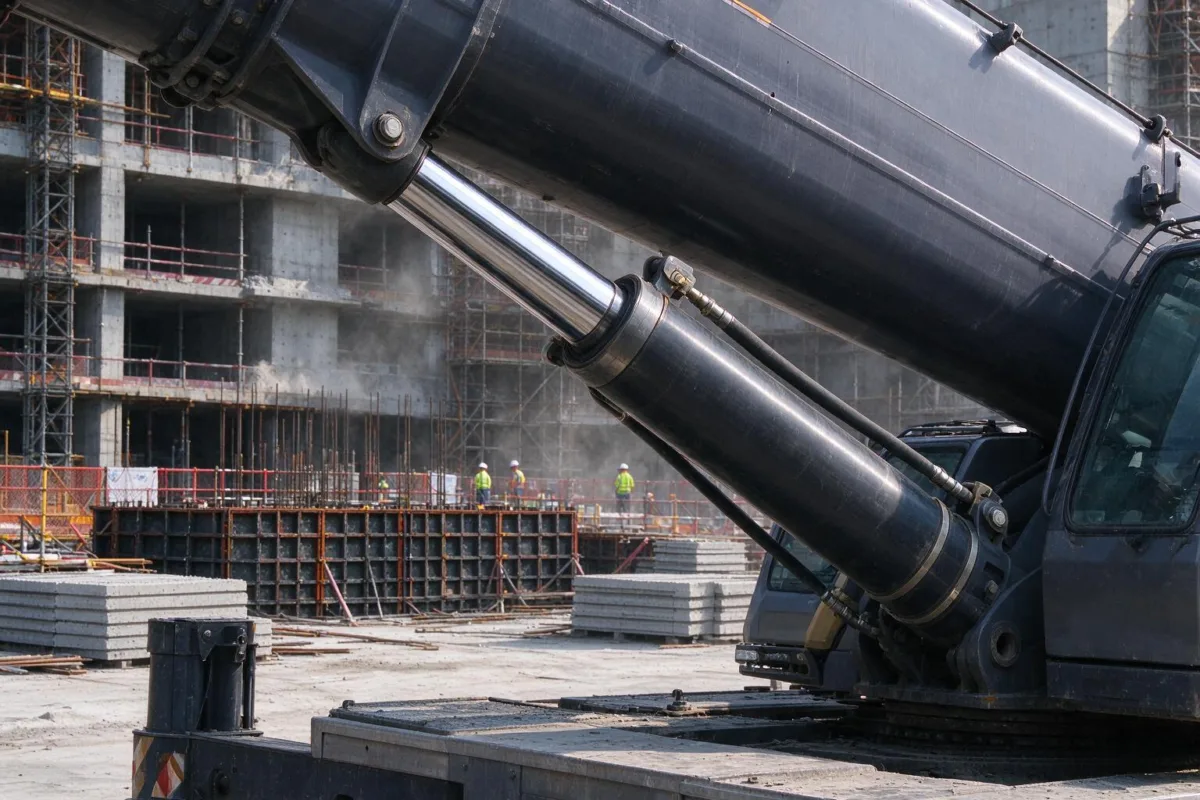
This XCMG QY25K hydraulic cylinder buying guide covers cylinder selection for the 25-tonne QY series truck crane, and any selection must reference the exact chassis and boom configuration. QY25K variants built across different production years differ in cylinder mounting arrangement and rod-end geometry, so a cylinder that fits one build year may not fit another, and buyers should confirm the machine’s configuration before ordering any replacement.
This guide covers four cylinder groups on the QY25K:
- Boom lift cylinders
- Boom telescope cylinders
- Outrigger cylinders
- Steering cylinders
It does not treat winch motors or rotary actuators. Those are separate assemblies with their own part numbering and service requirements, and they are outside the scope of this guide.
For identification, the crane serial number and the cylinder tag are the primary references. The cylinder tag typically carries the part number, stroke, bore, and rod diameter, and it should be recorded before any cylinder is removed. The crane serial number ties the machine to a specific production configuration, which matters when the tag is missing or unreadable.
Tonnage a
Cylinder Positions on the QY25K and Their Function
The 25-tonne QY25K carries several distinct hydraulic cylinder groups, each with its own function, mounting arrangement and purchasing considerations. Identifying the correct position before ordering is essential, since cylinders that appear similar externally can differ in bore, stroke, rod diameter or end fittings.
Boom Lift (Luffing) Cylinders
The boom lift cylinders raise and lower the main boom. On most QY25K builds, a twin-cylinder arrangement is used, and the two units should be matched for bore, stroke and rod diameter. Fitting a mismatched pair can cause uneven loading and accelerated seal wear on both cylinders.
Telescope Cylinders
Telescope cylinders extend the boom sections. Multi-stage units require stage-by-stage seal kits rather than a single kit, because each stage carries different seal dimensions and wear characteristics. Buyers should confirm the number of stages and the serial number break for the specific QY25K build before ordering.
Outrigger Cylinders
Vertical and horizontal outrigger cylinders level the crane. Horizontal outrigger cylinders often carry different rod-end fittings than vertical units, so the two types are not interchangeable in purchasing terms even where bore and stroke are similar.
Steering Cylinders
Steering cylinders on the carrier chassis are frequently overlooked in purchasing and are often the first to show rod scoring from road debris. Inspecting the rod surface at each service interval helps identify scoring before it damages the seals.
| Position | Function | Purchasing note |
|---|---|---|
| Boom lift (luffing) | Raises and lowers main boom | Twin-cylinder builds: match bore, stroke and rod diameter as a pair |
| Telescope | Extends boom sections | Multi-stage: order stage-by-stage seal kits |
| Outrigger, vertical | Levels the crane | Confirm mounting and fittings |
| Outrigger, horizontal | Levels the crane | Rod-end fittings often differ from vertical units |
| Steering (carrier) | Steers the chassis | Commonly overlooked; check rods for scoring |
Reading the Cylinder Nameplate and XCMG Part Numbers
The nameplate on a QY25K hydraulic cylinder is the primary identification record. Typical plates list bore diameter, rod diameter, stroke length, rated pressure, and an XCMG part number. Stampings corrode and become illegible over time, particularly on boom and outrigger cylinders exposed to weather and washdown, so the plate should be photographed before the cylinder is removed from the crane. Multiple photographs at different angles and lighting conditions improve the chance of recovering a partial number.
XCMG part numbers for QY25K cylinders follow a structured format in which position segments encode assembly, bore size, stroke, and variant. A partial number is not sufficient for ordering. Superseded numbers should be confirmed against the crane’s parts manual for the correct serial range, since XCMG revised cylinder assemblies across QY25K production runs.
Where the plate is unreadable, the bore can be measured as the cylinder barrel internal diameter, and the stroke as the rod extension between fully retracted and fully extended positions. The gland thread type and port sizes should also be recorded, as these vary between cylinder positions on the same crane.
| Parameter | Method |
|---|---|
| Bore | Barrel internal diameter |
| Stroke | Rod extension, retracted to extended |
| Gland thread | Thread gauge or pitch measurement |
| Port size | Thread identification at ports |
Aftermarket catalogues should be cross-referenced against the OEM number rather than against tonnage class. Cylinders from other QY variants in the 25-tonne class are not interchangeable with QY25K units, and tonnage alone does not establish fitment.
Specification Verification Before Purchase
Replacement hydraulic cylinders for the XCMG QY25K crane must be verified against the machine’s build data before ordering. Generic “25-tonne crane” dimensions are not sufficient, because cylinder geometry and pressure ratings are tied to the specific QY25K boom and outrigger circuit design.
Dimensional Checks
Bore, rod diameter and stroke should be confirmed to the millimetre. Stroke is the most sensitive dimension: a deviation of even a few millimetres alters boom elevation geometry and can prevent limit switches from triggering at the correct boom angle or cause the cylinder to bottom out before the mechanical stop is reached. Retracted and extended centre-to-centre lengths should be cross-checked against the same drawing.
Pressure Ratings
Rated working pressure and test pressure must be matched to the QY25K hydraulic system specification, not to a nominal tonnage figure. Relief valve settings on the QY25K main valve block determine the maximum pressure the cylinder will see in service; the replacement must carry a rated working pressure at or above that value and a test pressure consistent with the original component’s acceptance criteria.
Mounting Interface
Confirm pin diameter, clevis width, rod-end thread (diameter and pitch) and the gland retention method. Glands may be threaded, bolted or keyed, and these are not interchangeable without modifying the cylinder or the mounting.
Seal Compatibility
Seal elastomer selection depends on the hydraulic oil in use. Mineral oil, biodegradable esters and fire-resistant fluids each require different seal compounds; a seal specified for mineral oil may swell or harden in an ester-based fluid. The oil type and operating temperature range should be stated at the time of order.
OEM, OEM-Equivalent and Aftermarket Cylinders
Genuine XCMG cylinders for the QY25K carry traceable part numbers and documented test records. These records typically cover pressure testing, bore and stroke verification, and material certification. Genuine units serve as the reference against which fit, mounting geometry and pressure rating are judged, which matters when a crane has been through multiple repair cycles or when build variations exist within the QY25K series.
OEM-equivalent cylinders from independent manufacturers can meet specification, but only if the critical parameters are verified in writing before purchase. The buyer should obtain documented confirmation of bore diameter, stroke length, rated working pressure, rod diameter, and mounting configuration (pin diameter, clevis or flange type, and port positions). A cylinder that matches on tonnage alone is not a verified equivalent.
Refurbishment is often economic for QY25K lift cylinders. Re-barrelling, rod re-chroming and resealing can restore function at a fraction of replacement cost, provided two inspections are carried out: the barrel is checked for ovality along its full length, and the rod is checked for straightness and surface damage beyond the chrome layer. Ovality or a bent rod will cause premature seal failure regardless of new seals.
Cylinders specified only by tonnage should be avoided. A 25-tonne rating does not define bore, stroke or mounting for a specific QY25K build. Tonnage figures describe crane capacity, not cylinder geometry, and a cylinder sold on that basis may not fit the mounting or deliver the required force at system pressure.
| Option | Verification required |
|---|---|
| Genuine XCMG | Part number and test records |
| OEM-equivalent | Written bore, stroke, pressure, mounting data |
| Refurbished | Barrel ovality and rod straightness inspection |
Inspection Checklist on Receipt
Incoming hydraulic cylinders for the XCMG QY25K crane series should be inspected against the purchase specification before installation or storage. Document every measurement and retain the records with the delivery paperwork.
Dimensional Verification
Measure the bore diameter, rod diameter, and stroke, then compare each value to the specification on the purchase order. Record actual readings rather than pass/fail marks so that any deviation can be traced later. For QY25K-series applications, confirm that the cylinder matches the intended boom, outrigger, or steering function, since mounting dimensions differ between positions on the 25-ton class chassis.
Surface and Bore Inspection
Examine the chrome-plated rod along its full length for scoring, pitting, and straightness. Run a straightedge or dial indicator along the rod to check for bending. Inspect the barrel bore for scoring and measure ovality at several points along the length. Any bore distortion affects seal life and should be documented before acceptance.
Pressure Test
Pressure-test the assembled cylinder at its rated working pressure and hold it long enough to observe behaviour. Confirm no external leakage at the gland, at the ports, and along the weld seams. A drop in held pressure with no visible leak may indicate internal bypass past the piston seal.
Fit and Documentation Checks
Verify port threads, pin bores, and rod-end thread against the crane’s mounting points. Confirm the seal kit part number is recorded and matches the cylinder variant supplied. The table below summarizes the checks.
| Check | Method | Record |
|---|---|---|
| Bore, rod, stroke | Calipers or micrometer | Actual dimensions |
| Rod condition | Visual and straightness gauge | Scoring, pitting, runout |
| Barrel bore | Visual and ovality measurement | Scoring, out-of-round |
| Pressure test | Rated pressure hold | Leak points, pressure drop |
| Ports, pins, threads | Trial fit | Thread and bore match |
| Seal kit | Documentation review | Part number |
Supplier Evaluation Criteria
A part number match alone is insufficient evidence that a hydraulic cylinder is suitable for a 25-tonne class QY25K crane. Buyers should require dimensional drawings showing bore, rod diameter, stroke, closed and extended lengths, pin bore sizes, and mounting geometry. Material specifications should identify tube and rod steel grades, hard chrome thickness on the rod, and seal types by compound and profile. These details allow comparison against the original cylinder and reveal whether a supplier is working from generic drawings or from model-specific data.
Pressure test records should be requested for each cylinder, showing test pressure, hold duration, and acceptable leakage limits. Where the application involves lifting duties or regulated inspection regimes, third-party inspection reports from a recognized body add independent verification of test results and material traceability.
Warranty terms merit close reading. Coverage should explicitly address external leakage, rod chrome flaking or corrosion, and weld integrity at the tube-to-head and rod-eye joints. Buyers should also confirm whether the warranty is void if the cylinder is resealed in the field, since many QY25K fleets are maintained by independent workshops. A warranty that lapses on resealing may offer limited practical value.
Finally, lead time should be assessed alongside consumable supply. Seal kits and replacement rods should be available as stocked items, not special-order parts. For QY25K fleets in continuous service, delayed access to seals or a spare rod can sideline a crane for weeks. Suppliers who publish seal kit part numbers and hold stock of rods for the QY25K series present lower operational risk than those quoting cylinder assemblies only.
Common Buying Errors and Risk Controls
Most purchasing problems on XCMG QY25K hydraulic cylinders trace back to identification and specification errors rather than manufacturing defects. The controls below address the four most frequent failure patterns.
Ordering by tonnage class instead of serial number and part number
Ordering by tonnage class alone, such as “25-ton cylinder,” is the most frequent error. The QY25K designation covers multiple production series, and cylinder part numbers differ across boom sections, outriggers, and steering circuits. Buyers should order against the crane serial number and the cylinder part number stamped on the unit or listed in the parts manual. Tonnage should always be paired with the model series, for example QY25K and QY25K5, because components are not interchangeable across series without verification.
Mismatched seals and seal kits
Reusing seals from a different cylinder position, or fitting a single-stage seal kit to a multi-stage telescope cylinder, causes premature failure. Each position has specific seal geometry, pressure ratings, and material requirements. Multi-stage telescope cylinders require stage-specific kits; a single-stage kit will not seat correctly and will leak under extension load.
Skipping rod straightness checks after a boom incident
After a boom incident or side load, rod straightness must be verified before any seal replacement. A bent rod will destroy a new gland seal within hours regardless of seal quality. Checking straightness with a dial indicator along the rod length is a low-cost control that prevents repeated gland failures.
Ignoring oil and seal material compatibility
Failing to confirm oil compatibility with the supplied seal material risks swelling and leakage within the first operating hours. Buyers should confirm the hydraulic oil type, mineral or synthetic, and verify the seal compound, typically NBR or PTFE-based, against the oil specification before installation.