
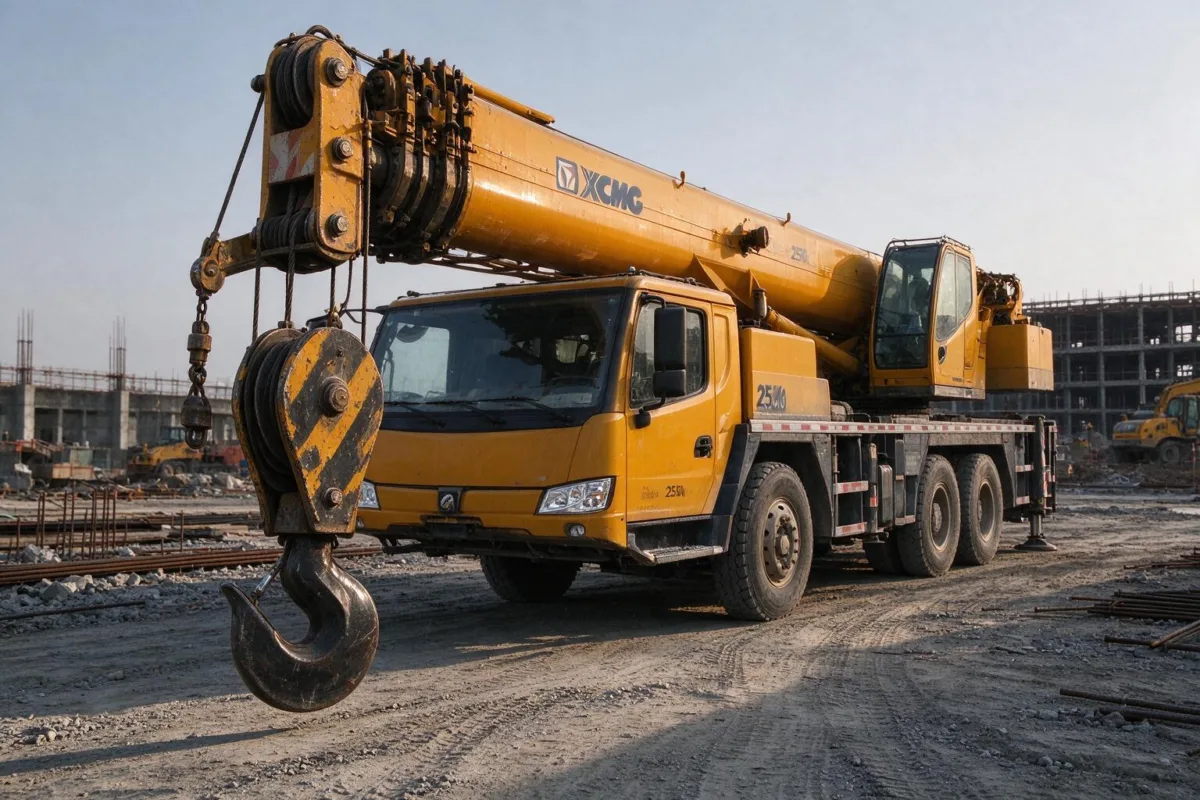
The XCMG QY25K is a 25-ton truck crane in the QY series, a model class commonly deployed for construction, logistics, and infrastructure work. Buyers researching the XCMG QY25K hook price should first understand that the boom geometry, outrigger configuration, and load chart define the lifting envelope, and every rigging component on the machine must operate within those limits.
The hook assembly is a critical load-bearing component on the QY25K. Its rated capacity, wire rope diameter compatibility, and throat opening must match the crane’s specifications. A mismatch between hook capacity and the reeved line pull can produce overload conditions that the load chart does not anticipate. Hook selection therefore begins with the crane’s rated capacity and the diameter of the wire rope installed on the hoist drum.
Hook Types and Specifications for QY25K
The XCMG QY25K crane is typically configured with a single main hook and an auxiliary hook. The main hook capacity is commonly rated at 25 tons, matching the QY25K series lifting class, while the auxiliary hook capacity varies by configuration, often falling in the 3–5 ton range for lighter or faster lifts.
Common hook types for this class of crane include forged single hooks and ramshorn hooks. Material grades such as 35CrMo or 34CrNiMo6 are frequently specified for the hook body, selected for strength and resistance to fatigue under repeated loading. Ramshorn designs are generally used where two-point rigging is required, while single hooks suit standard lifting slings.
Key specifications to verify when sourcing a replacement include hook opening size, shank diameter, thread type, and safety latch configuration. These dimensions must match the original hook block and the crane’s load chart to maintain rated capacity and safe operation.
Hook blocks for the QY25K may include features such as swivel bearings for load rotation, spring-loaded safety latches, and weight-reducing designs that lower the block’s own mass and preserve available lifting capacity. Buyers should confirm the block’s rated capacity, hook material grade, and latch type against the crane’s serial-specific parts documentation before purchase.
| Specification | Typical Value |
|---|---|
| Main hook capacity | 25 t (QY25K series) |
| Auxiliary hook capacity | 3–5 t |
| Hook type | Forged single hook, ramshorn hook |
| Material grade | 35CrMo, 34CrNiMo6 |
| Key dimensions | Opening size, shank diameter, thread type |
| Block features | Swivel bearing, safety latch, weight-reducing design |
Factors Influencing XCMG QY25K Hook Price
The price of a hook assembly for the XCMG QY25K crane varies considerably across listings, and several technical and commercial factors account for the spread.
Material and Manufacturing Process
Forged hooks generally cost more than cast hooks. Forging produces a finer grain structure and better fatigue resistance under repeated lifting cycles, which matters on a 25-ton truck crane used in general construction duty. Cast hooks are cheaper to produce but offer lower strength and are less tolerant of shock loading. Machined finish, heat treatment, and surface coating (typically galvanized or painted) also affect cost.
Load Capacity and Safety Factor
A hook rated for the QY25K’s maximum lifting duty requires more material and stricter quality control than a lower-capacity unit. Hooks are designed to a specified safety factor, commonly 4:1 or higher for lifting applications. Higher-rated hooks involve more material, more extensive non-destructive testing, and tighter dimensional tolerances, all of which raise the price.
Brand and Origin
Genuine XCMG parts typically command a premium over aftermarket alternatives. Aftermarket hooks may fit the QY25K series but differ in material traceability, documentation, and warranty support. Buyers should confirm whether a listing is a genuine part or a compatible replacement.
Certification and Testing
Hooks supplied with third-party certification, such as CE marking or ISO 9001-backed manufacturing records, often carry higher prices. Proof load testing and material certificates add cost but simplify compliance and inspection records.
Market Demand and Supply Chain Conditions
Price fluctuates with demand from fleet operators and with supply chain conditions, including raw steel costs, freight, and import duties. Lead times can also shift pricing for genuine parts.
| Factor | Effect on Price |
|---|---|
| Forged vs. cast construction | Forged higher |
| Load rating and safety factor | Higher rating, higher price |
| Genuine XCMG vs. aftermarket | Genuine higher |
| Third-party certification | Certified higher |
| Demand and supply chain | Variable |
Price Range and Market Reference
Pricing for XCMG QY25K crane hooks varies by hook type, load rating, and supplier. The figures below are indicative market references for planning and comparison, not fixed quotations.
Main Hook Pricing
Genuine XCMG QY25K main hooks are typically priced in the range of USD 800 to 1,500 per unit. The spread reflects differences in rated capacity, sheave configuration, hook block weight, and the supplying dealer or distributor. Main hooks configured for the 25-tonne QY25K series with multi-sheave blocks generally sit at the upper end of this band, while single-sheave or lighter configurations fall toward the lower end.
Auxiliary Hook Pricing
Auxiliary hooks for the QY25K generally range from USD 300 to 600. These lighter units are used for secondary lifting duties and typically carry lower rated capacities than the main hook block. Specification differences such as hook weight, latch type, and finish account for most of the variation within this range.
Aftermarket Options
Aftermarket hooks may be priced 20-40% lower than genuine equivalents. Buyers should note that quality, material traceability, and compliance with relevant lifting standards vary considerably among aftermarket suppliers. Lower cost does not automatically indicate equivalent performance or certification status, and verification of load ratings and test documentation is advisable before purchase.
Reference Summary
| Hook Type | Indicative Price Range (USD) |
|---|---|
| Genuine QY25K main hook | 800 – 1,500 |
| QY25K auxiliary hook | 300 – 600 |
| Aftermarket hook | 20–40% below genuine pricing |
All prices are indicative and subject to change with market conditions, exchange rates, and supplier inventory. Buyers should request current quotations from suppliers before committing to a purchase.
Identifying Genuine XCMG Hooks
Counterfeit lifting hooks present a significant risk on QY25K series cranes, where a failed hook can cause load loss and injury. Buyers should verify authenticity through physical markings, documentation, and packaging before accepting delivery.
Markings on the Hook Body
Genuine XCMG hooks carry the XCMG name or logo cast or stamped into the hook body, typically on the shank or the side of the bowl. Part numbers should match XCMG’s published catalog for the QY25K series, and each hook should bear a serial number that can be traced to a production batch. Stamping should be clean and legible; shallow, uneven, or missing characters are a warning sign. Check that the part number corresponds to the correct rated capacity for the 25-tonne QY25K platform rather than a hook intended for another model series.
Documentation
Authentic hooks ship with a certificate of conformity and a material test report (MTR) covering the hook forging or casting. The MTR should list steel grade, heat number, and mechanical properties, and the heat number should be traceable to the serial number on the hook. Certificates lacking heat numbers, or with generic wording and no XCMG reference, warrant closer scrutiny.
Packaging
Original packaging includes XCMG logos, the correct part number label, and anti-counterfeit labels or holograms. Packaging that is plain, relabeled, or inconsistent with the documentation should be questioned.
Load Rating and Safety Factor
Confirm the hook’s rated capacity and safety factor against XCMG’s official specification for the QY25K series. The stated working load limit on the hook should match the crane’s rigging configuration and the published XCMG data. Any discrepancy between the marking, the certificate, and the official specification indicates a non-genuine or misrepresented part.
Procurement Considerations for B2B Buyers
Hook assemblies for the XCMG QY25K (25-tonne QY series) are safety-critical lifting components, and sourcing decisions should reflect that status. Buyers should prioritize authorized XCMG distributors or established aftermarket suppliers that maintain traceable quality records. Traceability matters because hook blocks for the QY25K carry rated capacities tied to the crane’s load chart, and undocumented components introduce verification risk during inspection and recertification.
Documentation should be requested before purchase, not after delivery. Suppliers should provide material certificates for the hook body and shackle components, load test reports confirming the rated capacity, and written warranty terms. For a 25-tonne QY series hook block, load test documentation typically references proof-load testing at a multiple of the working load; buyers should confirm the report matches the specific part number supplied.
Total cost of ownership should be weighed alongside unit price. Genuine or OEM-equivalent parts may carry a higher initial cost but can offer longer service life and reduced downtime, particularly on high-cycle lifting operations. A lower-priced hook that fails inspection prematurely or wears faster can erode savings through replacement labor and crane idle time.
Compatibility checks are essential. The hook assembly must match the QY25K’s wire rope diameter, sheave configuration, and rigging setup, including shackle and swivel interfaces. Buyers should verify part numbers against the crane’s parts manual rather than relying on generic descriptions.
For bulk orders, pricing and lead times are negotiable. Volume purchases of hook assemblies or related rigging components justify requesting tiered pricing, consolidated shipping, and firm delivery schedules, ideally with spare units staged to cover inspection intervals.
| Documentation item | Purpose |
|---|---|
| Material certificates | Verify hook body and shackle steel grade |
| Load test reports | Confirm rated capacity for the 25-tonne QY series |
| Warranty terms | Define coverage period and claim process |
| Part number cross-reference | Confirm QY25K compatibility |
Maintenance and Replacement Guidelines
Hook maintenance on the XCMG QY25K (25-ton QY series) follows the same inspection logic applied to any lifting accessory on a telescopic truck crane. The hook assembly should be inspected before each shift and at the intervals specified in XCMG’s maintenance schedule. Inspection focuses on three defect categories: wear, cracks, and deformation.
Wear is measured at the saddle and at the throat opening. A hook that has lost more than 10 percent of its original section thickness at the saddle, or whose throat opening has increased beyond the manufacturer’s limit, is removed from service. Cracks are most commonly found at the saddle, the bowl, and the transition between shank and body; magnetic particle or dye penetrant inspection is appropriate where visual examination is inconclusive. Deformation includes bending of the shank, twisting of the body, and any change in the hook’s original geometry. A hook showing any of these defects is replaced rather than repaired.
Replacement hooks must meet or exceed the original specifications for the QY25K hook block, including rated capacity, material grade, and dimensional fit with the existing block and latch. Substandard or unspecified hooks are not acceptable substitutes, regardless of price advantage.
Load testing follows XCMG’s published intervals and applies to the hook block as an assembly. Test results, inspection dates, findings, and replacement dates are recorded in a hook log retained for the life of the component. These records support safety compliance audits and provide traceability if a hook is removed from service.