
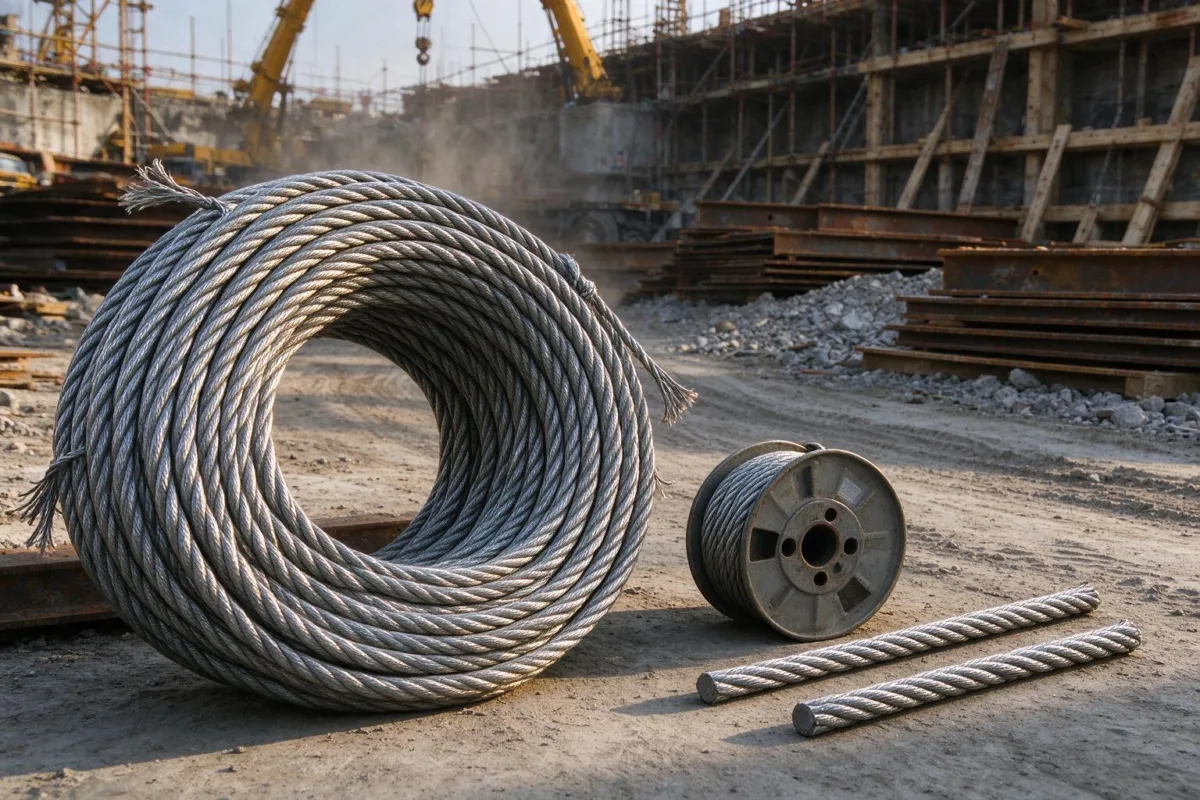
The XCMG QY25K is a 25-ton truck crane in the QY series, a model line widely used in construction, logistics, and infrastructure projects. Buyers researching the XCMG QY25K wire rope price should note that cost depends on rope diameter, construction, and length, as well as the specific hoist or boom system the rope serves. The crane’s combination of road mobility and lifting capacity makes it common on building sites, bridge and road work, and material handling yards where a dedicated crawler crane would be impractical.
Wire Rope Specifications for QY25K
The QY25K crane (25-tonne class, QY series) uses a main hoist wire rope that typically falls in the 14 mm to 16 mm diameter range. The exact diameter depends on the model year and configuration. Rope construction is generally either 6×19 class or 6×37 class. The 6×19 class offers greater abrasion resistance with fewer, larger outer wires, while the 6×37 class provides more flexibility for multi-part reeving. Buyers should confirm which construction applies to the specific crane before ordering.
Rope length varies with boom length and reeving arrangement. For the main hoist, common lengths range from 100 to 150 meters. Cranes set up for single-line operation use shorter lengths, while multi-part reeving for heavier lifts requires longer rope. Length should be calculated from the drum capacity and the number of parts of line in the intended lift plan.
Standard rope material is high-carbon steel, supplied in tensile strength grades of 1770 MPa or 1960 MPa. The higher grade offers greater breaking force for the same diameter but may have different fatigue characteristics under repeated bending over sheaves.
The rope core is either fiber core (FC) or independent wire rope core (IWRC). IWRC provides higher strength and better fatigue resistance, making it the more common choice for crane hoist duty. FC ropes are lighter and more flexible but carry lower breaking loads.
| Parameter | Typical Range |
|---|---|
| Diameter | 14–16 mm |
| Construction | 6×19 or 6×37 class |
| Main hoist length | 100–150 m |
| Tensile grade | 1770 MPa or 1960 MPa |
| Core type | FC or IWRC |
The crane’s parts manual remains the authoritative source for the exact rope specification, as variations exist across production years and regional markets.
Factors Influencing XCMG QY25K Wire Rope Price
The price of wire rope for the XCMG QY25K (25-ton QY series) crane varies with several technical and commercial variables.
Material and Construction
Independent wire rope core (IWRC) constructions generally cost more than fiber core (FC) ropes. The steel core provides higher breaking strength and better resistance to crushing and heat, which justifies the premium for lifting applications on the QY25K.
Diameter and Length
Price scales with both diameter and length. Larger diameters require more steel and more complex stranding, and longer cut lengths increase material volume proportionally. Buyers should confirm the specified rope diameter for the QY25K boom and hoist drums before comparing quotes.
Tensile Strength Grade
Ropes rated at 1960 MPa command a premium over 1770 MPa versions. The higher grade allows greater safe working loads for a given diameter but requires tighter manufacturing tolerances.
Brand and Origin
Genuine XCMG parts typically carry a higher price than aftermarket alternatives. The difference reflects assured dimensional compatibility with QY25K sheaves and drums, traceability, and consistent quality control.
Certifications
Ropes supplied with third-party certification, such as ISO or CE documentation, may include additional testing and paperwork costs.
Market Factors
Steel prices, shipping costs, and regional availability affect the final price. Freight for heavy coils and import duties in some markets can be significant relative to the rope cost itself.
| Factor | Lower-Cost Option | Higher-Cost Option |
|---|---|---|
| Core | Fiber core | IWRC |
| Tensile grade | 1770 MPa | 1960 MPa |
| Origin | Aftermarket | Genuine XCMG |
| Certification | Uncertified | ISO/CE documented |
Price Range and Cost Comparison
As of recent market data, a genuine XCMG wire rope for the QY25K main hoist is typically priced between USD 800 and 1,500 per set, depending on specification and length. The spread within this range reflects differences in rope diameter, construction (for example, 6×36 or 6×19 class), lay direction, and the ordered length. Buyers sourcing for the 25-tonne QY25K series should confirm the exact drum capacity and reeving configuration before requesting pricing, since these factors directly affect the required rope length and, consequently, the quoted figure.
Aftermarket wire ropes of equivalent specification can range from USD 500 to 1,000 per set. These products vary considerably in quality; some meet the original tensile and fatigue requirements, while others do not. Verification of certificates, breaking load data, and dimensional tolerances is advisable before selecting a lower-cost alternative.
Auxiliary hoist ropes are generally shorter and cost less, often in the USD 300 to 600 range. Because the auxiliary hoist on the QY25K sees less frequent duty in many applications, the price differential between genuine and aftermarket options is proportionally smaller.
Prices may vary by region and supplier; always request a detailed quotation including shipping and taxes. Consider the total cost of ownership: cheaper ropes may have shorter service life, leading to higher replacement frequency and increased downtime. A rope that costs 40 percent less but requires replacement twice as often offers no real saving.
| Rope Type | Price Range (USD per set) |
|---|---|
| Genuine XCMG, QY25K main hoist | 800 – 1,500 |
| Aftermarket, equivalent specification | 500 – 1,000 |
| Auxiliary hoist rope | 300 – 600 |
Identifying Genuine XCMG Wire Rope
Genuine XCMG wire rope for the QY25K crane is supplied with documentation that distinguishes it from aftermarket or counterfeit stock. A certificate of authenticity should accompany the rope, along with a traceable part number that links the component to the specific crane model. Buyers should retain this documentation, as it supports warranty claims and simplifies future replacement.
The rope itself should carry a manufacturer’s tag or marking. This marking typically includes the rope specification, batch number, and the standards to which it was produced. A missing or illegible tag is a reason to question the source of the product.
Packaging should display the XCMG logo and part number. It is important to note that XCMG does not manufacture wire ropes in-house. Genuine parts are sourced from approved suppliers and branded for distribution through XCMG’s parts network. This means the rope may carry both the supplier’s manufacturing marks and XCMG’s part identification.
Verification of the part number against the crane’s parts manual is the most reliable check. Where the manual is unavailable, an authorized XCMG dealer can confirm the correct part number for the QY25K and its tonnage class. Unusually low prices are a common warning sign. Ropes offered well below prevailing market rates may use inferior materials or be counterfeit, both of which carry risks for lifting operations on a 25-tonne class crane such as the QY25K.
| Check | What to Look For |
|---|---|
| Documentation | Certificate of authenticity and traceable part number |
| Rope marking | Manufacturer’s tag with specification, batch number, standards |
| Packaging | XCMG logo and part number |
| Part number | Matches crane parts manual or dealer confirmation |
| Price | Consistent with market rates for the specification |
Selection Criteria for Replacement Wire Rope
Replacement wire rope for the XCMG QY25K crane must be selected against the original specification rather than by generic size class. The QY25K, a 25-tonne truck crane in XCMG’s QY series, uses rope diameters and constructions defined for its boom telescope, hoist, and luffing functions, and each function may differ.
Dimensional and Construction Matching
The rope diameter, construction (for example 6x36WS-IWRC or 35×7 class), lay direction, and length should match the original specification exactly. Diameter tolerances affect how the rope seats in grooved sheaves and spools onto the drum; a rope that is nominally close but outside tolerance can cause uneven wear, rope stacking, or damage to drum flanges. Length should account for the reeving pattern and the required number of dead wraps on the drum.
Duty Cycle and Fatigue Resistance
The QY25K’s duty cycle influences rope choice. Heavier lifting schedules increase bending fatigue as the rope passes over sheaves. In these cases, compacted strand ropes offer higher fill factor and fatigue resistance, while rotation-resistant constructions suit multi-part reeving where load rotation must be controlled. The rope selected should align with the crane’s rated capacity charts and the actual lifting regime.
Standards and Certification
Ropes should conform to recognized standards such as GB/T 20118 or ISO 2408 for general-purpose wire rope. For safety-critical lifting, specify ropes with additional testing and certification, including mill test certificates and, where required, third-party inspection.
Sheave and Drum Compatibility
Confirm rope diameter against sheave groove radius and drum pitch. Mismatched diameter accelerates wear on both rope and sheave and can compromise spooling.
Installation and Maintenance Best Practices
Correct installation and a structured maintenance routine directly affect the service life of the boom hoist and main hoist wire ropes on the XCMG QY25K (25-tonne class) crane. The following practices apply to replacement ropes purchased on the aftermarket as well as to original components.
Installation
Rope installation should follow the crane manufacturer’s instructions for the specific QY25K model series. This includes correct reeving through the boom head and hook block sheaves, matching rope lay direction to drum winding, and applying the specified initial tension so that the rope seats properly in the drum grooves. Kinking, reverse bending during spooling, and twisted installation should be avoided, as each reduces fatigue resistance before the rope enters service.
Inspection
The rope should be inspected at intervals defined by the operator’s duty cycle and local requirements. Inspection items include broken wires (particularly at termination and sheave contact zones), corrosion, deformation such as bird-caging or flattening, and diameter reduction from wear. Replacement criteria should follow ISO 4309 or the applicable local regulation, whichever governs the machine’s operation.
Lubrication
Periodic lubrication with a compatible rope lubricant reduces inter-strand friction and protects against corrosion. The lubricant should be appropriate for the rope’s construction and the operating environment, and application should reach the strands rather than only the outer surface.
Operating Practice
Shock loading and sudden direction changes accelerate fatigue and should be avoided during lifting and lowering operations.
Records
Installation date, rope specification, inspection findings, and replacement history should be recorded to track service life and support planned replacement intervals.
| Record Item | Purpose |
|---|---|
| Installation date and rope specification | Establishes baseline service life |
| Inspection dates and findings | Tracks degradation trend |
| Replacement date and reason | Supports interval planning |
Sourcing and Procurement Considerations
Buyers sourcing wire rope for the XCMG QY25K (25-tonne class, QY series) should begin with authorized XCMG dealers or established aftermarket suppliers that can document a track record in crane parts. Suppliers without verifiable experience in lifting equipment are a poor fit, since rope selection for a 25-tonne crane depends on correct diameter, construction, lay direction, and minimum breaking force matching the QY25K boom hoist or main hoist duty.
Every quotation should specify the rope’s technical parameters, including nominal diameter, strand construction, tensile grade, lay, and length, along with applicable certifications and the warranty terms in writing. Offers that list only a part number and price leave the buyer unable to confirm fitness for the QY25K application.
Comparison should be made on total cost rather than unit price alone. Shipping, duties, and expected service life under the crane’s duty cycle all affect the real cost per operating hour. A lower-priced rope with a shorter replacement interval can cost more over the crane’s service life.
| Comparison factor | What to confirm |
|---|---|
| Technical parameters | Diameter, construction, lay, breaking force |
| Certification | Mill certificates and test reports |
| Warranty | Duration and coverage terms |
| Total cost | Unit price, freight, duties, service life |
| Lead time | Standard and expedited availability |
For bulk orders, buyers can negotiate pricing and lead times, and should consider stocking critical spares for the QY25K to reduce downtime. Before ordering, confirm the supplier’s return policy and its capacity to answer technical questions about rope fitment and installation.