
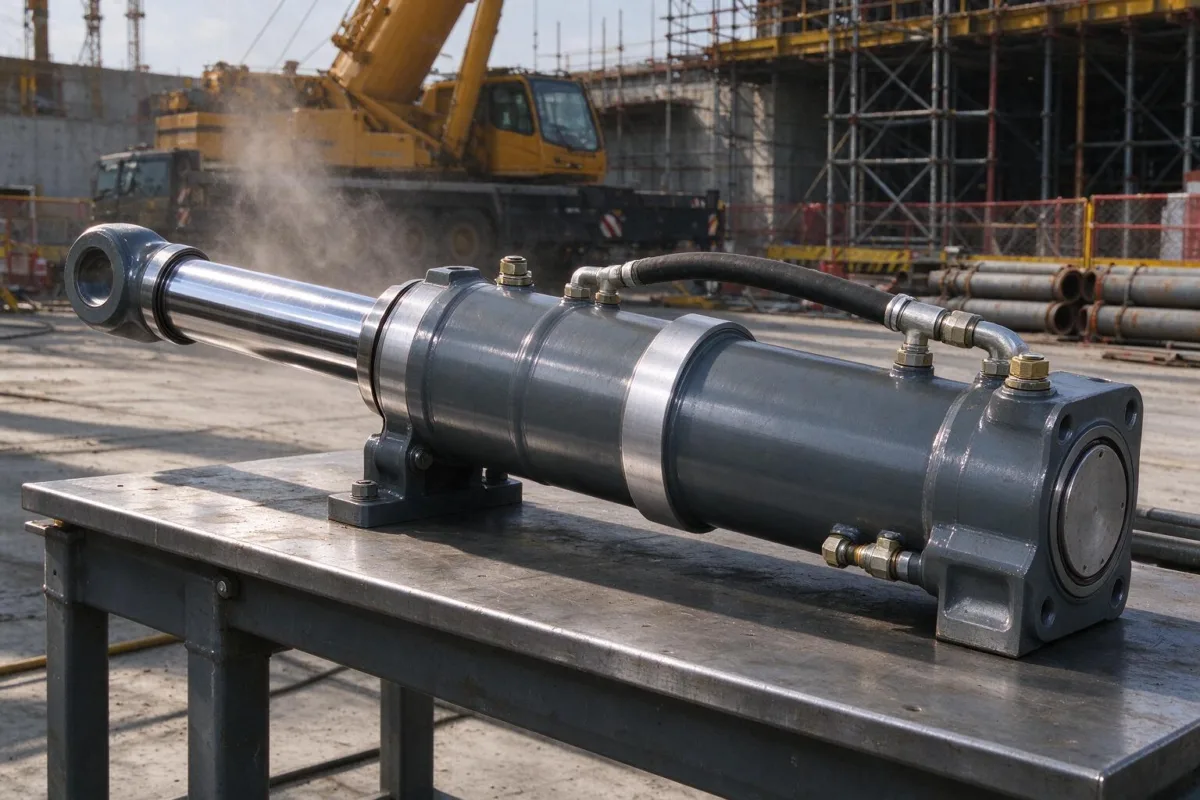
This 25 ton XCMG crane hydraulic cylinder buying guide covers the QY25 series truck crane and its variants, including the QY25K and QY25K5, which form the core of XCMG’s 25 ton lifting class. These machines carry multiple hydraulic cylinders serving distinct functions: boom telescoping, boom luffing, outrigger jacking and extension, counterweight movement, and steering. Cylinder count and configuration differ between variants and production years, so a parts list from one model cannot be assumed to fit another.
Hydraulic Cylinder Identification: Model, Serial Number, and Part Number
Accurate identification starts with the crane’s model plate and serial number. The model plate on a 25 ton XCMG crane states the model series and variant (for example, QY25K, QY25K5, or QY25K5-I), and the serial number ties the unit to a specific production batch. Both are needed before any cylinder part number can be confirmed.
XCMG assigns part numbers to hydraulic cylinders by function and model variant. A QY25K boom luffing cylinder part number will not interchange with a QY25K5 luffing cylinder without verification of mounting dimensions and pressure rating.
The cylinder nameplate or stamped markings on the barrel often include the manufacturer’s part number, bore diameter, stroke, and rated pressure. If the nameplate is missing or illegible, measure the bore, rod diameter, stroke, and mounting pin diameters directly.
Cross-referencing aftermarket cylinders requires matching critical dimensions:
| Parameter | Why It Matters |
|---|---|
| Bore diameter | Determines force output at rated pressure |
| Rod diameter | Affects buckling resistance and retract speed |
| Stroke | Must match full boom travel |
| Closed length | Governs mounting fit between pins |
| Pin hole diameter | Must match mounting pin size |
| Port thread size | Must accept existing hose fittings |
Minor differences in port orientation or rod end thread can prevent installation.
For older 25 ton XCMG cranes, parts catalogs may list superseded part numbers. A supplier should be able to confirm whether a given part number has been replaced and what the current equivalent is. Buyers should request written confirmation of interchangeability before ordering.
Genuine, OEM-Equivalent, and Aftermarket Cylinders: What the Labels Mean
For a 25 ton XCMG crane, the hydraulic cylinder is a load-bearing component, and the label attached to a replacement part carries real technical weight. The three common categories are not interchangeable in origin or in risk.
Genuine XCMG Cylinders
Genuine cylinders are supplied through XCMG’s authorized parts network and carry XCMG packaging and documentation. They serve as the reference standard for fit and function, matching the bore, stroke, mounting geometry, and rod end configuration of the original unit for the relevant model series. The trade-offs are lead time and cost: authorized channel supply can take longer to arrive and prices are typically higher than third-party alternatives.
OEM-Equivalent Cylinders
OEM-equivalent cylinders are produced by third-party manufacturers to match original specifications. Quality varies by supplier, and the label alone does not confirm conformity. Buyers should request dimensional drawings, material certificates for barrel and rod stock, and pressure test reports before ordering. A supplier that provides these documents is easier to qualify than one that does not.
Aftermarket Cylinders
Aftermarket cylinders may be reconditioned original units or new production from independent manufacturers. Reconditioned units should be inspected for barrel wear, rod straightness, and seal quality, since these determine remaining service life. New aftermarket cylinders require verification of bore tolerance, rod surface hardness, and seal compound compatibility with the hydraulic oil in use.
Interpreting the “OEM” Claim
The term “OEM” is sometimes used loosely in the aftermarket. Buyers should ask for the actual manufacturer name and facility location, not just an OEM claim. A supplier that cannot identify the production source is a higher-risk source, regardless of the terminology used in its listing.
Key Inspection Points for a Replacement 25 Ton Crane Cylinder
A replacement hydraulic cylinder for a 25 ton crane (for example, XCMG QY25K series) must be verified against the original specification before installation. The following inspection points apply to boom luffing, telescope, and outrigger cylinders.
Barrel Bore
Check the bore for scoring, ovality, and corrosion. A replacement cylinder should hold a bore tolerance within the original specification, typically H8 or H9 depending on cylinder function. Honed surfaces should show no longitudinal scratches. Measure ovality at several cross-sections along the barrel length.
Piston Rod
Verify chrome plating thickness and surface hardness. Rods on boom luffing and telescope cylinders are exposed to dust and moisture; pitting or flaking chrome indicates inadequate surface treatment. Check rod straightness on a surface plate or V-blocks, with runout measured along the full stroke length.
Seals
Confirm seal compound compatibility with the hydraulic oil specified for the crane. Nitrile (NBR) is common for mineral oil; polyurethane (PU) or PTFE-based seals may be specified for higher pressures or specific temperature ranges. Seal kits should come from a known manufacturer with traceable part numbers.
Mounting Interfaces
Pin hole diameter, pin bore hardness, and rod end thread must match the original. Inspect weld quality on mounting lugs for undercut, porosity, and proper penetration. Perform a pressure test at rated working pressure before installation.
| Check | Acceptance Criterion |
|---|---|
| Bore tolerance | H8 or H9 per function |
| Rod chrome | No pitting or flaking |
| Seal compound | Matches specified oil |
| Pin bore | Matches original diameter and hardness |
| Pressure test | Passed at rated working pressure |
Compatibility Checks Before Purchase
A 25 ton XCMG crane cylinder is not a universal part, even within the QY25 family. Buyers should verify fitment against the specific machine before ordering.
Model and Serial Number Range
Confirm the crane model and serial number range first. A cylinder listed for “QY25” may fit only certain production years. The QY25K and QY25K5 have different boom configurations, and their telescope cylinder arrangements differ. A cylinder that fits a QY25K boom section will not necessarily fit a QY25K5. Serial number breaks within a single model can also mark running changes to pin sizes, mounting flanges, or cylinder bore. Ask the seller for the serial number range the part was built for and compare it with the machine’s plate.
Hydraulic System Pressure
Verify the crane’s main relief valve setting, which determines the cylinder’s rated pressure requirement. A cylinder rated below the system pressure is unsafe and may fail under load. Request the cylinder’s test pressure and rated working pressure in writing. The rated working pressure should meet or exceed the relief setting with margin for pressure spikes.
Port Sizes and Thread Types
Check port sizes and thread types. Metric and BSP threads may appear on different production batches of the same QY25 series model. Adapters can resolve minor thread differences, but port location and angle must allow hose routing without chafing or excessive bending. Confirm port position on the drawing, not just the thread callout.
Multi-Stage Telescope Cylinders
For multi-stage telescope cylinders on QY25K and QY25K5 models, confirm the stage sequence and stroke of each stage. Incorrect stage sequencing can cause boom extension faults or structural damage. Request a stage-by-stage dimensional drawing and compare stroke values against the service manual before purchase.
Supplier Verification and Documentation
Verification for a 25 ton XCMG crane hydraulic cylinder (typically matched to QY25 series or comparable models) should begin with dimensional documentation. Request a drawing for the specific cylinder part number, not a generic catalog page. The drawing should dimension bore, rod diameter, stroke, closed length, mounting pin diameters, port threads, and overall envelope dimensions. These values determine fitment at the boom, outrigger, or steering application, and a supplier unable to produce a part-specific drawing cannot confirm interchangeability.
Material certificates for the barrel tube and piston rod should also be requested. Barrel material is commonly ST52 or an equivalent seamless tube; rod material is often CK45 or 42CrMo, induction hardened and chrome plated. Certificates should trace to the heat number so the mill source and chemistry can be checked against the drawing specification.
Pressure test reports should confirm testing at 1.5 times rated working pressure or per the applicable standard. The report should state test duration and note any observed leakage at seals, ports, or welds.
Warranty terms belong in writing. Acceptable documentation specifies the coverage period, the components covered (seals, rod, barrel), and the claims process. A supplier offering no written warranty, or requiring the buyer to pay return freight on defective units, represents a higher-risk source.
| Document | Key Content |
|---|---|
| Dimensional drawing | Bore, rod diameter, stroke, closed length, pin diameters, port threads, envelope |
| Material certificates | Heat number traceability, ST52 barrel, CK45 or 42CrMo rod |
| Pressure test report | 1.5x rated pressure, duration, leakage observations |
| Warranty | Coverage period, covered components, claims process |
Installation and Commissioning Notes
Proper commissioning of a replacement hydraulic cylinder on a 25 ton XCMG crane protects both the new component and the surrounding circuit. The following steps apply to cylinders used across the QY25 series and comparable 25 ton lifting equipment.
Line Flushing and Fluid Condition
Before installation, flush the hydraulic lines to remove debris introduced during removal or storage. Contamination is a common cause of premature seal failure in replacement cylinders. Replace the return filter at the same time, and check the reservoir for water or particulate; milky or cloudy fluid indicates water ingress and should be addressed before the cylinder is put into service.
Pre-Fill and Air Removal
Where the mounting arrangement allows, fill the cylinder with clean hydraulic oil before connecting the rod end to the load. This reduces the risk of air pockets and cavitation during first operation. Bleed air from the cylinder by cycling it slowly through several full strokes without load, checking that movement is smooth and free of judder.
Mounting Alignment
Check alignment of mounting pins and bushings. Misalignment places side loads on the rod and piston, leading to seal wear and rod scoring. Replace worn bushings before installing a new cylinder rather than reusing them.
Post-Commissioning Checks
After commissioning, monitor for leakage, unusual noise, and rod drift. A cylinder that drifts under load may have internal leakage past the piston seal or a faulty holding valve elsewhere in the circuit. Record operating pressure and cycle time for reference against future performance.
| Check | Interval | Action if Out of Spec |
|---|---|---|
| External leakage | After first 10 cycles, then weekly | Inspect seals and fittings |
| Rod drift under load | At commissioning | Test holding valve and piston seal |
| Operating pressure | At commissioning | Compare to QY25 series specification |
| Cycle time | At commissioning | Log as baseline reference |
Cost Factors and Lead Time Considerations
Cylinder cost varies by function and complexity. On a 25 ton XCMG crane, multi-stage telescope cylinders are typically the most expensive, followed by boom luffing cylinders. Outrigger and steering cylinders are generally lower cost. Aftermarket new cylinders are usually less expensive than genuine XCMG parts, but quality differences affect service life.
Lead time depends on whether the cylinder is stocked, made to order, or reconditioned. Standard single-stage cylinders may be available from stock; multi-stage telescope cylinders often require production lead time of several weeks. Buyers should plan replacement before failure where possible.
Reconditioning an original cylinder can be cost-effective if the barrel and rod are within tolerance. The process includes honing the barrel, re-chroming or replacing the rod, and installing a new seal kit. Reconditioned cylinders should carry a warranty comparable to new aftermarket units.
Shipping cost and duty for cross-border purchases should be included in the total cost comparison. Large cylinders are heavy and may require specialized freight. Buyers should confirm packaging protects the rod and ports during transit.
| Cylinder type | Relative cost | Typical availability |
|---|---|---|
| Multi-stage telescope | Highest | Made to order, several weeks |
| Boom luffing | High | Made to order or stock |
| Outrigger | Lower | Often stocked |
| Steering | Lower | Often stocked |
For 25 ton XCMG models such as the QY25 series, telescope cylinder lead time is the main planning constraint.