
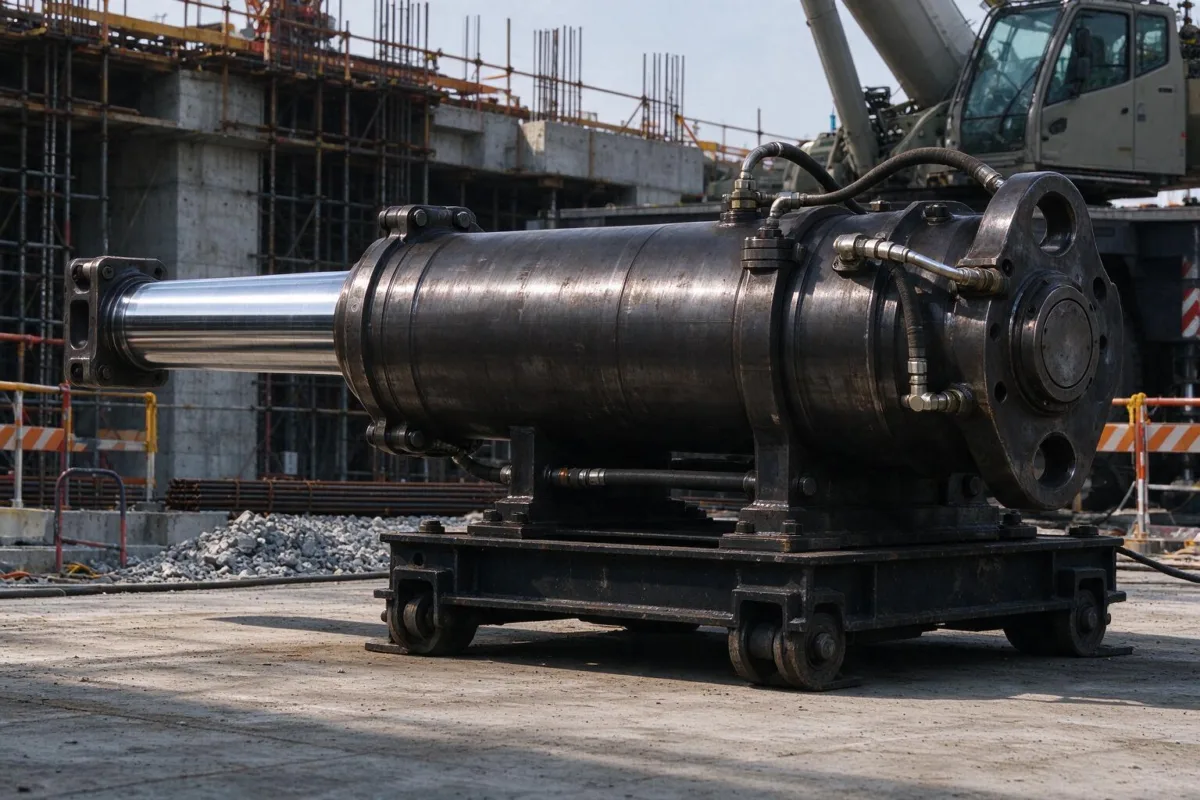
This 80 ton XCMG crane hydraulic cylinder buying guide starts with a point that is easy to miss: the 80 ton class in XCMG’s lineup covers more than one machine architecture. Telescopic truck cranes in the QY80 series, including the QY80K and QY80K5 variants, share the nominal tonnage but differ in boom geometry, counterweight configuration, and the load paths that hydraulic cylinders must carry. Crawler cranes in the same 80 ton bracket use a different structural layout entirely. The exact model series, not the tonnage figure alone, determines which cylinder assembly fits and how it is loaded in service.
Cylinder Positions on an 80 Ton XCMG Crane
An 80 ton XCMG crane carries several distinct hydraulic cylinder groups, and each position has different load, stroke, and duty-cycle requirements. Identifying the correct position before ordering is the first step in avoiding fitment errors.
Boom Lift and Telescopic Cylinders
Main boom lift (luffing) cylinders carry the highest axial loads on the machine and are typically the most expensive single cylinder in the hydraulic system. On QY80K-series truck cranes, telescopic boom extension cylinders operate inside the boom sections. These require precise stroke matching across synchronized cylinders; mismatched stroke causes boom section binding and accelerated wear on wear pads and slide surfaces.
Outrigger and Chassis Cylinders
Outrigger and outrigger jack cylinders operate at lower pressure but see high cycle counts. Seal quality dominates their service life, and seal material selection matters more than cylinder body condition in most rebuild decisions. Counterweight self-assembly cylinders and steering cylinders on the truck crane chassis are frequently mis-ordered because they share visual similarity with cylinders from other XCMG models. Bore, rod diameter, stroke, and mounting clevis dimensions should be verified against the serial-number-specific parts list.
Superlift and Auxiliary Mast Cylinders
Superlift or auxiliary mast cylinders appear on crawler configurations of the 80 ton class and must be matched to the specific boom and mast arrangement. A cylinder from a different mast geometry will not deliver the correct luffing angle or load path.
| Position | Load Characteristic | Ordering Risk |
|---|---|---|
| Main boom lift | Highest axial load | High cost, precision bore matching |
| Telescopic extension | Internal, synchronized stroke | Section binding if stroke mismatched |
| Outrigger / jack | Lower pressure, high cycle | Seal quality drives service life |
| Counterweight / steering | Moderate, chassis-mounted | Visual similarity to other models |
| Superlift / auxiliary mast | Configuration-dependent | Must match boom and mast geometry |
Specifications to Verify Before Ordering
Bore diameter, rod diameter, and stroke are the three primary dimensions for any 80 ton XCMG crane hydraulic cylinder. A mismatch in any one causes either loss of lifting force or mechanical interference. Bore diameter governs force output at a given pressure; rod diameter determines buckling resistance and retraction force; stroke fixes the usable range of boom motion. All three must be confirmed against the OEM drawing before an order is placed.
The working pressure rating must meet or exceed the crane’s rated hydraulic system pressure. For this class of 80 ton crane, system pressure typically falls in the 25–35 MPa range depending on model series. The cylinder’s rated pressure should carry a safety margin per the OEM specification, not merely match nominal system pressure.
Mounting configuration includes pin diameter, eye width, spherical bearing type, and rod-end thread pitch. These details are the most common source of fitment failures in aftermarket purchases, because a cylinder can match on bore and stroke yet fail to install due to a few tenths of a millimeter in eye width or an incorrect thread pitch.
Cushioning position (head-end, rod-end, or both) affects boom deceleration and must match the original design. An incorrectly positioned cushion changes deceleration behavior at end of stroke.
Paint color and external finish are not reliable identifiers. Dimensional verification against the OEM drawing is the only dependable method for confirming fitment.
| Parameter | Verification basis |
|---|---|
| Bore, rod diameter, stroke | OEM drawing dimensions |
| Working pressure rating | Rated system pressure plus OEM safety margin |
| Pin diameter, eye width, bearing type, thread pitch | Mounting interface drawing |
| Cushioning position | Original design specification |
Identifying Genuine Versus Aftermarket Cylinders
Verification of an 80 ton XCMG crane hydraulic cylinder begins with markings. Genuine units carry stamped or laser-etched part numbers on the barrel or end cap, together with serial numbers that allow traceability to the production batch. Aftermarket cylinders frequently omit these markings or reproduce them with incorrect formatting, character spacing, or part-number prefixes that do not match XCMG documentation for the relevant model series.
Weld quality at the barrel-to-end-cap joint is a reliable secondary indicator. Controlled manufacturing produces uniform penetration and a consistent bead profile around the circumference. Porosity, undercut, spatter, or an irregular bead on a new cylinder indicates a less controlled process and a higher risk of fatigue failure under rated load.
The chrome rod surface should be free of pits, spiral grinding marks, and color variation. A dull or mottled finish suggests inadequate hard chrome thickness, which accelerates seal wear and corrosion in service.
Seal kits should be identifiable by brand or material specification. Polyurethane, PTFE-filled, and nitrile seals are selected according to rod or piston position and operating conditions. Unbranded seals with no material designation are a common cost-cutting point and are difficult to match to the original specification.
Each unit should be supplied with the manufacturer’s test certificate recording proof pressure and leakage test results. Absence of this documentation leaves holding capacity and seal integrity unverified before installation.
| Check | Genuine Indicator | Aftermarket Risk Indicator |
|---|---|---|
| Markings | Stamped or laser-etched part and serial numbers | Missing, altered, or inconsistent markings |
| Weld joint | Uniform penetration, consistent bead | Porosity, undercut, irregular bead |
| Chrome rod | Clean finish, no pits or spiral marks | Dull or mottled finish |
| Seals | Branded or material-specified | Unbranded, unspecified |
| Documentation | Proof and leakage test certificate | Certificate not provided |
Seal and Chrome Quality Checks
Rod seals on the boom lift cylinders of 80 ton XCMG crane models (QY80, XCT80, and comparable series) operate in an exposed position. Dust, grit, and UV radiation attack the wiper element continuously, so wiper and scraper design carries as much weight as the primary seal. A robust polyurethane wiper with a defined scraping lip sheds abrasive particles before they reach the main sealing edge; a simple dust ring allows grit to migrate inward and score the rod.
Hard chrome plating thickness on the rod is typically specified in the 20–40 micron range for this duty. Plating below that band accelerates corrosion pitting, and each pit becomes a leak path and an abrasion point against the seal. Plating thickness should be verified by caliper measurement or an eddy-current gauge, not by visual appearance alone.
Barrel internal honing finish directly affects seal life. The cross-hatch pattern and surface roughness (Ra) should be confirmed against the OEM specification; a mirror-polished bore or a coarse, randomly ground bore both shorten seal service life.
Cushioning seals and check valves inside the cylinder are frequently omitted in low-cost rebuilds. Their absence produces boom drift and impact loads at stroke end that stress the rod and gland.
Pressure testing at 1.5 times rated working pressure is a reasonable acceptance criterion for incoming inspection. The test should hold at pressure with no external leakage and no measurable rod drift.
Supplier Vetting for 80 Ton Class Cylinders
Vetting a supplier for 80 ton class boom, outrigger, or lift cylinders requires evidence specific to that load class, not general hydraulic fabrication experience. The pressure, bore, rod diameter, and wall thickness combinations used on 80 ton XCMG chassis (for example, the QY80K and comparable series) differ materially from those on 25 or 50 ton machines, so a supplier’s broader portfolio says little about its capability at this rating.
Key verification points
- Reference list. Request documented supply of 80 ton class cylinders, with crane model series and cylinder position (boom lift, boom telescope, outrigger). Generic hydraulic references should be treated as insufficient.
- Manufacture versus sourcing. Establish whether the supplier machines and assembles in-house or brokers finished units. Ask for dimensional drawings, including bore, rod diameter, stroke, pin centers, and port orientation, for buyer review and sign-off before production begins.
- Warranty structure. Confirm that seal failure and chrome/rod finish defects are covered under terms separate from structural failure (barrel cracking, rod bending, weld failure). Remedies differ: seal and chrome claims are typically handled as rework or reseal, while structural claims involve replacement. A single blanket clause often obscures this.
- Lead time versus downtime. Compare quoted lead time against the daily cost of an idle 80 ton crane. A cheaper cylinder with a 16-week lead time frequently carries a higher total cost than a priced-higher unit delivered in 6 weeks.
- Packaging and preservation. Request shipping details: rod protection (sleeve or crate), port caps, bore preservative, and moisture barrier for sea freight. Unprotected chrome and open ports are common causes of arrival damage and warranty disputes.
| Check | Acceptable evidence |
|---|---|
| 80 ton references | Model series and cylinder position listed |
| Drawings | Signed dimensional drawing before production |
| Warranty | Separate seal/chrome and structural clauses |
| Lead time | Quoted weeks against downtime cost |
| Packaging | Rod sleeve, port caps, preservative specified |
Installation and Commissioning Notes
Correct installation and commissioning of the 80 ton XCMG crane hydraulic cylinder protect both the component and the surrounding circuit. The following steps apply to boom, outrigger, and hoist cylinders on 80 ton XCMG model series, and should be completed before the crane returns to loaded operation.
Air Removal
Bleed air from the cylinder and the hydraulic circuit before any loaded operation. Trapped air compresses under load and releases energy rapidly, producing cavitation that erodes internal surfaces and damages seals. Follow the OEM bleed procedure at the highest point of the circuit and repeat until the return flow is free of visible aeration.
Mounting Point Checks
Verify pin and bushing clearance at both mounting points against the OEM tolerance. Worn bushings allow the cylinder to sit off-axis, misaligning the bore and loading the rod seal unevenly. Replace bushings that exceed clearance limits before the cylinder is pinned in place.
Fastener Torque
Torque all fasteners to the OEM specification using a calibrated wrench. Fit new lock plates where specified, and apply thread-locking compound only to the fasteners and grades the OEM procedure identifies.
Low-Pressure Cycling
Run a low-pressure cycle through the full stroke several times, then inspect the rod, gland, and port connections for leakage and listen for abnormal noise. Resolve any finding before the crane is returned to service.
Documentation
Record the installed cylinder’s serial number and installation date in the maintenance log. This record supports seal replacement intervals and future maintenance planning for the 80 ton XCMG fleet.
Common Buying Mistakes to Avoid
Hydraulic cylinder sourcing for 80 ton XCMG cranes involves several recurring errors that lead to fitment failures, downtime, and unplanned rework. Most stem from incomplete identification or skipped verification.
Ordering by tonnage alone. An 80 ton rating does not define a single cylinder configuration. XCMG 80 ton platforms span multiple model series and production years, and bore, stroke, rod diameter, mounting pattern, and port placement can differ between them. Buyers should confirm the exact model series and production year, and cross-reference the crane’s parts manual or cylinder tag, before ordering. A cylinder correct for one 80 ton series may not fit another.
Assuming truck crane and crawler crane cylinders are interchangeable. Cylinders of similar physical size from an 80 ton truck crane and an 80 ton crawler crane are generally not interchangeable. Mounting geometry, load paths, rod-end designs, and duty cycles differ between the two crane types. Interchangeability must be verified against part numbers, not dimensions alone.
Accepting paint color or external appearance as proof of fitment. Cosmetic similarity, including paint color and external profile, is not evidence of correct specification. Internal bore, seal arrangement, and mounting dimensions determine fitment.
Overlooking cushioning and internal check valve configuration. Cushioning at stroke ends and internal check valve layout directly affect boom control and load drift. A cylinder that fits mechanically but lacks the correct cushioning or check valve arrangement can cause erratic boom motion or drift under load.
Skipping incoming inspection. Foregoing pressure testing and dimensional inspection to save time shifts risk to the installation phase, where a non-conforming cylinder is more costly to correct. Incoming checks on bore, stroke, rod diameter, mounting centers, and pressure integrity should be standard.
| Mistake | Consequence | Verification step |
|---|---|---|
| Tonnage-only ordering | Wrong bore, stroke, or mounting | Confirm model series and year |
| Assuming truck/crawler interchange | Fitment failure | Match part numbers |
| Relying on paint or appearance | Hidden dimensional mismatch | Measure critical dimensions |
| Ignoring cushioning/check valves | Boom drift, poor control | Verify internal configuration |
| Skipping incoming inspection | Risk shifts to installation | Pressure and dimensional test |