
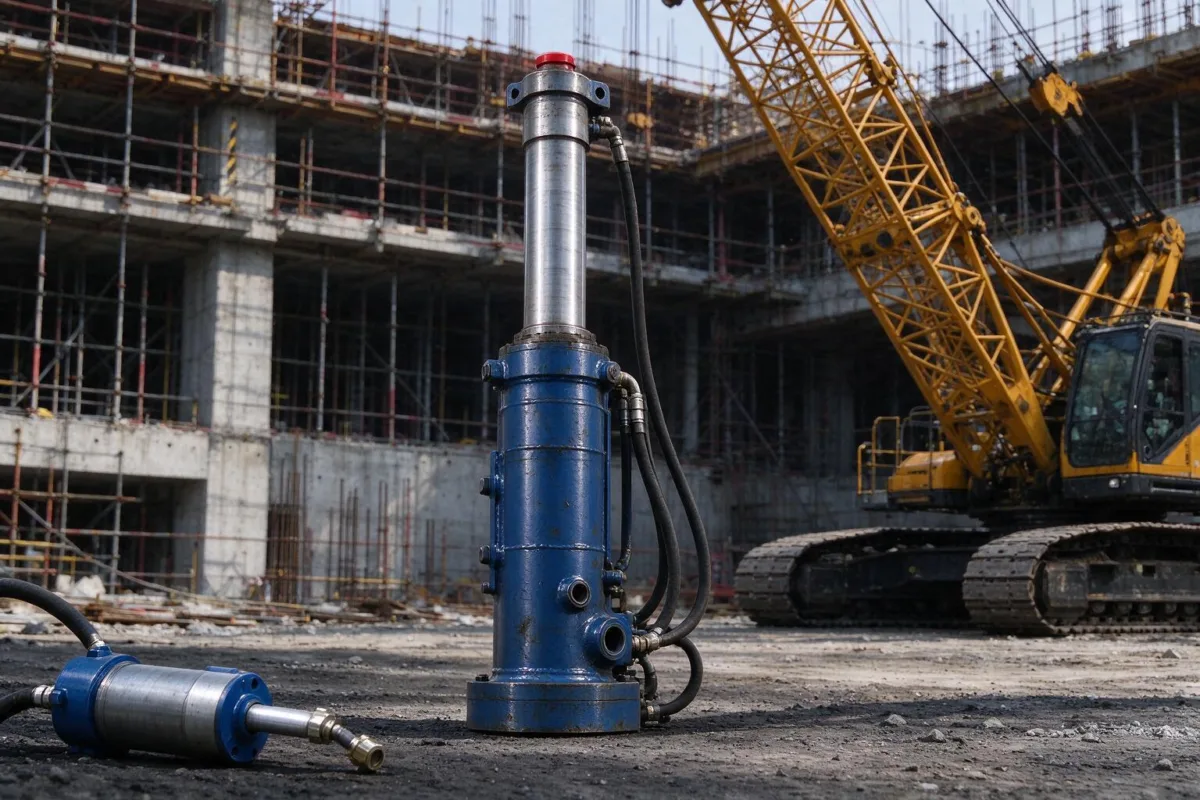
This XCMG crawler crane hydraulic cylinder buying guide begins with the circuit differences that matter most: crawler crane hydraulic systems differ from truck crane circuits in both duty cycle and pressure profile. Boom luffing, mast erection, counterweight handling, and track tension functions on a crawler crane operate at higher sustained pressures and slower cycle rates than the corresponding truck crane functions. The slower cycle rate is not a limitation to be designed around; it reflects the load-holding role of these circuits, where cylinders spend long periods under static or near-static load rather than cycling rapidly.
XCMG Crawler Crane Model Coverage and Cylinder Families
The XCMG QUY series of lattice-boom crawler cranes spans roughly 50 t to 650 t lifting capacity. Hydraulic cylinder part numbers are not interchangeable across tonnage classes, even where bore and rod diameters appear similar. Mounting geometry, stroke, rod-end thread, and pin diameter all vary by class, so a cylinder listed for one capacity range should not be substituted into another without dimensional verification against the machine’s parts book.
Cylinder families track the tonnage class:
- QUY50, QUY75, and QUY100 class: single luffing cylinder per machine, with smaller bore and shorter stroke than the 200 t and above machines.
- QUY200 to QUY400 class: typically twin luffing cylinders, plus separate mast erection cylinders and counterweight self-assembly cylinders. These are separate part families with their own seals and rod assemblies.
- QUY650 and larger: add superlift mast cylinders. Superlift components are a distinct part family and are rarely stocked as aftermarket items, so lead times are longer and cores are seldom available.
| Model class | Luffing arrangement | Additional cylinder families |
|---|---|---|
| QUY50–QUY100 | Single luffing cylinder | None typical |
| QUY200–QUY400 | Twin luffing cylinders | Mast erection, counterweight self-assembly |
| QUY650 and above | Twin luffing cylinders | Mast erection, counterweight self-assembly, superlift mast |
Model suffixes matter. Cylinder mounting clevis dimensions changed between revisions, so QUY150A and QUY150C cylinders are not necessarily interchangeable. Buyers should confirm the exact suffix and serial number break before ordering.
Specifications to Verify Before Ordering
Bore diameter, rod diameter, and stroke are the three primary dimensions on any XCMG crawler crane hydraulic cylinder order. Stroke deserves particular attention: a 10 mm stroke error will prevent full boom elevation before the cylinder bottoms out, which can damage the rod, gland, and structural stops. Measure stroke from the original unit or confirm it against the parts book for the specific model series, such as the QUY50, QUY75, or QUY150.
Working pressure rating and test pressure should match the original circuit. Luffing circuits commonly operate in the 25 to 35 MPa range, and replacement cylinders should be rated above the circuit relief setting, not merely at nominal working pressure. Request the test pressure figure and the relief valve setting for the machine before ordering.
Mounting geometry includes clevis pin diameter, pin center distance at retracted and extended positions, and rod-end thread specification. A cylinder that matches on bore and stroke can still fail to install if any of these dimensions differ.
Cushioning at both ends is standard on luffing cylinders. Confirm whether the original unit used fixed or adjustable cushioning, since the two are not interchangeable in terms of setup and deceleration behavior.
Port size and position (SAE or metric, axial or radial) affect hose routing and must match the machine’s existing lines. Verify thread type, port diameter, and angular orientation relative to the mounting clevis.
| Parameter | What to Confirm |
|---|---|
| Bore / rod / stroke | Exact figures from parts book or measurement |
| Pressure rating | Above circuit relief setting (25–35 MPa luffing range) |
| Mounting geometry | Pin diameter, center distances, rod-end thread |
| Cushioning | Fixed or adjustable, both ends |
| Ports | SAE or metric, axial or radial, size and position |
Seal Kits, Rod Chrome, and Material Specifications
Rod chrome plating on XCMG crawler crane hydraulic cylinders typically measures 20 to 40 microns. Plating at the lower end of this range is common on economy rebuilds and wears through faster, exposing the base steel to corrosion pitting. Pitting along the rod damages the wiper and main seals with every stroke, so buyers sourcing cylinders for coastal or high-humidity sites should confirm plating thickness and specify the upper end of the range where duty is severe. Hard chrome thickness can be checked with an eddy-current gauge or by micrometer comparison against an unplated section.
Seal sets should name the compound for each position. Nitrile (NBR) or polyurethane (PU) is standard for rod wipers and main rod seals; PU offers better abrasion resistance, while NBR suits moderate duty and wider temperature bands. PTFE-filled guide rings are common on high-load luffing cylinders, such as those on the 150-tonne class XGC series, where side loads are significant.
Barrels are usually seamless honed tube. The cross-hatch pattern and surface roughness (Ra) directly affect seal life, and both should be verified on remanufactured units rather than assumed from the original specification.
Gland construction matters for serviceability. Welded glands are cheaper but require cutting and rewelding to reseal; threaded glands allow field resealing with the cylinder in place. For machines in remote locations, threaded glands reduce downtime.
For operation below -20 C, request material certificates for rod and tube stock to confirm low-temperature Charpy impact values.
Identifying Genuine XCMG Parts and Counterfeit Risk
Genuine XCMG hydraulic cylinders carry a part number plate that must match the parts catalog entry for the specific machine. Buyers should cross-check the plate number against the model and serial number range, not just the model name, because cylinder specifications change across production runs. A number that is valid for one serial range may not apply to another machine of the same nominal model.
Counterfeit units frequently reuse genuine part numbers on castings made from different alloy compositions. Requesting hardness and material test reports is the practical way to verify the metallurgy behind the number. Paint color and decals are unreliable indicators, since counterfeiters replicate livery accurately; documentation outweighs appearance in every case.
Weld quality at the rod eye and port bosses provides a further check. Porosity and undercut welds indicate low-grade fabrication regardless of labeling, and these defects are visible before installation. Inspection should cover the full weld circumference rather than a single side.
Seal kits add another layer of risk. Genuine kits are often packaged with lot codes traceable to the supplier, while unbranded bagged seals are a common substitution in counterfeit kits. The table below summarizes the verification points.
| Check point | Genuine indicator | Counterfeit risk |
|---|---|---|
| Part number plate | Matches catalog entry for model and serial range | Genuine number reused on castings with different alloy |
| Material documentation | Hardness and material test reports available | Reports withheld or inconsistent |
| Weld quality at rod eye and port bosses | Consistent penetration, no undercut | Porosity and undercut welds |
| Seal kit packaging | Lot codes traceable to supplier | Unbranded bagged seals |
Inspection Checklist on Delivery
Replacement hydraulic cylinders for XCMG crawler cranes should be inspected against the purchase specification before any installation work begins. The checks below apply across model series, from the 55-tonne XGC55 to the 650-tonne XGC650, though dimensional tolerances tighten on larger bore cylinders used in main boom and luffing hoist circuits.
Dimensional Verification
Measure bore diameter, rod diameter, and stroke with calibrated calipers or an internal micrometer and compare each value to the purchase specification. Stroke should be checked with the rod fully extended against a reference datum. A cylinder that deviates from specified bore or rod diameter will alter force output and rod buckling margins, particularly on long-stroke boom luffing cylinders where rod slenderness is already a design constraint.
Rod Surface Condition
Inspect the full chrome-plated rod surface for flaking, scoring, pitting, or handling damage such as dings from lifting equipment. Any visible defect on the sealing surface warrants rejection before mounting. A damaged rod will destroy the rod seal within a short operating period and introduce contamination into the hydraulic circuit.
Pressure Test
Pressure-test the assembled cylinder at 1.5 times rated working pressure for a minimum of 10 minutes. Hold pressure steady and inspect the gland area, port fittings, and rod seal for external leakage. A pressure drop on the test gauge without visible external leakage indicates internal bypass past the piston seal and should be investigated before acceptance.
Pin Bores and Clevis Alignment
Confirm pin bore diameters at both the rod end and cap end with calipers, and check clevis alignment against the mating boom or superstructure brackets. Misalignment introduces side loading on the rod and gland, which accelerates seal wear and can score the rod.
Documentation
Record cylinder serial numbers, dimensional readings, and pressure-test results in the machine maintenance file. This record supports warranty claims and provides a baseline for future condition monitoring.
Sourcing Channels and Commercial Considerations
Authorized XCMG parts channels offer the strongest traceability, with documentation linking each cylinder to its production batch and original specification. The trade-off is lead time: large luffing cylinders for models such as the XGC series or the QUY150 can take several weeks to arrive, particularly when the unit is built to order. Buyers should align orders with scheduled maintenance windows rather than assume off-the-shelf availability, and should confirm the expected delivery date in writing before committing to a shutdown schedule.
Independent hydraulic cylinder manufacturers can produce to drawing for older models where OEM supply has ended, including earlier QUY series units. This route requires a complete dimensional drawing set and material certificates for barrel, rod, and end fittings; without these, dimensional and metallurgical conformity cannot be verified.
Remanufactured cylinders are viable for non-critical circuits such as track tension adjustment, where failure consequences are limited. They are generally not recommended for luffing service on cranes above 100 t, since remanufactured barrels and rods may not retain the fatigue margin required for high-load duty.
Freight for large cylinders requires crating with dedicated rod protection to prevent bending and surface damage in transit. Shipping terms should explicitly cover handling damage, with inspection at delivery.
Warranty terms should specify hours of operation and pressure limits, since crane duty cycles vary widely by application and a warranty tied only to calendar time offers limited protection.
| Channel | Traceability | Typical Lead Time | Best Suited To |
|---|---|---|---|
| Authorized XCMG parts | High | Several weeks for large luffing cylinders | Current-production models, critical circuits |
| Independent manufacturer to drawing | Medium, drawing-dependent | Varies by shop capacity | Older models with ended OEM supply |
| Remanufactured | Low to medium | Short | Non-critical circuits such as track tension |
Maintenance Practice That Extends Cylinder Life
Crawler crane hydraulic cylinders on luffing, boom hoist, and outrigger circuits are exposed to high duty cycles and, on site, to abrasive and corrosive conditions. A small number of routine practices materially extend service life and defer full cylinder removal.
Replace rod wiper seals early. The wiper is the first barrier against dirt ingress. A worn or damaged wiper allows grit to pass along the rod and reach the main rod seal. Wiper failure typically precedes main seal damage, so replacing the wiper at the first sign of dirt ingress (visible contamination at the rod gland, a damp film, or scoring on the rod) is done in situ and avoids a full cylinder removal. On larger luffing cylinders used in the 100–300 tonne class (for example, the XCMG XGC series), this simple step is the single most cost-effective maintenance action.
Control oil cleanliness. Particulate contamination is the leading cause of rod scoring on crawler crane luffing circuits. Oil cleanliness should be monitored against ISO 4406 targets, and filtration and oil changes scheduled accordingly. Sampling at defined intervals gives a trend rather than a single reading.
| Practice | Interval | Primary benefit |
|---|---|---|
| Wiper seal inspection/replacement | At first sign of ingress | Prevents main seal damage |
| Oil cleanliness check (ISO 4406) | Scheduled sampling | Limits rod scoring |
| Chrome inspection | Annually (coastal/chemical) | Detects pitting early |
| Spare cylinder storage check | On receipt and periodically | Preserves seals and bore |
Store spares correctly. Spare cylinders should be stored horizontally with the rod retracted and ports capped. This prevents corrosion of the chrome and avoids seal compression set on the rod seal.
Inspect chrome annually. On machines working near coastal or chemical sites, chrome should be inspected annually for pitting. Re-chroming before pitting reaches the base metal avoids substrate corrosion and costly rod replacement.