
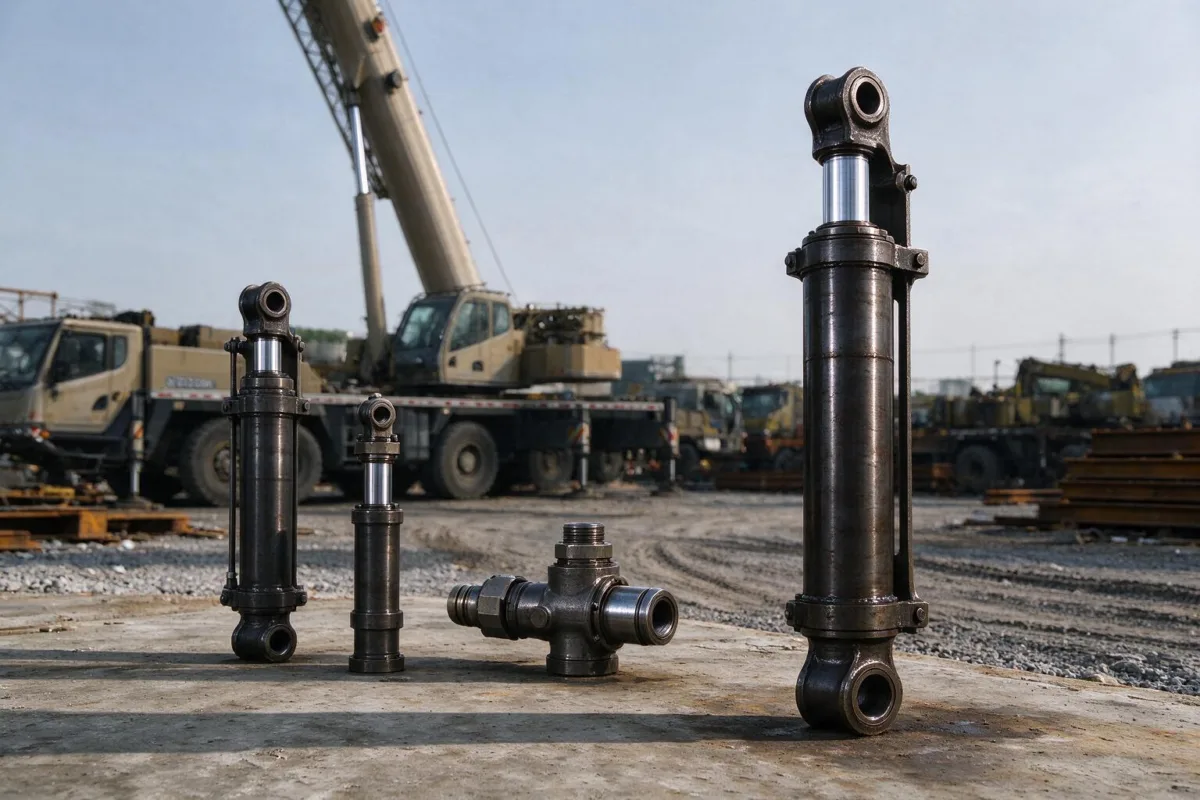
This comparison addresses XCMG QY25K hydraulic cylinder model compatibility for the 25-ton truck crane in XCMG’s QY series of automotive cranes. Because the QY25K uses cylinders across several circuits, including boom telescoping, boom luffing, outrigger extension and jacking, and steering, XCMG QY25K hydraulic cylinder model compatibility must be assessed by function rather than by treating all cylinders as a single interchangeable group. Each circuit imposes different dimensional and pressure requirements, so the comparison organizes cylinders according to the circuit they serve. Evaluation criteria are limited to characteristics that can be checked against a physical part or a published reference, including dimensional match, mounting interface, pressure rating, and seal configuration.
Hydraulic Cylinder Positions on the QY25K
The XCMG QY25K, a 25-ton truck crane in the QY series, uses hydraulic cylinders across several distinct functions: boom luffing (derrick), boom telescoping, outrigger extension and jacking, and steering or stabilizer assist where fitted. Each position carries its own load profile, mounting geometry, and bore/stroke specification, which is why position identification is the first step in any compatibility assessment.
The luffing cylinder operates at high continuous pressure, holding and raising the boom under varying radius and load conditions. Outrigger jacking cylinders, by contrast, see primarily static holding loads once the crane is leveled, with extension cylinders handling horizontal deployment at lower pressure. Steering or stabilizer assist cylinders, where fitted, work at intermittent low-to-moderate pressure.
Telescoping cylinders on the QY25K are typically multi-stage and are the least interchangeable across models. Their stage sequencing, stroke lengths, and internal sealing arrangements are specific to the boom section design, and a telescoping cylinder from another QY series model will rarely match without verification.
| Position | Load Characteristic | Interchangeability |
|---|---|---|
| Boom luffing (derrick) | High continuous pressure | Low across models |
| Boom telescoping | Multi-stage, sequenced | Lowest across models |
| Outrigger extension | Lower pressure, horizontal | Moderate |
| Outrigger jacking | Static holding load | Moderate |
| Steering/stabilizer assist | Intermittent, low-to-moderate | Varies by fitment |
A cylinder that fits one function will not fit another. Bore, stroke, rod diameter, pin mounting, and port orientation differ between positions, so cross-referencing must begin with the exact position on the 25-ton QY25K before any part number comparison.
OEM Part Reference and Serial Breaks
XCMG assigns part numbers at the assembly level, and those numbers change with each design revision. A hydraulic cylinder for the QY25K is therefore identified by an assembly number tied to a specific production configuration, not by a single number covering the whole model run. The QY25K (25-tonne class, K series) has passed through multiple production revisions, and cylinder mounting details—pin diameters, rod-end clevis dimensions, base-end lug spacing, and port orientation—have changed between them. Two cylinders that appear interchangeable by model name may differ in ways that affect fit and load path.
Serial number ranges are the most reliable identifier. XCMG production records map serial breaks to the revision in effect at the time of build, so a unit’s serial number narrows the correct OEM cylinder variant more precisely than the model designation alone. Where a machine sits near a break point, confirming the break against the crane’s parts manual is advisable before ordering.
Part numbers stamped on the cylinder barrel or shown on the nameplate should be cross-checked against the crane’s parts manual rather than matched by model name. Barrel markings can reflect a replacement cylinder fitted after delivery, and nameplate data may correspond to a superseded revision. The parts manual entry for the specific serial range resolves the ambiguity.
OEM cylinders are supplied through XCMG’s authorized parts channels. Independent suppliers typically offer equivalents built to matching dimensions and pressure ratings rather than OEM units; buyers should confirm that an equivalent is referenced to the correct assembly number and serial break for the QY25K unit in question.
Comparison of Aftermarket and OEM Fitment
Aftermarket hydraulic cylinders for the XCMG QY25K (25-tonne QY series) vary widely in how closely they reproduce OEM mounting dimensions. Pin bore diameter and clevis width are the most common mismatch points. A cylinder that is dimensionally close but not exact can introduce pin play, uneven load distribution across the clevis ears, or interference during installation. Buyers should compare these dimensions against the OEM drawing for the specific position rather than against a generic QY25K listing, since mounting geometry differs between boom, luffing, outrigger, and steering positions.
Pressure rating should meet or exceed the OEM specification for the specific position. Luffing cylinders on the QY25K generally require higher ratings than outrigger units because they carry continuous boom loads and see higher dynamic pressure peaks during lift and swing operations. An outrigger-rated cylinder substituted into a luffing position is a fitment risk regardless of dimensional similarity.
Seal kits and rod surface finish affect service life. Chrome thickness and hardness are useful comparison metrics where suppliers publish them; where they are not published, that absence is itself informative.
Warranty terms and documentation of dimensional compliance differ substantially between suppliers. Written confirmation of pin bore, clevis width, stroke, and pressure rating against the OEM specification should be requested before purchase, along with the warranty period and what it covers.
| Comparison point | What to request in writing |
|---|---|
| Pin bore and clevis width | Measured values against OEM drawing |
| Pressure rating | Rated pressure by position (luffing vs. outrigger) |
| Rod finish | Chrome thickness and hardness |
| Warranty | Term, coverage, and exclusions |
Cross-Model Compatibility Within the QY Series
Hydraulic cylinder interchangeability within the XCMG QY series is partial and depends on the cylinder’s function and the tonnage class of the crane. Among the 25-ton QY variants, certain auxiliary circuits are commonly shared. Outrigger cylinders and steering cylinders are the most likely candidates for cross-model use, because their bore, stroke, and mounting interfaces are often standardized across machines built on similar carrier platforms. Even here, verification against the specific parts catalog for each model is required, since running changes during production can alter rod ends, pin diameters, or port orientation.
Boom luffing and telescoping cylinders are generally model-specific. Boom geometry, section profiles, and load ratings differ between the QY25K and adjacent 25-ton models, and these differences propagate into cylinder stroke, mounting geometry, and rod buckling margins. A cylinder that physically fits may still be unsuitable if its design pressure or rod configuration does not match the boom’s load envelope.
Cross-model substitution should only be considered where bore, stroke, and mounting dimensions match exactly and the pressure rating is confirmed against the target machine’s relief valve setting and rated working pressure. Dimensional similarity alone is not sufficient evidence of compatibility.
Series membership is not a basis for assuming compatibility across tonnage classes. The QY25K should not be treated as interchangeable with larger QY models such as the QY50K; the 50-ton QY platform uses different boom sections, higher circuit pressures, and larger cylinder envelopes. Any substitution across these classes requires full dimensional and pressure verification, and in most cases the correct part is the model-specific cylinder.
Fitment Verification Checklist
Hydraulic cylinder replacement on the XCMG QY25K (25-tonne class, QY series) requires dimensional and specification confirmation before any order is placed. The following checks reduce the risk of a non-fitting unit and subsequent downtime.
Dimensional Verification
Measure the bore, rod diameter, and stroke of the original cylinder and compare them against the replacement unit’s published data. These three values define the cylinder’s displacement and force output; a mismatch in any one of them will affect lifting performance and mounting geometry. Measurements should be taken with calibrated instruments on a cleaned, fully retracted and extended cylinder.
Mounting Interface
Record pin diameters at both the rod-end and barrel-end eyes, along with clevis or flange dimensions where applicable. Note the position of all hydraulic ports relative to the mounting datum, and identify thread sizes and types (metric, BSPP, or SAE) at each port. Port orientation errors are a common cause of hose rework during installation.
Pressure Rating
Confirm the cylinder’s rated working pressure and test pressure against the QY25K crane’s hydraulic system specification. The replacement must meet or exceed the system’s maximum operating pressure, and the test pressure rating should align with the verification standard applied to the original component.
Part Number Confirmation
Cross-check the candidate part number against the serial-specific parts list for the exact QY25K unit in question. XCMG production changes across the QY25K build mean that parts lists are tied to machine serial numbers, and a part number valid for one production batch may not apply to another.
| Check | Data Recorded | Source |
|---|---|---|
| Bore, rod diameter, stroke | Measured values | Original cylinder |
| Pin diameters, clevis/flange, ports | Dimensions and thread sizes | Original cylinder |
| Rated and test pressure | Pressure figures | Crane hydraulic spec |
| Part number | Serial-specific number | QY25K parts list |
Common Compatibility Pitfalls
Selecting a hydraulic cylinder for the XCMG QY25K (25-tonne class) by crane model name alone is a frequent source of error. The QY25K designation spans multiple production batches, and cylinder part numbers can differ by serial number range even where the crane model and nominal tonnage are identical. Without serial verification against the parts listing, buyers may receive a cylinder with correct mounting centres but incorrect bore, rod diameter, or stroke for their specific build. Serial-level confirmation is the only reliable basis for selection.
Port thread standards present a second common mismatch. Cylinders that appear dimensionally identical may use metric ports on one variant and another thread standard on another. When port threads differ, installation stalls even though the main dimensions match, and adapters are not always available or approved. Port specification should be confirmed before ordering, not on receipt.
Cushioning and end-of-stroke damping are frequently omitted in aftermarket units. On the QY25K boom circuit, these features govern deceleration at stroke limits and affect boom control and load stability. A cylinder without them may fit and function but alter machine behaviour under load.
Paint colour and external markings are not reliable indicators of dimensional compatibility. Cosmetic differences between production runs do not correlate with bore, stroke, or port configuration, and identical paint can conceal incompatible internals. Dimensional verification against the serial-specific specification remains the governing check.
| Pitfall | Consequence | Verification step |
|---|---|---|
| Model-name-only matching | Wrong bore, rod, or stroke | Confirm by serial number |
| Port thread mismatch | Installation delay | Check thread standard pre-order |
| Missing cushioning | Altered boom control | Confirm damping features |
| Paint/marking comparison | False compatibility signal | Measure against specification |
Summary of Selection Guidance
For the QY25K 25-ton truck crane, serial-specific OEM references remain the most reliable basis for hydraulic cylinder selection. XCMG produced the QY25K across multiple build series, and cylinder part numbers, bore sizes, rod diameters, and mounting configurations can differ between serial ranges even where the nominal model designation is unchanged. Buyers should obtain the machine serial number and match it against the original parts documentation before evaluating any alternative.
Aftermarket equivalents can be viable where dimensional and pressure data are documented and verified against the original. A usable equivalent requires confirmed bore and rod diameter, stroke length, mounting center distance, pin diameter, port size and position, and rated working pressure. Where a supplier cannot provide these values in writing, the cylinder should not be treated as a drop-in replacement.
Cross-model sharing is limited mainly to auxiliary functions. Outrigger, steering, and certain lift-function cylinders may interchange across nearby XCMG crane models in some configurations, but boom cylinders should be treated as model-specific. Boom geometry, load-holding requirements, and rod buckling margins on the QY25K 25-ton crane differ from those of other capacities, and substituting a boom cylinder from a different model series is not advised without engineering review.
Buyers should request dimensional drawings and pressure ratings before committing to any replacement cylinder. A drawing review against the removed unit, combined with the serial-specific reference, provides the most dependable basis for confirming fit and function.
| Check | Requirement before order |
|---|---|
| OEM reference | Matched to machine serial number |
| Dimensions | Bore, rod, stroke, mounting centers, pin sizes |
| Pressure | Rated working pressure stated in writing |
| Ports | Size and position confirmed against original |
| Application | Boom cylinders treated as model-specific |