
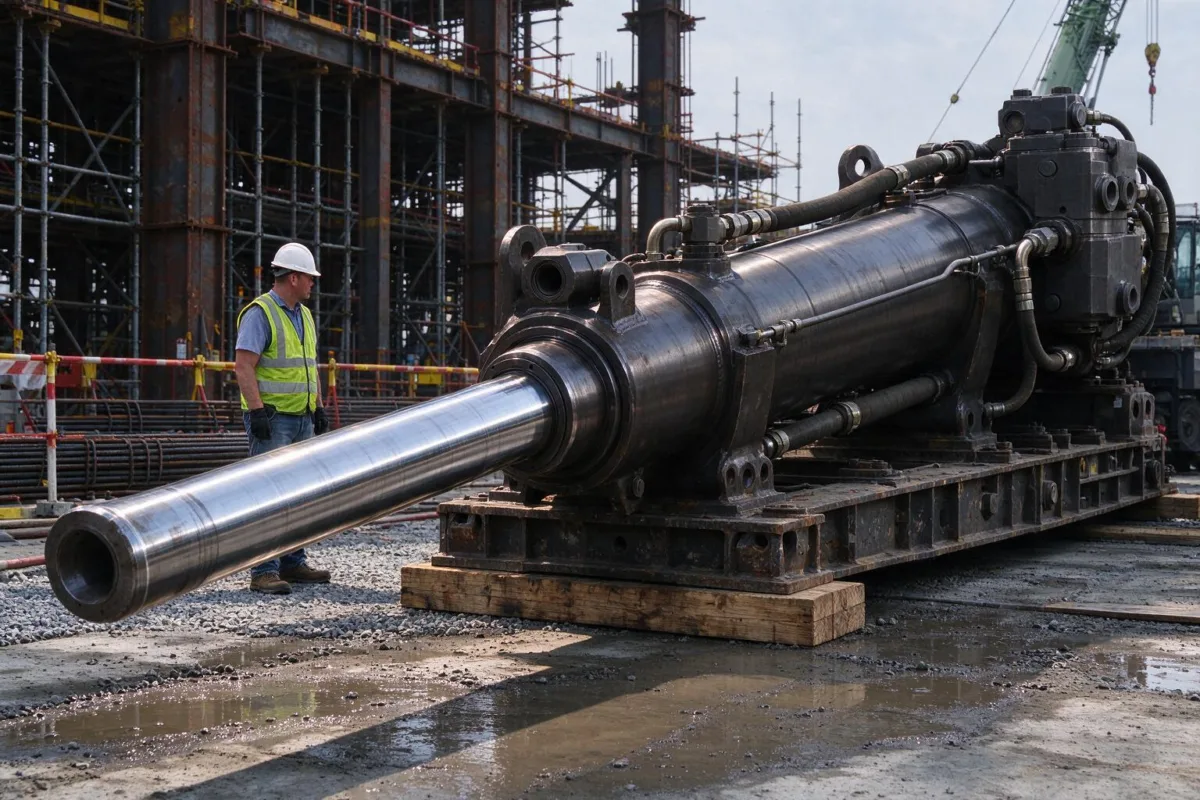
This 100 ton XCMG crane hydraulic cylinder buying guide begins with fitment, because the 100 ton lifting class spans several XCMG product families. Cylinder fitment depends on chassis type and boom configuration rather than tonnage alone, and a cylinder listed for a 100 ton crane will not necessarily fit every machine in that class. Truck crane platforms in this range include the QY100K and QY100K-I. On these carriers, the main boom lift, boom telescope, outrigger, and steering cylinders operate at different pressure and stroke ratings, so each circuit requires its own part number. The outrigger cylinders, for example, are rated for holding loads at the jack pad, while the telescope cylinder is sized around boom section extension length.
Cylinder Positions and Their Duty Profiles on a 100 Ton Crane
A 100 ton crane such as the XCMG QY100K or QY100K-I carries a hydraulic package in which each cylinder position has a distinct duty profile. Matching replacement cylinders to that profile matters more than matching catalogue dimensions alone.
Boom Lift Cylinders
Boom lift cylinders carry the highest continuous load in the system, holding the boom and suspended load through the full lift range. They are typically the largest bore units in the hydraulic package and see sustained pressure during travel and pick-and-carry work. Bore size, rod chrome integrity, and piston seal condition are the primary inspection points.
Boom Telescope Cylinders
Telescope cylinders operate with long stroke and are sensitive to rod buckling under compressive load. Rod diameter and chrome condition therefore matter more than bore size. Scoring, pitting, or flaking on the rod surface accelerates seal wear and can compromise buckling resistance on a fully extended section.
Outrigger and Jack Cylinders
Outrigger and jack cylinders are high-pressure, short-stroke units. Seal selection directly affects settling behaviour under load; a cylinder that bleeds down slowly is a load-holding concern, not merely a leak.
Steering and Suspension Cylinders
On wheeled 100 ton units, steering and suspension cylinders run at lower pressure but require precise bore tolerance to avoid drift and uneven steering response.
Counterweight Removal and Mast Cylinders
On crawler 100 ton units, counterweight removal and mast cylinders are intermittent-duty but must hold load safely during assembly and disassembly operations.
| Position | Duty | Key Specification |
|---|---|---|
| Boom lift | Continuous, highest load | Largest bore, seal integrity |
| Boom telescope | Long stroke | Rod diameter, chrome condition |
| Outrigger/jack | High pressure, short stroke | Seal selection, load holding |
| Steering/suspension | Lower pressure | Bore tolerance, drift control |
| Counterweight/mast | Intermittent | Safe load holding |
Reading the Nameplate and Part Number Before Purchase
On a 100 ton XCMG crane, the hydraulic cylinder nameplate is the first document to capture. Plates on QY100K and QY100K-I series cylinders typically list the model code, bore, rod diameter, stroke, rated pressure, and serial number. Photograph every field, including the plate edges and any stamped suffixes, before cross-referencing the number against a parts book. Partial readings are a common source of wrong orders.
Part numbers are machine-specific and are revised across production years. A number taken from an early QY100K may not fit a later QY100K-I, even where the cylinder performs the same function. Where the nameplate is missing, casting and forging marks on the barrel and gland can confirm the original supplier and narrow the production period.
If the plate is illegible, measure the bore, rod diameter, pin-to-pin closed length, and stroke, and record the mounting eye or flange dimensions. These values allow a supplier to match a cylinder against XCMG build records rather than a single part number.
| Field | Purpose |
|---|---|
| Model code | Identifies cylinder position and series |
| Bore and rod diameter | Confirms hydraulic capacity |
| Stroke and closed length | Confirms mounting geometry |
| Rated pressure | Confirms duty rating |
| Serial number | Ties unit to build year |
Request the machine serial number and build year from the seller to confirm the correct parts book revision before purchase.
Specification Matching: Bore, Rod, Stroke, and Pressure
Matching a replacement hydraulic cylinder for a 100 ton XCMG crane requires confirming every interface dimension and pressure rating against the machine, not against a generic catalog listing. The rated working pressure of the cylinder must meet or exceed the main hydraulic relief valve setting on the carrier or upper structure. A cylinder rated below that relief setting is a safety issue rather than a cost saving, since relief pressure spikes can exceed nominal system pressure during boom lift and luffing operations.
Rod surface hardness and chrome thickness directly affect seal life on boom lift cylinders exposed to dust and moisture. Hard-chrome plating in the 20 to 30 micron range on a hardened, ground rod limits pitting and abrasion that shorten wiper and rod seal service life.
The original design should be confirmed as single-acting or double-acting, and the end cap checked for integrated cushioning. Cushioning controls deceleration at stroke ends and affects structural loads on the boom.
Port size and thread standard must match the machine. Mismatched ports require adapters that alter flow characteristics and increase pressure drop.
Finally, verify pin diameter, eye width, and grease point locations against the mounting bracket. A cylinder that pins incorrectly or omits grease access points will accelerate bushing wear.
| Parameter | Verification point |
|---|---|
| Rated pressure | Equal to or above main relief setting |
| Rod finish | Hardness and chrome thickness for seal life |
| Acting type | Single or double-acting, with or without cushioning |
| Ports | Size and thread standard, no adapters |
| Mounting | Pin diameter, eye width, grease points |
Identifying Genuine, OEM-Supplier, and Aftermarket Cylinders
Hydraulic cylinders for 100 ton XCMG cranes (typically the QY100K and QY100 series) fall into three supply categories, and each carries different documentation expectations.
Genuine XCMG parts move through authorized distribution channels. Buyers should expect a traceable part number stamped or laser-etched on the cylinder barrel or gland, packaging marks that match the XCMG numbering format, and a dispatch record that ties the unit to a dealer invoice. Part numbers should be cross-checked against the crane’s parts catalogue for the specific model series rather than accepted from a photograph alone.
OEM-supplier cylinders are produced by the original component manufacturer to the same drawing as the genuine unit. These can be a valid alternative when the supplier provides drawing references, material specifications, and a certificate of conformity. Without that paperwork, an OEM-supplier claim cannot be verified.
Aftermarket units vary widely in quality. A credible supplier will provide material certificates for barrel and rod stock, pressure test records showing hold pressure and duration, and a dimensional inspection report covering bore, rod diameter, stroke, and mounting centers.
Quality signals visible on inspection include consistent weld bead appearance at port bosses and end caps, machined gland surfaces free of tool chatter, and documented chrome thickness, commonly in the 20 to 40 micron range for rod plating on this class of cylinder.
Warning signs include painted-over nameplates, serial number formats that do not match XCMG conventions for the model series, and the absence of any pressure test documentation. Any one of these warrants holding the order pending clarification.
| Check | Acceptable | Concern |
|---|---|---|
| Part number | Traceable to catalogue | None present |
| Pressure test | Record provided | No documentation |
| Chrome thickness | Documented | Undisclosed |
| Nameplate | Legible, original | Painted over |
Inspection Checklist on Receipt
A 100 ton XCMG crane hydraulic cylinder should be inspected against the purchase order and the machine’s parts documentation before installation. The checks below apply to cylinders for the QY and XCT series, though dimensional tolerances vary by model.
Bore and Rod Measurement
Measure the bore diameter and rod diameter at three points along the stroke: near the head end, mid-stroke, and near the rod-end gland. Use a bore gauge and micrometer calibrated to the tolerance stated on the drawing. Readings that differ by more than the specified limit indicate ovality or taper, which will cause uneven seal loading and premature leakage. Record the values for warranty purposes.
Chrome Surface Condition
Examine the chrome plating over the full rod length, with particular attention to the wiper seal travel zone, where contamination ingress is most likely. Look for pitting, scoring, and flaking. Isolated pits near the wiper zone are a common failure origin and should be documented photographically.
Stroke and Pin-to-Pin Lengths
Verify the stroke against the ordered value and confirm both closed and open pin-to-pin lengths. Compare these against the crane model’s published dimensions. A mismatch in pin-to-pin length will prevent correct boom geometry and mounting.
Weld Inspection
Inspect the barrel-to-end-cap joint and the mounting boss welds for porosity, undercut, and incomplete fusion. Dye penetrant testing is advisable on critical joints.
Seal Kit Compatibility
Confirm the seal kit type and material against the hydraulic oil specified for the machine. NBR, PU, and PTFE seals have different compatibility profiles with mineral and biodegradable oils.
| Check | Method | Accept Criteria |
|---|---|---|
| Bore/rod diameter | Bore gauge, micrometer at 3 points | Within drawing tolerance, no ovality |
| Chrome condition | Visual, 10x loupe | No pitting, scoring, flaking |
| Stroke, pin-to-pin | Tape measure, calipers | Matches order and model data |
| Welds | Visual, dye penetrant | No porosity or undercut |
| Seal kit | Documentation review | Compatible with specified oil |
Installation and Commissioning Notes
Correct installation and commissioning determine how well a replacement hydraulic cylinder performs on a 100 ton XCMG crane. The following steps apply to the main boom, outrigger, and auxiliary cylinders across the relevant model series.
Circuit Flushing
Before fitting the replacement cylinder, flush the hydraulic circuit to remove debris that can damage new seals. Contamination from a failed cylinder, such as metal particles and degraded seal material, can remain in the lines and reservoir. Flush according to the machine service manual, replace the filter elements, and verify fluid cleanliness before connecting the new unit.
Air Bleeding
Bleed air from the cylinder and lines before applying full load. Trapped air causes spongy response, cavitation noise, and localized overheating. Follow the machine service manual procedure for the specific 100 ton XCMG model series, typically involving slow cycling at low pressure with the bleeder points open.
Fastener Torque
Torque mounting pins and fasteners to the values in the relevant XCMG service documentation, not generic tables. Pin retention bolts, flange fasteners, and hose fittings on a 100 ton crane carry load-dependent specifications that differ from general torque charts. Use a calibrated torque wrench and confirm values against the manual for the exact model.
Low-Pressure Test Cycle
Run a low-pressure cycle through full stroke and check for drift, noise, and external leakage before returning the crane to work. Inspect rod seals, port connections, and pin areas. Any drift under load or unusual noise warrants investigation before the machine resumes lifting duties.
Maintenance Record
Record the new cylinder serial number and installation date in the machine log. This supports future maintenance planning, warranty tracking, and seal replacement intervals for the 100 ton XCMG crane.
Supplier Verification and Commercial Terms
Verification of a supplier for 100 ton XCMG crane hydraulic cylinders should begin with documentation rather than price. A dimensional drawing is the primary control document. The buyer should request it and compare it line by line with the machine parts book for the specific model series, for example the QY100K or XCA100, checking bore, rod diameter, stroke, closed length, pin diameter, mounting center distance, and port orientation. Any unexplained deviation in these values is a reason to pause.
Warranty terms should be requested as separate line items rather than as a single period. Seal failure, rod chrome condition, and weld integrity at the barrel and rod ends are typically covered for different durations, and a combined statement can obscure which period applies to which failure mode. The buyer should obtain the periods in writing.
Commercial terms to confirm include lead time measured from drawing approval, the packing method for long-stroke cylinders, and freight insurance. Long-stroke units are prone to bending and seal damage in transit, so crating and support blocking should be specified. Insurance should cover the full replacement value.
After-sale support should be established before order placement. Seal kits are consumables and will be required over the service life of the 100 ton XCMG cylinder, so the buyer should confirm kit availability and the expected support period.
For export orders, the documentation set should be verified: certificate of origin, packing list, and a pressure test report for each cylinder.
| Document | Purpose | Check |
|---|---|---|
| Dimensional drawing | Fit verification | Matches parts book |
| Warranty schedule | Failure coverage | Separate periods listed |
| Pressure test report | Performance proof | Per-unit, signed |
| Certificate of origin | Customs clearance | Consignee correct |