
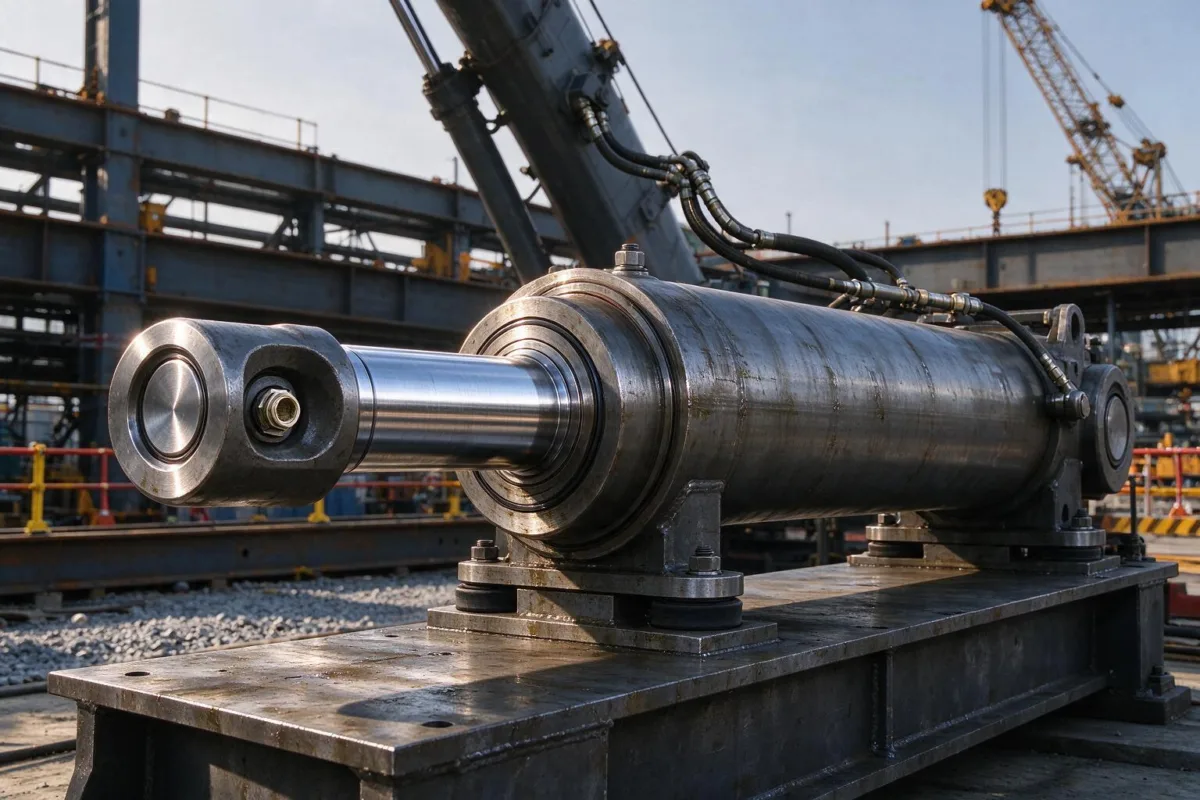
This 50 ton XCMG crane hydraulic cylinder buying guide starts with platform identification, because the 50 ton lifting class spans three XCMG platforms: the QY50 truck crane, the XCT50 truck crane, and the QUY50 crawler crane. Each platform uses a distinct hydraulic cylinder set, so parts sourcing must begin with correct model identification rather than tonnage alone. Truck cranes (QY50, XCT50) rely on boom lift, boom telescope, outrigger, and steering cylinders, while crawler cranes (QUY50) use a different arrangement: boom hoist, mast, and track tension cylinders. The functional split reflects the different chassis and boom designs, and the cylinder sets are not shared across platform types.
Cylinder Types and Function on 50 Ton Cranes
A 50 ton crane uses several distinct hydraulic cylinder groups, each with its own duty profile and failure pattern. Understanding these differences matters when specifying replacements for XCMG models such as the QY50 series truck cranes or the QUY50 crawler.
Boom Lift Cylinders
Most 50 ton truck cranes carry two boom lift cylinders that raise and lower the main boom. These units see high load duty and frequent cycling, so rod chrome quality, seal selection, and rod bearing wear are the main service concerns.
Boom Telescope Cylinders
Telescope cylinders sit inside the boom and use single or multi-stage designs. Sealed internal stages are common on 50 ton classes. External rod damage from contact or debris is a primary failure mode, and scoring on any stage can cause drift or loss of boom section control.
Outrigger Cylinders
Outriggers use vertical jack cylinders and horizontal extension cylinders. Pressure duty is lower than the boom circuits, but the rods and glands are exposed to ground contamination, so wiper seals and rod condition deserve inspection.
Steering Cylinders
Truck crane axles use double-rod or single-rod steering cylinders. Leakage affects steering precision and can render the machine non-compliant for road travel.
Crawler Boom Hoist, Mast, and Track Tension Cylinders
On QUY50-class crawlers, boom hoist and mast cylinders operate at high force and low speed. Track tension cylinders are smaller but critical to undercarriage life.
| Cylinder group | Typical quantity | Duty profile |
|---|---|---|
| Boom lift | Two | High load, frequent cycling |
| Boom telescope | One, multi-stage | Internal sealing, rod damage risk |
| Outrigger | Four sets | Lower pressure, contamination exposure |
| Steering | One or two | Precision, road legality |
| Boom hoist/mast (crawler) | Per design | High force, low speed |
Identifying the Correct Cylinder for QY50, XCT50, and QUY50
The 50 ton XCMG crane family spans several model series, and hydraulic cylinders are not universally interchangeable across the QY50, XCT50, and QUY50 platforms. Identification begins with the crane’s serial number, which is used with the XCMG parts catalog to confirm the cylinder part number. Part numbers vary by production batch and market region, so a number from one machine may not supersede correctly on another. The serial number narrows the catalog lookup to the correct build configuration.
Physical verification follows. Measure and record bore diameter, rod diameter, stroke, closed length, pin hole diameter, and mounting center distance. These dimensions should be compared against the replacement unit before installation, not after delivery. A mismatch in any one dimension can prevent mounting or alter force output.
Port details require equal attention. Check port thread type and position, whether SAE, BSPP, or metric. Port orientation affects hose routing and must match the original cylinder to avoid hose strain or interference.
The cylinder head and gland design, whether threaded, bolted, or welded, determines serviceability. Confirm the replacement uses the same sealing arrangement as the original. Aftermarket cylinders may use different seal kits, so request the seal specification and confirm kit availability before purchase.
| Check | Record |
|---|---|
| Bore and rod diameter | Measured values |
| Stroke and closed length | Measured values |
| Pin hole and mounting center distance | Measured values |
| Port thread type and position | SAE, BSPP, or metric |
| Gland design | Threaded, bolted, or welded |
Distinguishing Genuine, OEM-Supplier, and Aftermarket Cylinders
Hydraulic cylinders for 50 ton XCMG cranes (typically QY50 series and related models) reach the market through three distinct supply paths, and each carries different documentation and traceability.
Genuine XCMG cylinders carry factory part numbers, casting marks on the barrel and end caps, and traceable serial numbers. Packaging labels and accompanying documentation should match the part number on the cylinder itself. Buyers should verify that the serial number can be checked against XCMG’s records before accepting delivery.
OEM-supplier cylinders are produced by XCMG’s tier-one suppliers and may carry supplier marks instead of XCMG branding. These can be functionally equivalent to genuine units when bore, stroke, rod diameter, mounting dimensions, and pressure ratings match the original specification. The supplier name and part number should be cross-referenced against the crane’s parts catalog.
Aftermarket cylinders vary widely in material grade, chrome plating thickness, and seal quality. Request material certificates for the barrel and rod, plus dimensional inspection reports covering bore, rod diameter, stroke, and mounting centers.
Cylinders with no traceable part number, or with part numbers that do not match the crane’s catalog, are difficult to service and may not fit. These should be treated as unsuitable for a 50 ton QY50 application unless independently verified.
Chrome rod hardness and plating thickness are key durability indicators. Typical requirements call for chrome plating in the 20–40 micron range with rod surface hardness in the 50–60 HRC range after induction hardening, though the exact specification should follow XCMG’s data for the specific model. Specify minimum requirements in the purchase order and request test data with each shipment.
Inspection Criteria for Replacement Cylinders
Replacement hydraulic cylinders for 50 ton XCMG cranes, including the QY50 and QY50K series, should be inspected against defined criteria before installation. The checks below cover visual condition, dimensional accuracy, pressure integrity, seal specification, and documentation.
Visual Inspection
The chrome-plated rod surface should be examined for pitting, scoring, flaking, or polishing that exposes the base metal. Localized chrome damage will accelerate seal wear and should be grounds for rejection. The barrel should be checked for dents, ovality at the weld joints, and weld quality at the end caps and ports. Paint coverage should be uniform, with no exposed primer or bare steel on machined faces.
Dimensional Verification
Bore diameter, rod diameter, stroke length, and mounting dimensions (pin diameters, clevis width, and center-to-center pin distance) should be verified against the crane’s specification. Tolerance stack-up across the rod end, pin bore, and frame bracket directly affects pin fit and cylinder alignment; a cylinder that meets nominal dimensions individually can still bind if cumulative tolerances are not controlled.
Pressure Testing
A hold-pressure test report should be requested, performed at rated pressure, typically 1.5 times working pressure, with no external leakage at the seals, ports, or weld seams. The report should state test pressure, duration, and result.
Seal Quality
Seal brand or material specification should be confirmed, for example polyurethane for rod wipers, PTFE for wear rings, and NBR or FKM for static seals. The stated temperature range must match the crane’s operating environment.
Documentation
Request material certificates for the barrel and rod, a chrome plating thickness report (typically 20–40 µm), and an assembly test record traceable to the cylinder serial number.
| Check | Acceptance Criterion |
|---|---|
| Rod surface | No pitting, scoring, or chrome flaking |
| Bore and rod diameter | Within drawing tolerance |
| Hold-pressure test | 1.5× working pressure, no leakage |
| Seal material | Specification and temperature range confirmed |
| Documentation | Material, chrome, and test records provided |
Common Failure Modes and Selection Considerations
Rod seal leakage caused by contamination is the most frequent failure mode on 50 ton XCMG crane hydraulic cylinders. Dust, grit, and metal particles drawn past the wiper score the rod and damage the primary seal lip, allowing fluid to bypass. When specifying replacements for models such as the QY50K or QY50KA, buyers should confirm the wiper seal type and rod protection match the job site environment. Chrome-plated rods with a robust polyurethane wiper suit general construction, while sites with heavy airborne abrasive require additional rod boots or bellows.
Barrel scoring from side loading indicates misalignment between the cylinder and its mounting points. Before installing a new cylinder, inspect pin bushings, boom pivot wear, and frame straightness; a worn bushing will transfer bending loads into the barrel and repeat the failure. Telescope cylinder internal leakage causes boom drift under load. Multi-stage designs demand precise seal selection at each stage and clean, controlled assembly, since a single damaged stage seal will produce drift that is difficult to diagnose in the field.
Outrigger cylinder bent rods often result from operation on uneven ground, where a partially deployed jack takes the full reaction load. Rod material and diameter should be reviewed when specifying replacements, particularly for machines working on unprepared surfaces. Crawler crane track tension cylinders are exposed to continuous debris; sealed or shielded designs reduce failure frequency compared with open configurations.
| Failure Mode | Typical Cause | Selection Consideration |
|---|---|---|
| Rod seal leakage | Contamination ingress | Wiper seal type, rod protection |
| Barrel scoring | Side loading, misalignment | Bushing and pivot inspection |
| Boom drift | Internal leakage in telescope stages | Stage seal precision, clean assembly |
| Bent outrigger rod | Uneven ground loading | Rod material and diameter |
| Track tension cylinder damage | Debris exposure | Sealed or shielded design |
Sourcing Checklist and Supplier Evaluation
Hydraulic cylinder procurement for a 50 ton XCMG crane should be driven by part-level identification rather than model-level assumptions. A 50 ton rating spans multiple XCMG series (QY50, XCT50, and related variants), and cylinder specifications differ between them. The checklist below supports consistent supplier comparison.
Identification and Documentation
Confirm the supplier can quote against the crane’s serial number or the specific part number on the cylinder nameplate, not merely the model name. Serial-number-based identification reduces the risk of receiving a cylinder built to a different production batch or boom configuration.
Request a dimensional drawing for approval before production begins. Verify mounting dimensions (pin diameters, bracket centres, clevis orientation), port sizes and thread types, closed and open centre distances, and rod end configuration against the original. Approval should be documented in writing.
Testing and Warranty
Ask for test reports covering pressure hold, external and internal leakage, and stroke verification. Review these before shipment release, not after delivery. Confirm test pressure relative to the crane’s rated system pressure.
Clarify warranty terms in writing: duration, coverage for seal leakage under normal duty, and the position on rod chrome failure such as flaking or pitting. Seal leakage and chrome damage are the most common claim categories and are frequently excluded without explicit wording.
Logistics and Aftermarket Verification
Check lead time and packaging. Cylinders require rod protection (sleeve or crate) and secure mounting to prevent bending or port damage in transit. For aftermarket suppliers, request references from comparable 50 ton crane applications and confirm seal kit availability as a separate line item, since kit lead time often exceeds cylinder lead time.
Installation and Maintenance Notes
Correct installation and a defined maintenance routine directly affect the service life of the hydraulic cylinder on a 50 ton XCMG crane, whether the unit is a QY50K, QY50KA, or a comparable model in the QY series. The following points apply to replacement cylinders and to cylinders reinstalled after resealing.
Line Flushing and Cleanliness
Hydraulic lines should be flushed before the cylinder is connected. Debris left in hoses, tubes, and fittings after repair or replacement is a leading cause of early seal failure, and particles that reach the rod seal or piston seal can score the rod and damage the barrel bore. Flush to the circuit’s specified cleanliness level, then verify with a patch test or particle counter where the maintenance program requires it.
Fastener Torque and Port Connections
Mounting pins and port fittings must be torqued to the values in the crane’s service manual for the specific QY50 series model. Under-torqued pins allow relative movement that wears bores and bushings; over-torqued fittings can crack port bosses. New seals and washers should be used at every port connection, and fittings should be checked for leaks after the first pressure cycle.
Air Bleeding
Air must be bled from the cylinder after installation. Entrained air causes erratic operation, spongy response, and cavitation damage, and it can overheat and damage seals as it compresses. Bleed at the highest point in the circuit per the manual, then cycle the cylinder through its full stroke at low pressure before returning to normal operation.
Alignment
Cylinder and boom pivots must be aligned within the tolerances stated in the service literature. Misalignment accelerates rod seal wear and can bend the rod, particularly on the long-stroke boom cylinders used on 50 ton QY series cranes.
Inspection Interval
Inspect the rod surface, seals, and pin wear every 500 operating hours or per the crane’s maintenance schedule, whichever comes first. Record rod condition, leakage, and pin clearance at each interval to track wear trends.