
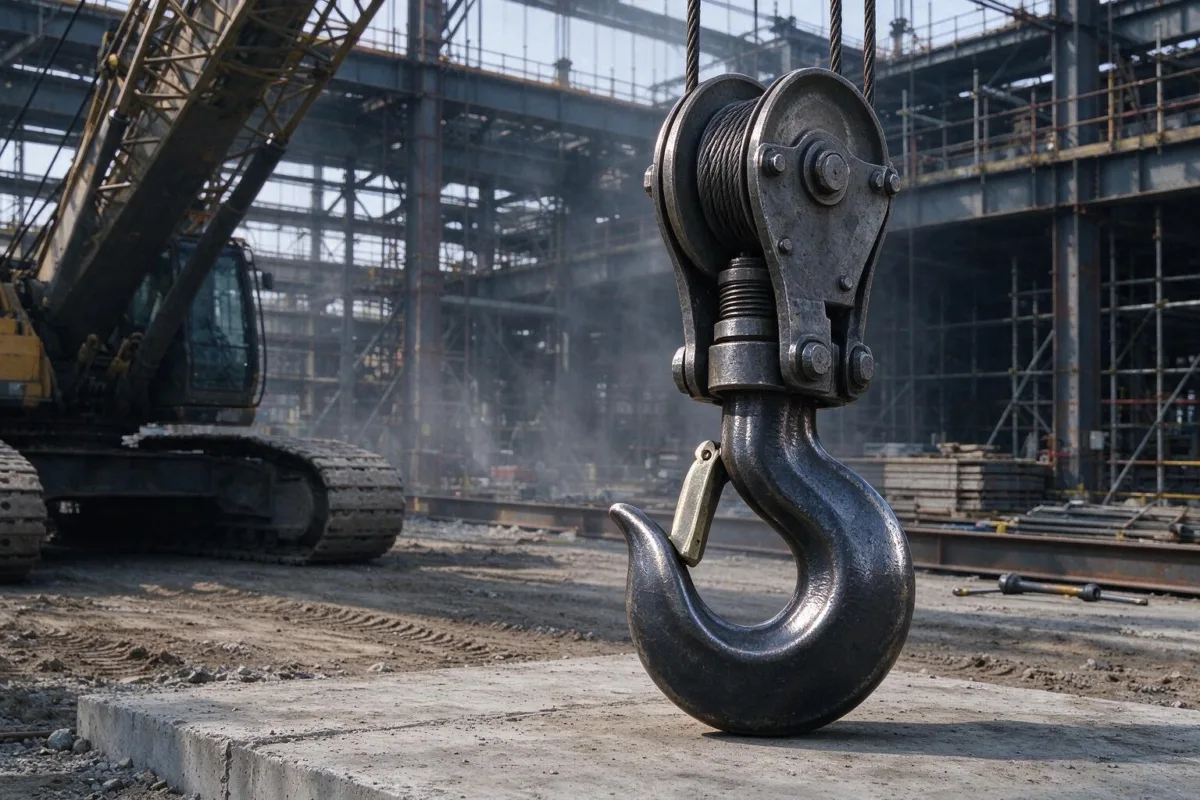
This XCMG crawler crane hook buying guide covers the hook assembly, the primary load-bearing interface between the crane’s hoist rope and the rigging. On XCMG crawler cranes, the assembly typically comprises the hook block, sheaves, shank, safety latch, and swivel bearing. Each component carries a defined role: the sheaves guide the hoist rope through the block, the shank transfers load from the hook to the block frame, the safety latch retains slings under slack conditions, and the swivel bearing allows the load to rotate without inducing torque in the rope.
Tonnage Ratings and Model Series Compatibility
Hook blocks for XCMG crawler cranes are commonly available in 25t, 50t, 75t, 100t, 150t, and 200t capacity classes, with larger blocks offered for heavy-lift configurations. Capacity class alone does not define a compatible hook; the sheave count, sheave diameter, and rope size must also match the crane’s reeving plan.
The QUY50 (50t class) typically uses a 50t hook block with a single or double sheave arrangement, depending on the part-line reeving selected for the lift. The QUY100 (100t class) generally pairs with a 100t block fitted with three or four sheaves. The XGC series follows similar tonnage logic: the XGC55 (55t) uses a 55t-class hook, the XGC130 (130t) uses a 130t-class hook, and the XGC260 (260t) uses a 260t-class hook block.
| Crane model | Capacity class | Typical hook block |
|---|---|---|
| QUY50 | 50t | 50t, single or double sheave |
| QUY100 | 100t | 100t, three or four sheaves |
| XGC55 | 55t | 55t class |
| XGC130 | 130t | 130t class |
| XGC260 | 260t | 260t class |
The hook’s rated capacity must always be verified against the crane’s load chart for the specific boom length, radius, and reeving. A hook rated above the crane’s maximum capacity for a given configuration does not increase lifting capacity; the load chart remains the governing limit.
When replacing a hook, match the original equipment manufacturer’s part number and specification. Cross-referencing by tonnage alone can lead to mismatched sheave diameters or rope sizes, which affects rope wear, reeving alignment, and safe operation.
Material and Manufacturing Specifications
XCMG crawler crane hook blocks are typically forged from alloy steel, with the hook shank and body heat-treated to develop strength and fatigue resistance. Common materials include 35CrMo or equivalent grades, selected for hardenability and toughness under cyclic loading. Heat treatment parameters affect the hook’s ability to resist deformation and cracking over service life, so verification of material grade and treatment records is a reasonable part of the purchasing process.
Each hook should carry a clear rating tag or stamp indicating capacity, proof load, and manufacturer. For XCMG original parts, the part number is usually stamped on the block or shank, which allows cross-checking against the crane’s parts manual. Buyers sourcing for specific models, such as the XGC series or QUY series, should confirm that the stamped capacity matches the crane’s rated load chart rather than relying on external labels alone.
Sheaves must be machined to match the wire rope diameter specified for the crane. A mismatch in sheave groove radius accelerates rope wear and can cause rope damage, particularly on multi-part reeving configurations. Groove profile and hardness should be checked against the rope specification before installation.
Safety latches are mandatory on lifting hooks. The latch should be spring-loaded and capable of withstanding the hook’s rated load without deformation. Surface finish and corrosion protection, whether paint or plating, are indicators of manufacturing quality. Poorly finished surfaces may indicate inadequate heat treatment or substandard base material.
| Inspection Item | Specification to Verify |
|---|---|
| Hook material | 35CrMo or equivalent alloy steel |
| Rating tag/stamp | Capacity, proof load, manufacturer, part number |
| Sheave groove | Matched to specified wire rope diameter |
| Safety latch | Spring-loaded, rated-load resistant |
| Surface finish | Consistent paint or plating, no defects |
Safety Standards and Certification
Hooks used in lifting applications should comply with recognized standards such as ISO 7597, ASME B30.10, or an equivalent regional standard. XCMG original hooks for crawler crane models, including the QUY series and the larger XGC series, typically carry certification to these standards or to Chinese national standards (GB). Buyers should confirm which standard applies to the specific hook and tonnage rating before purchase.
Proof load testing is a key requirement. A hook should be proof-loaded to at least twice its rated capacity without permanent deformation. The proof load certificate should state the test load, the rated capacity, and the result of post-test dimensional checks.
Certification documents should include material test reports, proof load certificates, and non-destructive testing (NDT) results for critical welds and forgings. For aftermarket hooks, verify that the supplier can provide traceability to the original manufacturer or a certified testing laboratory. Lack of documentation is a significant risk indicator, particularly for hooks intended for higher-capacity configurations such as the QUY150 or XGC15000 class machines.
Inspection intervals and retirement criteria should follow the crane manufacturer’s manual and local regulations. Common retirement criteria include:
| Criterion | Limit |
|---|---|
| Cracks | Any crack, including in the saddle or bowl |
| Throat opening | Exceeding the manufacturer’s limit |
| Wear | Beyond 10% of original dimension |
| Deformation | Any permanent bend or twist |
Hooks exceeding any of these limits should be removed from service.
Identifying Genuine XCMG Hook Components
Genuine XCMG hook blocks carry a part number that can be cross-referenced with the crane’s parts catalog. This number is typically stamped or cast into the block body or shank, and it should match the catalog entry for the specific crane model and tonnage rating, such as the 50-ton QY50 or 100-ton XCA100 series. A number that cannot be matched to the catalog warrants further scrutiny.
Packaging and documentation should include XCMG branding, the part number, and certification. Aftermarket parts may use similar packaging, so the part number must be verified against official XCMG documentation rather than relying on box appearance alone.
The hook’s forging marks and heat treatment codes should be examined closely. Genuine parts have consistent, legible markings; counterfeit parts often have poorly defined or missing marks. Verification points are summarized below.
| Check | Genuine Part | Counterfeit Indicator |
|---|---|---|
| Part number | Stamped or cast, matches catalog | Missing, illegible, or unmatched |
| Documentation | XCMG branding and certification | Generic or absent paperwork |
| Forging marks | Consistent and legible | Poorly defined or absent |
| Weight and dimensions | Match original specification | Lower weight, thinner sections |
Weight and dimensions should be compared to the original specification. Counterfeit blocks may use lower-grade steel or thinner sections, resulting in lower weight or different dimensions.
Purchase from authorized XCMG parts distributors or reputable aftermarket suppliers with traceable certification. Unbranded hooks with no documentation should be avoided regardless of price.
Inspection and Maintenance Checklist
Hook blocks on XCMG crawler cranes require systematic inspection to remain within safe working limits. The following checks apply across model series, from the 50-ton QUY50 through the 300-ton QUY300 and larger units.
Daily Visual Inspection
Inspect the hook daily for cracks, with particular attention to the saddle and throat areas where stress concentrates. For critical applications, supplement visual inspection with dye penetrant or magnetic particle testing to detect surface and near-surface discontinuities that are not visible to the eye.
Throat Opening Measurement
Measure the throat opening at each inspection interval and compare it against the original dimension recorded at commissioning. If the opening exceeds the original dimension by more than 10%, the hook should be retired from service regardless of other condition indicators.
Safety Latch
Check the safety latch for proper spring action and wear. Replace any latch that does not close fully under spring tension or that shows deformation, bending, or excessive clearance at the tip.
Sheave Inspection
Inspect sheaves for groove wear, cracks, and bearing condition. Worn grooves can damage wire rope and reduce lifting efficiency, while failing bearings introduce heat and misalignment. Compare groove profile against the rope diameter specified for the crane.
Swivel Bearing
Verify that the swivel bearing rotates freely without excessive play or roughness. Lubricate according to the maintenance schedule for the specific model series and load rating.
Documentation
Record inspection results and maintain a history for each hook block. This history supports retirement decisions and safety audits, and provides traceability when a block is transferred between crane units.
| Check | Interval | Retirement or Replacement Criteria |
|---|---|---|
| Cracks (saddle, throat) | Daily; NDT for critical lifts | Any crack |
| Throat opening | Per inspection cycle | Exceeds original by more than 10% |
| Safety latch | Daily | Does not close fully or is deformed |
| Sheaves and bearings | Per inspection cycle | Groove wear, cracks, bearing failure |
| Swivel bearing | Per lubrication schedule | Excessive play or seizure |
Procurement Considerations for Aftermarket Hooks
Aftermarket hooks can be a cost-effective alternative to OEM parts, but quality varies significantly across suppliers. Buyers should request material certificates, proof load test reports, and dimensional inspection reports for every hook under consideration. These documents confirm the base material grade, verify that the hook has been tested at the specified proof load, and allow comparison of critical dimensions against the original specification. Absence of any of these documents is a reason to disqualify a supplier.
Compatibility must be confirmed against the specific XCMG model series and tonnage. A hook rated for a QUY100 may not fit an XGC130 without adapter plates or a different reeving configuration. Mounting interfaces, pin diameters, and throat openings differ between model families, so the supplier should be asked to confirm fitment in writing against the crane’s serial number or model code.
The supplier’s quality management system should also be evaluated. ISO 9001 certification and a documented testing regime are minimum indicators of a reliable supplier. Buyers may request the scope of certification and the frequency of proof load testing.
Lead time and availability affect downtime directly. Critical spares should be stocked on site or sourced from suppliers holding local inventory.
For high-utilization cranes, hooks with enhanced fatigue resistance or higher safety factors may be justified, provided they meet the crane’s load chart requirements.
Summary of Key Selection Criteria
Selecting a hook for an XCMG crawler crane requires verification against the specific lifting configuration rather than the crane’s nominal tonnage alone. The hook capacity must be matched to the load chart for the intended boom length, radius, and reeving arrangement, since the permissible load at a given radius is frequently lower than the crane’s headline rating. A hook rated above the charted capacity for the configuration provides no operational benefit and may introduce unnecessary weight to the load path.
Model series compatibility is a separate constraint. QUY and XGC series cranes use different hook mounting interfaces and reeving requirements, so a hook specified for one series is not interchangeable with the other without confirming the head assembly, sheave arrangement, and connection geometry. Tonnage alone does not establish fit.
Documentation should accompany every hook: the part number, material certificates, proof load test record, and non-destructive testing (NDT) reports. These documents allow the buyer to confirm the hook’s rated capacity and traceability.
| Check | What to Verify |
|---|---|
| Capacity | Matches load chart for boom length, radius, and reeving |
| Series fit | QUY or XGC mounting and reeving compatibility confirmed |
| Documentation | Part number, material certs, proof load test, NDT reports |
| Counterfeit indicators | Consistent markings, complete certification, dimensions within tolerance |
Counterfeit indicators include inconsistent or poorly applied markings, missing certification, and dimensional deviations from the specified part. A regular inspection and maintenance schedule, covering wear, deformation, and latch function, supports safe operation and extends hook service life.