
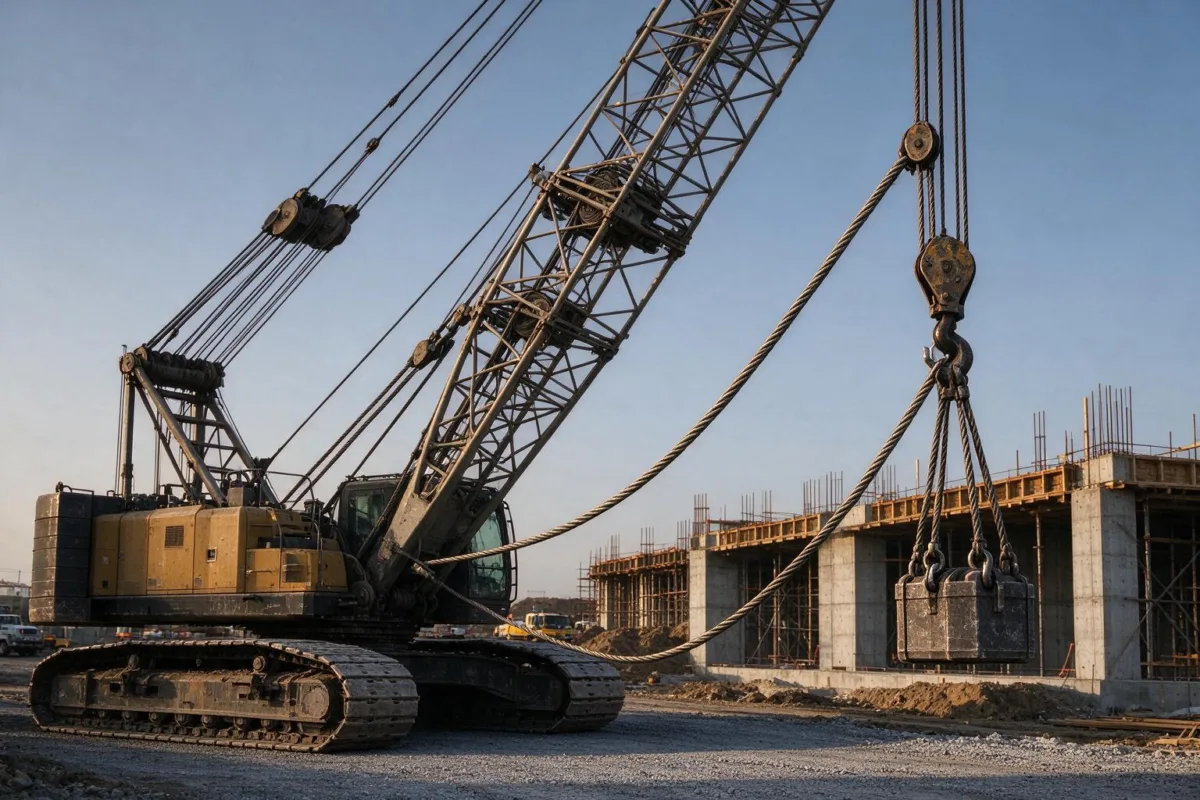
This XCMG crawler crane wire rope buying guide covers how the three principal model families differ in their wire rope requirements, based on boom length, line pull, and load chart characteristics. Because each family places distinct demands on rope selection, matching the correct construction and diameter to the crane model is essential for safe and efficient operation.
Wire Rope Construction and Core Types for Crawler Cranes
Crawler crane hoist ropes are specified by strand construction, core type, lay direction, and rope grade. Each parameter affects fatigue life, crush resistance, and minimum breaking force (MBF) within the limited drum and sheave envelope of the machine.
Strand Construction
6×19S (Seale) provides good abrasion resistance and is suited to smaller drums with fewer parts of line. 6×37S offers greater flexibility for larger drums and multi-part reeving. 6×K36WS (compacted) improves fatigue resistance and reduces diameter reduction under load, which helps maintain sheave groove fit over the service interval.
Core Type
Independent Wire Rope Core (IWRC) is standard for crawler crane hoist ropes. Compared with fiber core (FC), IWRC delivers higher crush resistance and higher MBF for the same nominal diameter.
Lay Direction
Right Regular Lay (RRL) is common for the main hoist. Left Regular Lay (LRL) may be specified for the auxiliary hoist to balance torque in multi-rope systems.
Application Notes
Compacted-strand ropes such as 6×K36WS+IWRC are increasingly used on XGC series machines to mitigate drum crushing and extend service life in high-utilization lifting. Rotation-resistant ropes (18×7+IWRC, 35×7+IWRC) suit single-line lifts where load rotation is critical, but they have lower abrasion resistance and require larger sheave diameters.
| Parameter | Typical specification |
|---|---|
| Strand | 6×19S, 6×37S, 6×K36WS |
| Core | IWRC (standard), FC |
| Lay | RRL (main), LRL (auxiliary) |
| Grade | 1960 MPa or higher |
Rope grade of 1960 MPa or higher is typical for crawler crane hoist ropes to achieve the required MBF within limited drum space. Final selection should always be verified against the crane manual and the specific load chart.
Key Specifications: Diameter, MBF, and Safety Factors
Nominal rope diameter must match the crane’s sheave and drum groove dimensions. Deviation can cause uneven spooling, rope damage, or reduced Minimum Breaking Force (MBF). Groove geometry is cut for a specific nominal diameter, so a mismatch affects contact pressure and wear distribution across the rope and sheave.
MBF must meet or exceed the crane manufacturer’s specified value. Hoist ropes are typically sized with a safety factor of 5:1, though this varies by application and regional standards. The rope’s actual MBF, not its nominal class rating, should be checked against the manual.
Representative configurations for XCMG crawler cranes include:
| Model | Application | Typical rope | MBF reference |
|---|---|---|---|
| QUY50 (50 t) | Main hoist | 20 mm, 6×19S+IWRC, 1960 MPa | approx. 250 kN |
| XGC150 (150 t) | Main hoist | 28 mm compacted, 6×K36WS+IWRC | above 500 kN |
| XGC150 (150 t) | Auxiliary hoist | 20 mm rotation-resistant | per manual |
These values are indicative only; the specific crane manual governs.
Diameter tolerance for new ropes should fall within +2% to +4% of nominal. Undersized ropes can slip in grooves, while oversized ropes may not seat properly. Length calculation must account for drum wraps, sheave reeving, and a dead-end allowance, typically 3–5 m, to avoid shortfalls during installation.
Application-Specific Selection: Main Hoist, Auxiliary Hoist, and Boom Hoist
Wire rope selection on XCMG crawler cranes depends on the duty of each hoist. The three hoist systems impose different load profiles, and a rope suited to one function is rarely optimal for another.
Main Hoist
The main hoist carries the highest number of load cycles and demands priority on fatigue resistance and abrasion resistance. Compacted 6×K36WS+IWRC and 6×37S+IWRC constructions are common choices for high-cycle lifting. Compacted strands increase fill factor and bearing surface against sheaves and drums, which extends service life where repeated bending occurs.
Auxiliary Hoist
The auxiliary hoist often requires a smaller diameter and greater flexibility. 6×19S+IWRC or 6×37S+IWRC may be used, and rotation-resistant options are specified for single-line work where load rotation must be controlled. On models such as the 50–100 t XGC series, auxiliary rope diameter should follow the drum and sheave groove dimensions in the crane manual.
Boom Hoist (Luffing)
The boom hoist must handle high tension and dynamic loads during boom raising and lowering. 6×37S+IWRC or 6×K36WS+IWRC with high minimum breaking force (MBF) is typical. Rotation-resistant ropes are generally not used here because their lower fatigue life does not suit the sustained tension and cycling of luffing duty.
Duty-Cycle and Corrosive Applications
For pick-and-carry or duty-cycle work, such as XGC series units on infrastructure projects, ropes with compacted strands and a high fatigue rating are preferable to withstand frequent cycling. In corrosive environments, including coastal sites and chemical plants, galvanized or stainless steel ropes may be specified, but sheave material compatibility should be verified to avoid galvanic corrosion.
Wire Rope Identification and Counterfeit Avoidance
Genuine XCMG wire ropes are typically supplied with a certificate of conformity that lists minimum breaking force (MBF), rope construction, and traceability information. Third-party ropes may lack this documentation, which complicates verification against the crane manual.
Rope tagging is a primary check. Original ropes often carry a metal tag or embedded marker showing the manufacturer logo, rope grade, and date of manufacture. Counterfeit ropes may have missing or inconsistent markings, and tags that do not match the certificate should be treated as a red flag.
Supplier authorization should be verified. Authorized distributors can provide XCMG parts numbers and batch traceability. Claims of direct-from-factory supply warrant scrutiny, particularly where no batch records are offered.
Surface inspection reveals further indicators. Counterfeit or low-quality ropes may show uneven lay, loose strands, or excessive lubricant. Genuine ropes have a uniform lay and consistent diameter across the length.
For critical lifts, request material test reports (MTRs). MTRs should confirm chemical composition and mechanical properties per the applicable standard, such as GB/T 8918 or ISO 2408.
| Check | Genuine Rope | Counterfeit Risk |
|---|---|---|
| Certificate of conformity | Supplied with MBF and traceability | Missing or incomplete |
| Tagging | Metal tag with logo, grade, date | Missing or inconsistent |
| Lay and diameter | Uniform | Uneven lay, loose strands |
| MTR | Available on request | Often unavailable |
MBF values significantly below specification indicate a non-conforming rope. Cross-check stated MBF against the crane manual for the relevant model series, such as the XGC or QUY range, and seek independent verification where doubt remains.
Installation and Maintenance Best Practices
Correct installation and a disciplined maintenance regime directly affect wire rope service life on XCMG crawler cranes, including the 50–150 t class (QUY50, QUY75, QUY100, QUY150) and larger lifting configurations.
Pre-installation inspection
Before fitting a new rope, inspect sheave grooves for wear in both depth and radius. Grooves worn beyond the manufacturer’s tolerance will not support the rope correctly and can damage a new rope rapidly. Check drum condition for grooving, corrosion, or rope-crossing damage, and confirm the drum diameter matches the rope specification.
Proper reeving
Follow the crane manual for the number of parts of line and the exact rope path. Incorrect reeving reduces rated capacity and can cause rope crossing, spooling faults, and accelerated wear on both rope and sheaves.
Initial tensioning
Apply the recommended pre-tension, typically 2–5% of minimum breaking force (MBF), to seat the rope in the grooves and prevent slack during the first lifts. Recheck tension after the initial working cycles.
Lubrication
Use the rope manufacturer-recommended lubricant and re-lubricate at regular intervals, particularly after exposure to water or chemicals. Adequate lubrication reduces internal friction and corrosion.
Inspection and retirement
Perform daily visual inspection for broken wires, corrosion, and diameter reduction. Conduct periodic detailed inspection per ISO 4309 or applicable local regulations. Replace the rope when broken wires exceed standard limits, diameter reduction exceeds 10%, or corrosion or mechanical damage is evident.
| Check | Action threshold |
|---|---|
| Broken wires | Exceed ISO 4309 limits for the rope construction |
| Diameter reduction | Greater than 10% of nominal |
| Corrosion or mechanical damage | Evident on inspection |
Supplier Evaluation and Procurement Checklist
Supplier qualification for XCMG crawler crane wire rope should be structured around specification conformance, documentation, and lifecycle cost rather than price alone.
Specification Conformance
Confirm the supplier can supply ropes built to XCMG model-specific requirements. For example, boom hoist and main hoist ropes on the 55–90 t class (XGC series) typically differ in diameter and construction from those on 150–400 t class units (QUY series), where larger diameters and higher minimum breaking force (MBF) ratings apply. Verify construction (e.g., 6×36WS-IWRC, 6×19S), nominal diameter, lay direction and type (regular or lang lay), and MBF against the crane’s parts manual or rope schedule.
Documentation Requirements
Request the following with each quotation or delivery:
- Certificate of origin
- Mill test reports showing measured breaking force and dimensional checks
- Traceability records linking finished rope to raw material batches (wire rod heats)
Technical Support
Assess whether the supplier can assist with rope selection, sheave and drum compatibility checks, and installation guidance, including pre-stretching and run-in procedures. Suppliers without application engineering support shift selection risk onto the buyer.
Lead Time and Stock
Check availability of common sizes such as 20 mm and 28 mm and quoted lead times for non-stock diameters. Downtime on a 100 t class crawler crane typically outweighs rope price differences by a wide margin.
Total Cost of Ownership
Compare expected service life, replacement frequency, and downtime cost alongside initial price. A lower-cost rope with shorter life can raise annual cost per operating hour.
Third-Party Verification
For critical lifts or high-cycle applications, consider independent inspection or destructive testing to verify MBF and construction before acceptance.
| Check | Evidence Required |
|---|---|
| Model-specific fit | Rope schedule match (construction, diameter, lay, MBF) |
| Documentation | Origin certificate, test reports, batch traceability |
| Technical support | Selection and installation guidance offered |
| Availability | Stock or lead time for 20 mm, 28 mm sizes |
| Cost of ownership | Life and downtime estimates vs. price |
| Verification | Third-party test report |