
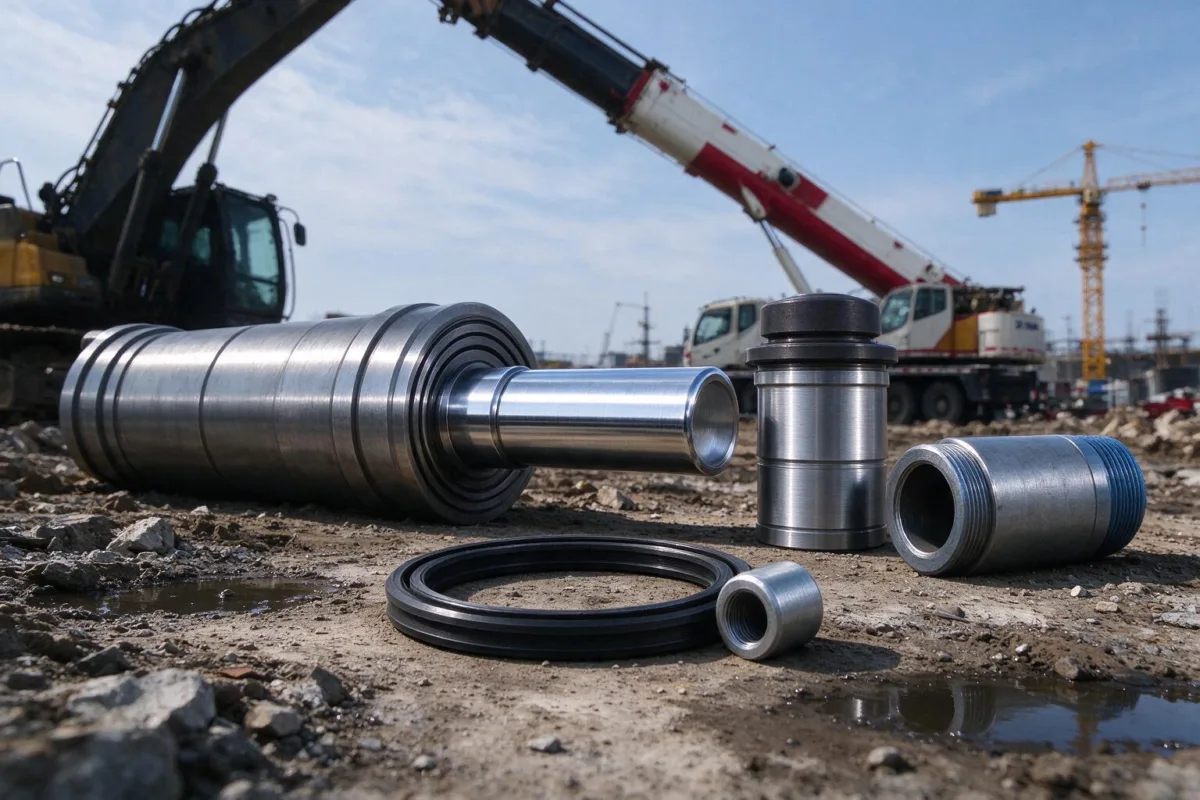
This XCMG QY25K hydraulic cylinder parts guide covers the 25-ton lifting-capacity model in the XCMG QY series of truck cranes. The QY range also includes the QY16K, QY35K and QY50K variants, which span lifting capacities from 16 to 50 tons. All are carrier-mounted telescopic-boom cranes, and the QY25K is commonly specified for general construction, plant erection and utility work.
Hydraulic Cylinder Functions on the QY25K
The QY25K (25-tonne class, K-series) uses hydraulic cylinders across both the carrier and the superstructure. Each group performs a distinct function and carries its own bore, stroke, and mounting geometry.
Boom telescope cylinder
The telescope cylinder extends and retracts the telescopic boom sections. It is the most load-sensitive cylinder on the superstructure, because boom length and load radius change together during operation. Seal wear or rod damage here shows up quickly as drift or slow section movement.
Boom lift (luffing) cylinder
The boom lift cylinder raises and lowers the boom. On the QY25K it is typically a large-bore, high-pressure cylinder with a rod-end trunnion or pin mounting. It carries the full boom and load moment, so bore size, rod diameter, and mounting pin condition are critical to safe operation.
Outrigger cylinders
Outrigger circuits combine vertical jack cylinders and horizontal extension cylinders. Together they level the crane and transfer load to the ground. Vertical jacks hold working load during lifting; horizontal cylinders position the beams. Both are exposed to contamination and mechanical damage at ground level.
Carrier cylinders
On the truck chassis, steering cylinders and, where fitted, suspension or cab-tilt cylinders handle road-mode functions. These operate at lower pressures than superstructure cylinders but see constant cycling and road debris.
Verification against the parts catalogue
Because each group has distinct bore, stroke, and mounting geometry, a part number alone should be verified against the machine’s parts catalogue and serial number range before ordering.
| Cylinder group | Primary function | Typical mounting |
|---|---|---|
| Boom telescope | Extend/retract boom sections | Internal, boom-mounted |
| Boom lift (luffing) | Raise/lower boom | Rod-end trunnion or pin |
| Outrigger vertical jack | Level crane, transfer load | Base-mounted, vertical |
| Outrigger horizontal | Extend/retract outrigger beams | Beam-mounted, horizontal |
| Carrier steering | Steer chassis | Chassis-mounted |
Identifying the Correct Cylinder and Part Number
Correct identification on the XCMG QY25K (25-tonne class) begins with the machine record. The serial number and build year should be logged before any cylinder is ordered, because XCMG part numbering can change across production batches of the same model. Two QY25K cranes of different years may carry functionally similar cylinders under different part numbers, and a number valid for one batch may not supersede cleanly to another.
The cylinder barrel itself is the primary source. Most units carry a stamped or cast identification on the barrel, typically a cylinder model code and a serial number. These markings should be recorded exactly, including any suffix characters, since suffixes often denote rod-end or porting variations.
Where markings are illegible or absent, dimensional measurement is required. The following should be taken and recorded:
| Measurement | Method |
|---|---|
| Bore diameter | Internal caliper or bore gauge at the barrel end |
| Rod diameter | Micrometer across the chrome rod |
| Stroke | Pin-centre to pin-centre at full extension minus closed length |
| Closed pin-centre length | Tape or rod between pin centres, fully retracted |
| Mounting type | Pin, trunnion, flange or clevis |
| Pin diameters | Caliper at both mounting points |
| Port thread sizes | Thread pitch gauge and caliper |
Mounting configuration must be confirmed, as pin-mounted, trunnion-mounted, flange-mounted and clevis cylinders are not interchangeable even where bore and stroke match.
Final verification should reference the QY25K parts catalogue drawing for the specific serial range. Aftermarket listings frequently consolidate several cylinder variants under a single number and should not be used as the sole identification source.
Key Specification Parameters to Match
Replacement hydraulic cylinders for the XCMG QY25K (25-tonne class) crane must be specified against the original cylinder data, not against nominal tonnage alone. The following parameters determine fit, function, and service life.
Bore, Rod Diameter, and Force Output
Bore diameter sets the effective piston area and therefore the force available at a given pressure. Rod diameter governs buckling resistance under compressive load. On boom lift, boom telescope, and outrigger cylinders, the rod acts as a strut, and reducing rod diameter lowers the critical buckling load disproportionately. Substituting a smaller rod diameter is not acceptable on boom lift cylinders, even where the retracted length and mounting eyes match.
Pressure Ratings
Rated working pressure and test pressure should meet or exceed the original cylinder rating for the QY25K hydraulic system. A cylinder rated below system pressure risks seal extrusion, tube yield, and rod seal failure. Confirm both the continuous working rating and the proof or test pressure stated by the supplier.
Stroke Length
Stroke must match the original within tolerance. Excess stroke can drive boom section stops or outrigger limit positions past their designed travel, causing mechanical damage or incorrect limit switch actuation. Undersized stroke limits function and may prevent full boom extension or outrigger deployment.
Seals and Oil Compatibility
Seal type and material should suit the hydraulic oil in use (mineral, biodegradable, or fire-resistant) and the ambient temperature range of the application. Standard nitrile seals are common; low-temperature or high-temperature service may require different compounds.
Ports and Routing
Port size, thread standard (BSPP, BSPT, SAE, or metric), and hose routing orientation should be confirmed before ordering. Minor differences can require adapter fittings or re-routing, adding leak points and installation time.
| Parameter | Match Requirement |
|---|---|
| Bore and rod diameter | Equal to original; no rod downsizing on boom lift |
| Working and test pressure | Equal to or above QY25K system rating |
| Stroke | Within tolerance; no excess travel |
| Seal material | Compatible with oil type and temperature range |
| Port size, thread, orientation | Confirmed against original cylinder |
Seal Kits and Wear Parts
A hydraulic cylinder seal kit for the XCMG QY25K (25-tonne class, QY series) typically includes the rod seal, wiper, piston seal, wear rings, O-rings and backup rings. Some kits also supply a buffer seal or rod bearing strip where the cylinder design calls for them. The contents vary by cylinder position and rod diameter, so the parts list should be confirmed against the cylinder’s bill of materials before ordering.
Seal kits are cylinder-specific. A kit listed for the QY25K may cover only one cylinder group, such as the boom lift, telescope, outrigger or steering cylinders. The kit number should be matched to the cylinder code stamped on the barrel or shown in the machine’s parts catalog. Fitting a kit from a different cylinder group risks dimensional mismatch on the rod seal and wear ring widths.
Rod seals and wipers are the most frequently replaced items because they are exposed to dust and grit on construction sites. Contamination drawn past a worn wiper damages the rod seal lip and allows fluid to weep past the gland.
Piston seals and wear rings should be inspected whenever the cylinder is opened. Scoring or ovality on the bore accelerates seal failure, and worn wear rings allow piston-to-bore contact. Chrome rod condition should be checked at the same time. Pitting or deep scoring requires rod repair or replacement, since a new seal will not compensate for a damaged running surface.
Inspection Criteria Before Replacement
Accurate diagnosis before ordering parts prevents repeat failures on the XCMG QY25K (25-tonne class) boom lift and outrigger cylinders. The following checks should be completed with the cylinder removed or, where possible, in place.
Leakage Assessment
External leakage at the rod seal, gland threads or port threads points to seal degradation or a failed fitting. Fluid tracking along the barrel should be traced to its origin before parts are specified, since a leaking port fitting can mimic a rod seal failure. Internal leakage presents as drift under load, slow boom movement or elevated oil temperature. A load-hold test with the cylinder extended under rated load confirms bypass past the piston seal.
Rod and Barrel Condition
Rod runout and straightness should be measured with a dial indicator along the chrome surface. A bent rod on a boom lift cylinder is a structural issue and cannot be corrected by seal replacement alone. Barrel inspection should cover bore scoring, ovality and corrosion, particularly in the gland area where moisture collects. Any of these conditions is grounds for re-honing or replacement rather than resealing.
Mounting Hardware
Mounting pins, bushings and clevis eyes wear in service and should be assessed together with the cylinder. Worn bushings introduce side loading that destroys new seals shortly after installation.
| Check | Method | Action Threshold |
|---|---|---|
| External leakage | Visual, cleaned surfaces | Any active seepage |
| Internal bypass | Load-hold test | Drift under rated load |
| Rod runout | Dial indicator | Per service specification |
| Bore scoring | Visual, bore gauge | Scoring or ovality beyond limit |
| Bushing wear | Pin-to-bore clearance | Clearance beyond limit |
Sourcing Checks for Aftermarket and OEM-Equivalent Parts
Buyers sourcing hydraulic cylinders for the XCMG QY25K (25-ton class) should apply a consistent verification sequence before committing to an order.
Part identification
The supplier should be able to reference the XCMG cylinder code or the QY25K parts catalogue number, not only the crane model. Model-level identification alone is insufficient, since the QY25K uses multiple cylinder groups (boom, outrigger, steering) with distinct part numbers that vary by build configuration.
Material and dimensional data
Request material and dimensional data: barrel steel grade, chrome plating thickness on the rod, and seal brand or material specification. Suppliers who cannot provide these values in writing are difficult to assess against original specifications.
Build year and supersession
Ask whether the part is a direct replacement for the specific build year, or a superseding part that requires additional fittings. Superseding parts are common and acceptable, but the required adapters, hose ends, or mounting changes must be confirmed before shipment.
Pressure test documentation
Verify pressure test documentation. Cylinders on 25-ton class cranes such as the QY25K operate at high system pressure, and test records support quality assessment. Records should show test pressure, hold duration, and any leakage observations.
Commercial terms
Check warranty terms, return policy, and lead time, particularly for low-volume cylinder groups such as outrigger or steering cylinders. These items are often made to order, so lead time and return conditions warrant confirmation in writing.
| Check | Documentation requested |
|---|---|
| Part identity | XCMG cylinder code or QY25K catalogue number |
| Materials | Barrel steel grade, rod chrome thickness, seal specification |
| Fitment | Build year confirmation or supersession notice |
| Testing | Pressure test record with values |
| Commercial | Warranty, return policy, lead time |
Installation and Maintenance Notes
Correct installation and follow-up maintenance determine how long a replacement cylinder performs on a QY25K crane. The procedures below apply to the boom, outrigger, and steering circuits on the 25-tonne QY25K series, and should be read alongside the model-specific service documentation.
Pre-Installation Cleaning
Hydraulic lines and ports must be cleaned before a replacement cylinder is fitted. Caps and plugs should remain in place until the moment of connection, and open lines should be flushed or wiped to remove debris that could otherwise enter the system and damage seals, valves, or pump components.
Air Bleeding and Break-In
After installation, air must be bled from the cylinder. The rod should be cycled slowly through its full stroke several times at low pressure before the machine returns to working load. Trapped air causes erratic movement, cavitation, and seal damage if the cylinder is loaded immediately.
Fitting Torque
Gland and port fittings must be torqued to the values stated in the QY25K service documentation. Under-torqued glands can loosen under load; over-torqued fittings can distort threads or damage seals. A calibrated torque wrench should be used, and values recorded.
Filter Replacement After Failure
Hydraulic filters should be replaced after any cylinder failure. Seal fragments and metal particles can circulate through the system and contaminate valves and pumps. A filter change, together with a fluid inspection, limits secondary damage.
Maintenance Records
Cylinder serial numbers and installation dates should be recorded to build a maintenance history for each unit in a fleet. This record supports interval planning and helps identify repeat failures on a specific QY25K machine.
| Task | Timing | Reference |
|---|---|---|
| Clean lines and ports | Before fitting | Service manual |
| Bleed air and cycle slowly | After installation | Service manual |
| Torque gland and port fittings | During fitting | QY25K torque values |
| Replace hydraulic filters | After cylinder failure | Maintenance schedule |
| Record serial number and date | At installation | Fleet records |