
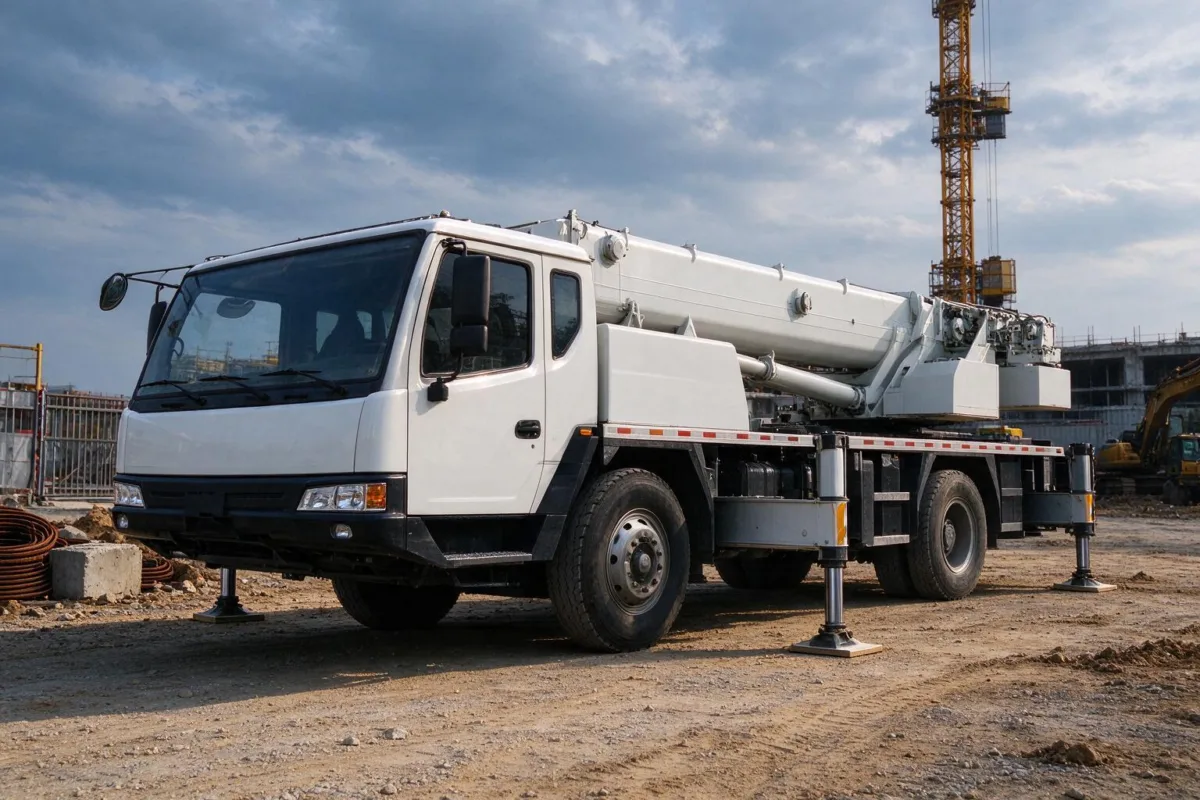
This guide addresses outrigger-related components for the XCMG QY25K, a 25-ton truck crane in the QY series, and explains how to evaluate an XCMG QY25K outrigger price against the actual configuration of the machine. Coverage includes the outrigger beam, jack cylinder, leg assembly, pivot pins, pads, and the hydraulic and structural hardware associated with these assemblies. The intent is to give maintenance planners, procurement staff, and fleet operators a working framework for evaluating outrigger pricing on this specific model rather than a generic figure that may not apply to their machine.
Outrigger Components on the QY25K
The XCMG QY25K (25-tonne class, K series) uses four hydraulically actuated outriggers arranged in an H-pattern, each combining a horizontal extension beam with a vertical jack. The outrigger cylinders are double-acting on most configurations, with pilot-operated check valves or lock valves holding load in the event of hose failure. Jack pads (floats) attach to the cylinder rod ends and bear on the ground; their size and articulation vary by production batch.
Typical replaceable items on this assembly include:
- Outrigger cylinder (barrel, rod, and seal kit)
- Jack pad or float, including the retaining pin and collar
- Horizontal extension beam
- Slider pads and wear strips on the beam and leg box
- Pins, bushings, and retaining hardware
- Lock valves and pilot check valves
Structural weldments such as the beam and leg box are generally replaced as complete assemblies rather than repaired in the field, since alignment and weld integrity affect stability calculations. Hydraulic and wear parts are sold individually and are the most common line items in parts pricing.
Control-side components sit outside the individual outrigger assemblies but affect the whole circuit. The outrigger selector valve, solenoid coils, and pressure relief settings determine how all four jacks behave, and these items are priced separately from the cylinders and beams. Buyers pricing a repair should distinguish between per-leg hardware and circuit-level controls, because the two categories follow different pricing and lead-time patterns.
| Component group | Typical supply form | Price driver |
|---|---|---|
| Cylinder, seals, lock valves | Individual part | Bore/rod size, seal type |
| Jack pad, pins, slider pads | Individual part | Material, batch variation |
| Beam, leg box | Assembly | Weldment size, freight |
| Selector valve, relief settings | Individual part | Circuit configuration |
What Determines XCMG QY25K Outrigger Price
Outrigger pricing for the XCMG QY25K (25-tonne class) varies widely because the term covers parts ranging from a few dollars to several thousand. The main cost drivers are set out below.
Component Category
A complete outrigger leg assembly, including the weldment, hydraulic cylinder, and jack pad, sits at the top of the price range. A single cylinder seal kit or a replacement jack pad is a minor line item by comparison. Buyers should confirm which level of assembly a quoted price refers to before comparing offers.
Genuine Versus Aftermarket
Genuine XCMG parts carry a premium tied to documented traceability and factory tolerances. OEM-equivalent aftermarket parts are generally cheaper but vary in documentation and batch consistency, so the price difference reflects risk as much as material.
Material and Machining
Forged pins, induction-hardened cylinder rods, and precision-bored barrels cost more than standard stock items. On a 25-tonne machine, rod hardness and bore tolerance directly affect seal life and leg stability under load.
Supply Route
Authorized dealers, independent importers, and used or salvage markets each produce a distinct price band. Salvage parts are cheapest but carry unknown service history.
Order Volume and Lead Time
Single-unit urgent orders attract expediting and small-lot surcharges. Scheduled batch orders placed against planned maintenance usually price lower.
Region and Freight
Outrigger weldments and cylinders are heavy and freight-sensitive. Landed cost therefore differs from ex-works price, particularly for cross-border shipments.
| Cost Driver | Effect on Price |
|---|---|
| Complete leg assembly vs. seal kit | Highest vs. lowest |
| Genuine vs. aftermarket | Premium vs. discounted |
| Forged/hardened vs. stock material | Higher vs. lower |
| Dealer vs. salvage route | Highest vs. lowest |
| Urgent single unit vs. batch | Surcharge vs. standard |
| Freight distance | Raises landed cost |
Typical Price Bands and How to Read Them
Outrigger pricing for the XCMG QY25K (25-tonne class) falls into three broad bands that reflect component complexity and sourcing route.
Lower band: wear items
Pins, bushings, and slider pads sit in the lowest band. These are high-turnover consumables with simple geometry, so unit prices are modest and largely driven by material grade, surface treatment, and order quantity. Buyers should confirm whether pricing is per piece or per set, since leg kits are often quoted as assemblies of several pins and bushings.
Mid band: hydraulic cylinders and lock valves
Outrigger hydraulic cylinders and lock valves form the mid band and are the most frequently quoted outrigger line item on the QY25K. Price variation here is substantial and depends on bore and stroke, rod chrome specification, seal kit inclusion, and whether the lock valve is supplied as a matched pair with the cylinder. Cylinder quotes should state whether seals, gland nuts, and test certificates are included.
Upper band: weldment assemblies
Complete outrigger leg or beam weldment assemblies sit in the highest band and are usually quoted on request, because dimensions, plate thickness, and mounting interfaces vary by build configuration and serial range.
Reading a quote correctly
Any quoted price should state whether it is ex-works, FOB, or delivered, and whether core exchange or old-unit return applies. Prices quoted without a part number and serial number reference should be treated as indicative only, as QY25K outrigger configurations changed across production runs.
Identifying the Correct Part for a QY25K
Outrigger components for the 25-tonne QY25K crane are not interchangeable across all production years without verification. Buyers should begin by confirming the machine’s model plate and serial number, since the QY25K was built in several revisions whose outrigger geometry differs. The serial number establishes the build period and narrows the applicable parts listing.
Where the original component is available, the XCMG part number stamped on the casting or cylinder body should be matched directly. This is the most reliable identifier. When the stamp is illegible or the part has been replaced previously, dimensional checks take precedence over the model name. The following measurements should be recorded:
| Check | Purpose |
|---|---|
| Cylinder bore | Confirms load capacity and seal kit compatibility |
| Stroke | Confirms extension range and mounting geometry |
| Rod diameter | Confirms buckling margin and gland fit |
| Mounting pin spacing | Confirms frame and leg interface alignment |
| Lock valve cracking pressure | Confirms safe load holding under rated pressure |
| Port orientation | Confirms hose routing and valve clearance |
The lock valve deserves particular attention. A valve with the wrong cracking pressure may fail to hold the leg under load or may release prematurely during retraction. Port orientation affects hose routing and can cause interference at full extension.
Before ordering, the installed component and its mounting interface should be photographed from multiple angles, including the pin bosses, hose connections, and any identification marks. These images allow the supplier to cross-check the candidate part against the actual installation and reduce the risk of a mismatch on delivery.
Genuine Versus Aftermarket Outrigger Parts
Genuine outrigger components for the XCMG QY25K (25-tonne class, QY series) are supplied through XCMG’s authorized channel with documented part numbers and traceability. Each leg cylinder, beam weldment, pin, and load-holding valve can be matched to a parts catalogue entry and, where applicable, a serial or batch record. This documentation supports warranty claims and provides a baseline for maintenance planning.
Aftermarket equivalents may meet dimensional requirements but can differ in material grade, heat treatment, and hydraulic tolerances. A beam weldment produced from a different steel grade, or a cylinder barrel with different honing and tolerance limits, may fit the mounting points while behaving differently under load. Heat treatment of pins and pivot bosses affects wear life and fatigue resistance, and these properties are not visible on a dimensional drawing.
For structural weldments and load-holding valves, deviation from specification affects stability margins and should be assessed carefully. The outrigger circuit holds the machine’s weight during lifting, so a valve with a different cracking pressure or internal leakage rate changes how the leg behaves under sustained load. Any substitution in these areas warrants an engineering review rather than a price comparison alone.
Buyers should ask suppliers for material certificates, pressure test records, and dimensional inspection data on cylinders and pins. A lower price on a load-bearing outrigger component should be weighed against the availability of this verification documentation. Where records cannot be produced, the cost difference reflects an unverified risk rather than a saving.
Procurement Checklist Before Ordering
Outrigger assemblies for the XCMG QY25K (25-tonne QY series) vary by production year and configuration, so a purchase order issued on description alone carries a real risk of receiving a non-fitting component. Buyers should complete the following checks before committing to an order.
Identification in writing. The buyer should obtain written confirmation of the machine model (QY25K, 25-tonne QY series), the machine serial number, and the original XCMG part number for each item on the order. Serial number breaks within the QY25K production run can change beam sections, jack cylinder mounts, and hydraulic fitting locations.
Dimensional documentation. For outrigger cylinders and structural parts such as beams, legs, and pads, a dimensional drawing or specification sheet should be requested. Key figures include closed and extended length, bore and rod diameter, pin diameters, mounting centre distances, and pad plate dimensions.
Commercial terms. Warranty duration and coverage, core return policy for remanufactured cylinders, and freight responsibility should be clarified in writing. The price basis must also be stated explicitly, as shown below.
| Price basis | What is included | Buyer responsibility |
|---|---|---|
| Ex-works | Goods at supplier premises | Freight, insurance, export clearance |
| FOB | Loaded on vessel at named port | Ocean freight, insurance, import clearance |
| Delivered | Transport to named destination | Import duties and taxes, unless stated |
Currency should be confirmed, along with the exchange-rate basis and validity period of the quotation.
Used and salvage parts. Inspection records, pressure-test results, and remaining service history should be requested for any used outrigger component.
Cross-reference capability. The supplier should demonstrate the ability to cross-reference XCMG part numbers against supersessions and revisions, rather than matching by description alone.
Application Context and Maintenance Notes
The XCMG QY25K is a general-purpose 25-ton truck crane within the QY series, commonly deployed in construction, utility, and plant maintenance work. Its outrigger system carries a significant share of the load path during lifting, so outrigger condition directly affects stability at the point of lift. Operators and maintenance planners should treat outrigger inspection as part of routine crane readiness checks rather than a reactive repair item.
Worn slider pads, bent outrigger beams, and leaking hydraulic cylinders should be addressed promptly. Pad wear allows play in the beam-to-housing interface, which can translate into settlement or deflection under load. Bent beams may indicate side-loading or impact damage and warrant alignment checks before further use. Cylinder leaks reduce holding force and can allow drift during operation, so seal condition should be verified whenever hydraulic performance is questioned.
Regular inspection of pins, slider pads, and hydraulic seals extends cylinder life and reduces replacement frequency. Pin bores should be checked for ovality, pads measured against wear limits, and seals inspected for weeping or hardening. Catching these items early limits secondary damage to rods and bores, which are typically the most costly outrigger components to replace.
Keeping a record of replaced outrigger part numbers simplifies future sourcing and price comparison. A simple log covering part number, position (front or rear, left or right), replacement date, and supplier allows buyers to compare quotes across vendors and identify which components recur most often. For a 25-ton QY series crane in mixed duty, this record also helps distinguish normal wear from a recurring fault pattern.
| Inspection Item | Check | Action if Out of Spec |
|---|---|---|
| Slider pads | Wear depth, play | Replace pads |
| Outrigger beams | Straightness, cracks | Realign or replace |
| Hydraulic cylinders | Leaks, drift | Reseal or replace |
| Pins and bores | Ovality, fit | Replace pins, ream bores |