
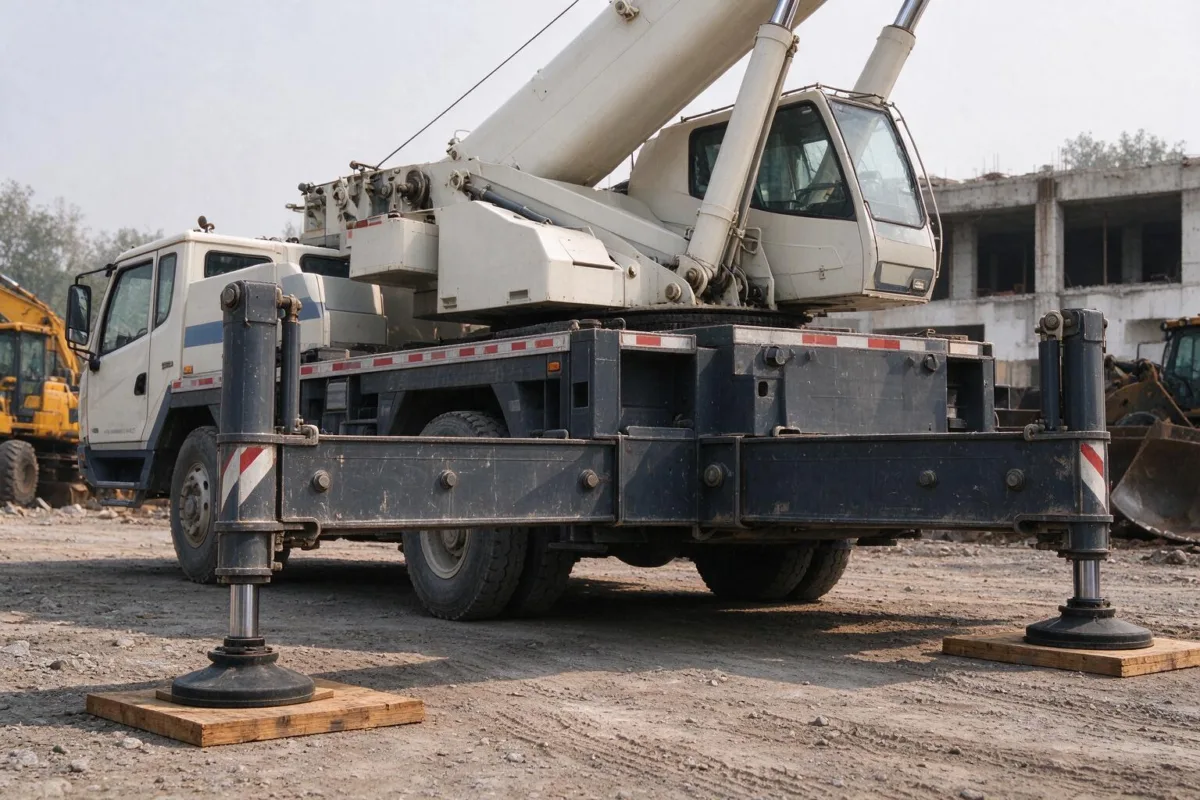
This XCMG QY25K outrigger parts guide covers the outrigger system of the 25-ton truck crane in the QY series, which stabilizes the chassis during lifting and transfers load to the ground, forming the interface between the crane and the supporting surface. The XCMG QY25K outrigger parts guide addresses components whose performance directly affects level tolerance, chassis attitude, and the load path into the ground during pick-and-carry and stationary lifting operations. Outrigger parts on the QY25K fall into four groups: structural (outrigger beams, jack legs, and pads or floats); hydraulic (extension and jack cylinders, control valves, and hoses); mechanical (pins, bushings, and beam locks); and electrical (position sensors, limit switches, and wiring). Because the outrigger set defines the crane’s rated capacity charts, parts must match the original configuration rather than a generic 25-ton specification.
Outrigger Configuration on the QY25K
The XCMG QY25K, a 25-tonne crane in the QY series, typically uses an H-style outrigger arrangement with four hydraulic jacks, one at each corner of the chassis. In this configuration the leg assemblies extend laterally from the chassis frame rather than sliding straight down, which widens the effective support base for lifting duties across the 25-tonne QY25K envelope.
Each leg assembly generally consists of four main elements: a horizontal extension beam that carries the jack outward from the chassis, a vertical jack cylinder that applies ground pressure, a foot pad that distributes load at the contact point, and lock or pin mechanisms that secure the beam in the deployed position. The pinning arrangement is a key inspection point, since worn or damaged locks affect the rigidity of the deployed leg.
Control is normally routed through a dedicated outrigger valve bank, which provides individual leg controls plus a leveling function so the operator can bring the chassis to level before lifting. Some QY25K configurations include load-holding valves on each jack cylinder to prevent drift under load. These valves are part of the hydraulic circuit and should be matched to the correct circuit when replacing cylinders or valve sections.
Because XCMG revised outrigger layouts across QY25K production batches, the specific configuration should be confirmed by serial number before ordering beams, cylinders, pads, or lock components. Parts that fit one batch may not fit another within the same 25-tonne QY25K model series.
Part Identification: Numbers, Castings, and Markings
Correct identification of XCMG QY25K outrigger components depends on reading the numbers and marks present on the part itself. XCMG part numbers follow a structured coding system in which each segment identifies a major assembly, a subassembly, and the individual component. The outrigger section prefix should be recorded together with the full number, because the same base number can appear in different assemblies across the QY25K crane series. Partial numbers taken from a parts list or an old invoice are a common source of mismatched orders.
Cast and forged parts, including outrigger jack housings, beam end fittings, and pivot brackets, often carry a manufacturer mark, casting code, or heat number on the surface. These marks help confirm the original supplier of the component and are useful when the XCMG number is illegible or has been superseded. Heat numbers can also link a part to a specific production batch.
Outrigger cylinder barrels and rods usually carry a serial or date code, typically stamped or laser-etched near the rod end or on the barrel shoulder. These codes are useful when matching seal kits and confirming rod dimensions, since cylinder revisions within the QY25K series can differ in seal profile and rod diameter.
Before removal, photograph the installed part in place, the machine nameplate, and any stamped numbers at close range. This record simplifies cross-checking with suppliers and reduces the risk of ordering a component that fits a different QY25K build configuration.
Specification Checks Before Purchase
Outrigger components for the QY25K (25-tonne class, K series) must be matched to the machine’s service data before ordering. Substitution with near-equivalent parts is a common source of reduced performance and accelerated wear.
Hydraulic Cylinders
Verify cylinder bore, rod diameter, and stroke against the QY25K service data. A near-match cylinder will alter jacking force and speed: a smaller bore reduces lifting capacity at a given pressure, while a different rod diameter changes retraction speed and buckling resistance. Confirm mounting dimensions, including pin centers and clevis width, against the original assembly.
Mechanical Parts
For pins, bushings, and linkage components, check pin diameters, bushing inner and outer dimensions, and retention methods. Circlips, retaining nuts, and welded collars are not interchangeable; a bushing pressed into a housing with a welded collar requires a different replacement procedure than one retained by a circlip groove.
Foot Pads
Confirm contact area, mounting pattern, and material grade. QY25K outrigger pads are commonly cast steel or fabricated steel with a bolted or pinned connection. Pad thickness and hole spacing affect load distribution and must match the leg interface.
Hoses and Fittings
Hydraulic hoses and fittings must match the working pressure rating and thread type of the circuit. Metric and BSP fittings are not interchangeable, and thread pitch differences are not always visible on inspection.
Surface Treatment
Confirm surface treatment, such as painting or plating, matches the chassis finish where cosmetic consistency matters. Plated pins and painted brackets should follow the original specification to avoid galvanic or coating compatibility issues.
| Check | Verify Against |
|---|---|
| Cylinder bore, rod, stroke | QY25K service data |
| Pin and bushing dimensions | Original part dimensions |
| Pad contact area and pattern | Leg mounting interface |
| Hose pressure rating and thread | Circuit specification |
Distinguishing Genuine, OEM-Supplier, and Aftermarket Parts
Outrigger components for the QY25K (25-tonne class, QY series) fall into three broad supply categories, each with distinct traceability characteristics.
Genuine XCMG parts are distributed through the manufacturer’s authorized dealer network. They carry traceable part numbers and factory packaging, and the part number on the component or label should reconcile with the dealer invoice and the QY25K parts catalogue. This channel provides the clearest documentation trail for warranty and audit purposes.
OEM-supplier parts are produced by the same component manufacturers that supply XCMG, but are sold outside the dealer channel. Markings, casting numbers, and dimensions often match genuine items closely because the tooling and material specifications originate from the same source. Buyers should confirm that the supplier’s part reference maps to the correct QY25K outrigger assembly, since the same supplier may produce variants for other crane models.
Aftermarket parts vary widely in quality. Acceptable items reproduce original dimensions and material grades and can be verified against drawings or samples. Poor items substitute lower-grade steel, reduce section thickness, or omit load-holding features such as pilot-operated check valves in outrigger cylinders or mechanical locks in extendable beam sections.
Red flags include:
- Missing or altered part numbers
- Inconsistent or poorly formed casting marks
- Components noticeably lighter than the original
- Hydraulic cylinders supplied without test documentation
For structural and hydraulic outrigger parts on the QY25K, buyers should request material certificates (showing steel grade and heat number) and pressure test records for cylinders where available. These documents allow verification of material grade and proof-pressure testing independent of the seller’s claims.
Supplier Evaluation Criteria
Buyers sourcing outrigger components for the 25-tonne QY25K should begin by requesting the exact part number for each item, along with the applicable QY25K serial number range. XCMG has revised outrigger assemblies across production runs, and a part that fits one serial range may not fit another. The supplier should also state clearly whether the item is genuine, supplied by an OEM-tier supplier, or aftermarket, since this affects traceability and price benchmarking.
Dimensional drawings or measurement data should be requested for outrigger cylinders, pins, and support pads. Pin diameters, cylinder stroke, rod end thread, and pad mounting geometry should be compared against the removed part before ordering. For hydraulic cylinders, bore and rod diameters plus mounting centre distances are the critical figures.
Warranty terms, return policy, and lead time should be confirmed in writing. Outrigger cylinders are often made to order, and a long lead time can leave a 25-tonne QY25K series crane out of service. Suppliers that can also provide seal kits, hose assemblies, and outrigger lock valves reduce sourcing fragmentation and simplify matching of mating parts.
For export orders, verify documentation and packing standards for hydraulic components: port caps fitted, rod surfaces protected, and corrosion protection applied for sea freight. Incoterms and packing lists should be agreed before shipment.
| Check | What to request |
|---|---|
| Part identity | Exact part number, QY25K serial range, genuine/OEM-supplier/aftermarket status |
| Dimensions | Cylinder, pin, and pad drawings or measurement data |
| Commercial terms | Warranty, return policy, lead time |
| Range coverage | Seal kits, hose assemblies, valves |
| Logistics | Export documents, port caps, corrosion protection |
Installation and Fitment Verification
Before any XCMG QY25K outrigger component is installed, the removed part and the replacement should be compared side by side. Pin diameters, bore sizes, mounting hole spacing, and pad geometry must match the original within tolerance. On the QY25K series, outrigger beam pins and cylinder rod-end pins are matched to specific bore classes, and a pin that seats loosely or requires force beyond a light tap indicates a mismatch that should be resolved before assembly proceeds. Cylinder stroke should be checked against the removed unit, and pad mounting bolt patterns aligned to the beam flange.
After assembly, each outrigger is cycled through full extension and retraction without load. The technician watches for binding in the beam slides, uneven movement between legs, and hydraulic leaks at fittings and rod seals. Any hesitation or asymmetric travel points to air in the circuit, a restricted hose, or incorrect pin alignment.
Lock mechanisms are then verified to engage fully in the extended position, and the leveling function is checked on all four legs to confirm correct response and holding. The hydraulic circuit is pressure-tested at the specified setting, with fittings and cylinder seals inspected for seepage before the crane returns to lifting service.
Replaced part numbers, serial numbers where applicable, and installation dates are recorded in the crane maintenance log. This record supports future troubleshooting and parts ordering for the QY25K series.
Common Sourcing Pitfalls
Sourcing outrigger parts for the XCMG QY25K involves several recurring errors that lead to fitment problems, premature failures, and inspection complications.
Ordering by Tonnage Alone
A 25-ton lifting rating does not guarantee fitment to the QY25K outrigger geometry. Tonnage class indicates capacity, not mounting dimensions, pin diameters, beam cross-sections, or cylinder stroke. Parts should be ordered against the specific model and series designation, not the nominal capacity alone.
Assuming Cross-Compatibility Within the QY Series
Outrigger components are not universally interchangeable across QY series models. The QY25K5, for example, can differ from the QY25K in outrigger beam dimensions, jack cylinder specifications, and mounting interfaces. Verifying part numbers against the machine’s serial number range and parts catalog is necessary before ordering.
Neglecting Seal Kits and Wear Items
Replacing an outrigger cylinder without renewing seals, wiper rings, bushings, and wear pads typically produces repeat failures. Contaminants retained in worn seals damage new rod and bore surfaces, and reused wear items accelerate misalignment. Cylinder replacement should be planned as a kit-based repair.
Accepting Parts Without Documentation
Structural outrigger components supplied without material certificates, dimensional reports, or traceability documentation complicate periodic inspection and reduce resale value. Documentation should be requested at the quotation stage.
Overlooking Hose and Fitting Standards
Outrigger hydraulic hoses and fittings vary in thread type, seat angle, and pressure rating. Mismatched threads or under-rated assemblies can leak or fail under load. Specifications should be confirmed against the machine’s hydraulic schematic rather than matched visually.
| Pitfall | Consequence | Mitigation |
|---|---|---|
| Tonnage-only ordering | Fitment failure | Order by QY25K model and serial range |
| Cross-series assumptions | Dimensional mismatch | Verify against QY25K parts catalog |
| Skipped seal kits | Repeat cylinder failure | Replace seals and wear items with cylinder |
| Missing documentation | Inspection and resale issues | Request certificates with quotation |
| Unverified hose standards | Leaks, pressure failure | Confirm thread and rating to schematic |